
 Your Place in the UniverseJason ChinAn exploration of relative size and distance opens with four average eight year olds looking through a telescope and then comparing their height to that of an ostrich, which is twice as tall as the children but still not as tall as a giraffe, which is more than twice as tall as an ostrich or more than four times taller than the children if they were all standing on each other’s shoulders. Each succeeding page shows progressively taller and taller comparison —redwood trees, skyscrapers, mountains, and then into space, where the comparisons turn to distance. Outer space expands to the Milky Way, the Andromeda galaxy, galaxy clusters, and the universe. In addition to illustrating the concepts of relative size and distance, Chin also introduces elemental astronomy and physics, but all is on a level that is comprehensible to the average eight year old, who serves as the starting place and the anchor in this intriguing look at comparisons and fascinating exploration of the vastness of space. Chin’s realistic watercolor and gouache illustrations are at once whimsical and scientific.Science, Technology and the Natural WorldView book details
CCBC Choices 2021
The 2021 edition contains 241 selections published by the Cooperative Children's Book Center, University of Wisconsin-Madison. The source uses 15 audience or subject sections, including Science, Technology and the Natural World, Seasons and Celebrations, Historical People, Places, and Events, and Biography, Autobiography, and Memoir. It is one annual edition of CCBC Choices, the librarians' bibliography of recommended books.
CCBC Choices 2021See the original list
Selections241
Published byCooperative Children's Book Center, University of Wisconsin–Madison
Sections15 sections
Browse sections15 sections
Science, Technology and the Natural World
8 selections
Your Place in the UniverseJason ChinAn exploration of relative size and distance opens with four average eight year olds looking through a telescope and then comparing their height to that of an ostrich, which is twice as tall as the children but still not as tall as a giraffe, which is more than twice as tall as an ostrich or more than four times taller than the children if they were all standing on each other’s shoulders. Each succeeding page shows progressively taller and taller comparison —redwood trees, skyscrapers, mountains, and then into space, where the comparisons turn to distance. Outer space expands to the Milky Way, the Andromeda galaxy, galaxy clusters, and the universe. In addition to illustrating the concepts of relative size and distance, Chin also introduces elemental astronomy and physics, but all is on a level that is comprehensible to the average eight year old, who serves as the starting place and the anchor in this intriguing look at comparisons and fascinating exploration of the vastness of space. Chin’s realistic watercolor and gouache illustrations are at once whimsical and scientific.Science, Technology and the Natural WorldView book details NestingHenry Cole, illustrated by Henry ColeDetailed realistic illustrations follow a pair of robins as they build their nest, lay eggs, wait for them to hatch, care for their fledglings, and, finally, fly away again with a large group of robins. The text is minimal, and the pen-and-ink drawings use a variety of page designs and visual perspectives to tell this naturally dramatic story that avoids anthropomorphizing the birds. Vertical panels are effectively used to show the passage of time—the parents flying back and forth … and back and forth …. with food for the juveniles, for example—and small moments of conflict (such as, the parents fending off a hungry snake). The beauty of this book is in its understatement, in both the narrative and the uncluttered illustrations, drawn in black and white with occasional touches of robin’s egg blue to depict the eggs, the sky, and the stunning end pages.Science, Technology and the Natural WorldLexile Text Measure 241LATOS Book Level 2View book details
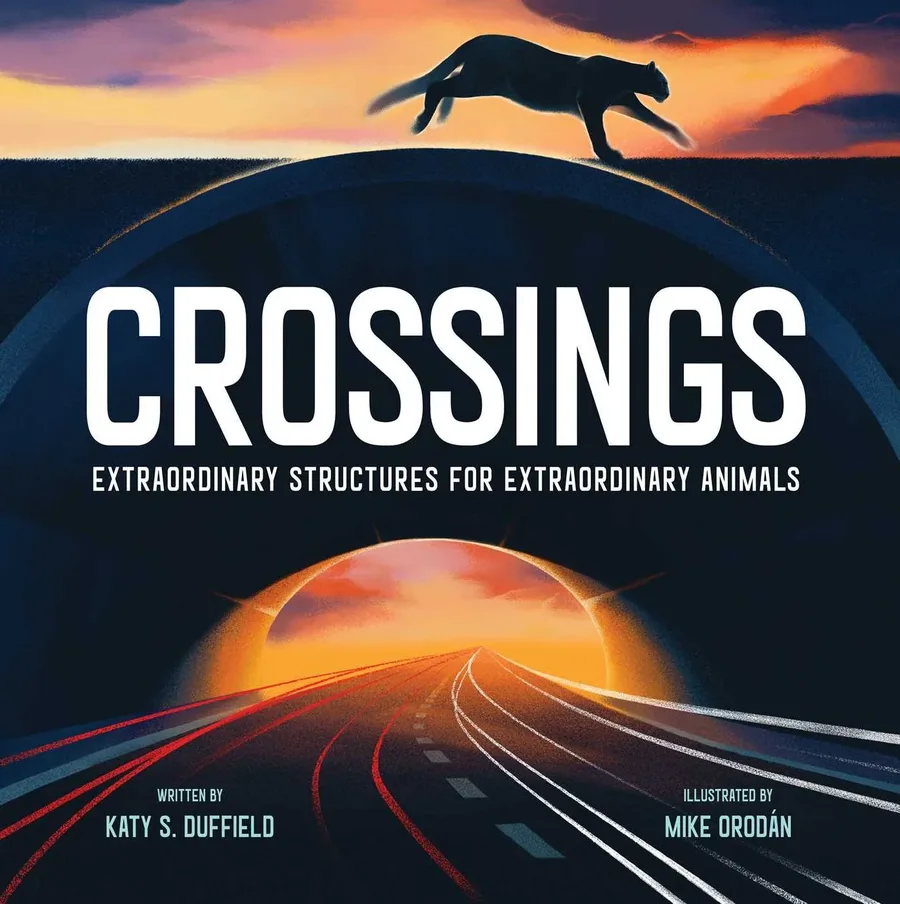 Crossings: Extraordinary Structures for Extraordinary AnimalsKaty S. DuffieldAn informational picture book describing successful efforts to provide accommodations for 12 different animal species to safely cross roads and highways and other threats presented by human construction also highlights four directional prepositions, “over, under, across, or through,” and features terrific action verbs as it describes how each animal travels its new path. “A mama elephant thunders UNDER a crowded Kenyan road … Titi monkeys tightrope ACROSS blue rope bridges that keep them safe above a Costa Rican road.” These single sentences in larger white font on each double page spread are accompanied by a brief but longer explanation of the accommodation in smaller type of a contrasting color to the dramatic full-page illustrations. The upbeat focus on these successful human efforts to protect wildlife from human-created dangers concludes with a double-page spread providing more information about each of the featured crossings.Science, Technology and the Natural WorldView book details
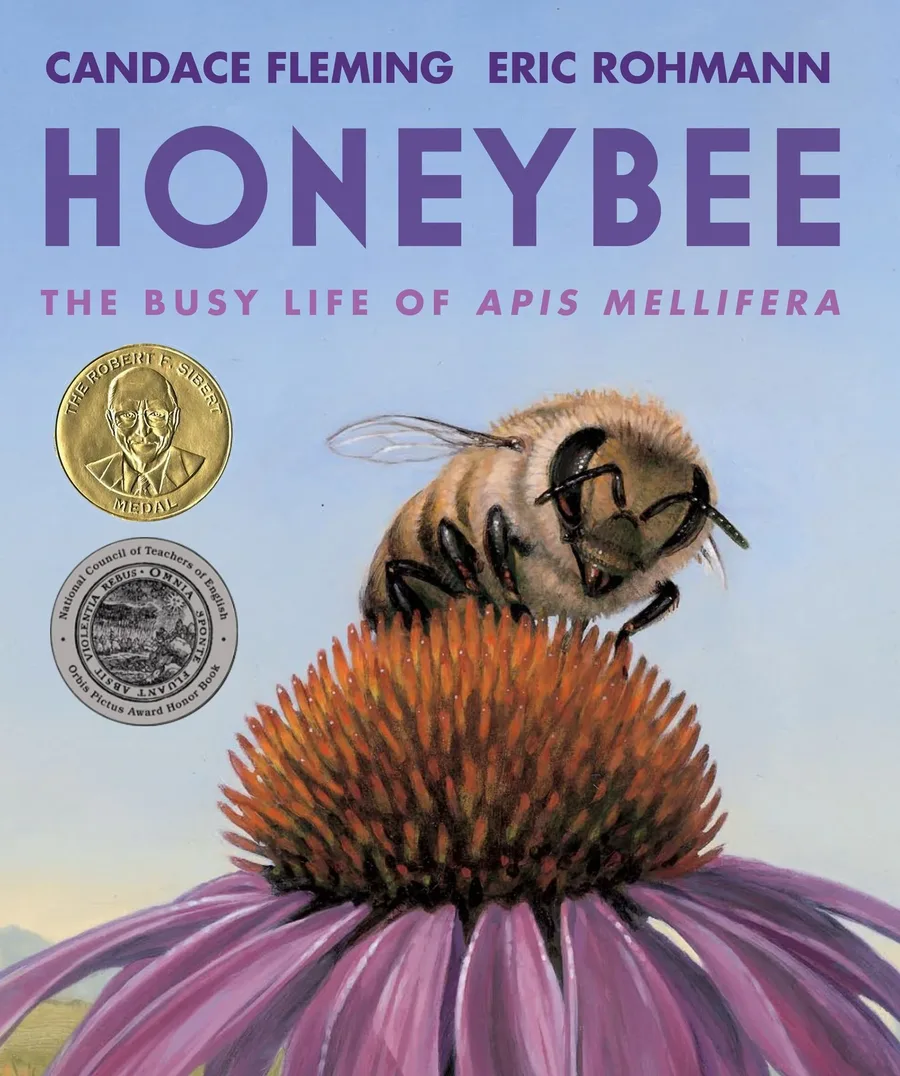 Honeybee: The Busy Life of Apis MelliferaCandace FlemingDrawing on the innate drama of the natural world, Fleming and Rohmann recreate the life cycle of a single honeybee from the moment she emerges from the egg to her death 35 days later. Before she even flies, there are so many specialized jobs within the hive—cleaning the nursery, nursing larvae, tending the queen, building the comb, handling the food, guarding the hive— before she finally flies off triumphantly on a double fold-out page that shows her over a field of flowers. Fleming perfectly paces the succession of in-hive jobs by concluding the description of each one with a child-friendly pattern: “It is time for her new job. Flying? [page turn] Not yet …” By the time she is ready to gather nectar, the honeybee has lived nearly three-quarters of her life. Rohmann’s larger-than-life watercolor illustrations give a great sense of bee’s perspective and of being right in the hive or atop a flower with them. The back matter includes a clear diagram of a bee, info on how to help honeybees, and more about different kinds of bees, their dances, and additional resources.Science, Technology and the Natural WorldView book details
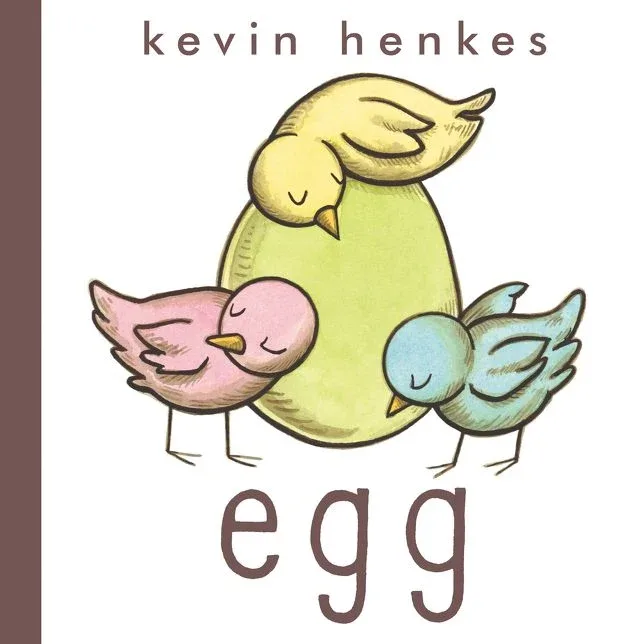 EggSteve Jenkins, Robin PageA simple concept is gracefully and artistically portrayed in a small, square-shaped book with heavy-stock pages. Facing pages show two different eggs, accompanied by a few words of rhyming text, e.g. “Blue egg. / New egg. / Dotted egg. / Spotted egg. / Rosy Egg. / Cozy egg.” The realistic illustrations show seven pairs of eggs, some in nests, some just the egg itself, and include one Cadbury egg (“Sweet egg.”), a literal, tongue-in-cheek Easter egg. The final page has a visual index of the 13 real eggs, identified by the species each one belongs to. The 14th egg, of course, belongs to whoever finds it first.Science, Technology and the Natural WorldLexile Text Measure AD1050LATOS Book Level 7.2View book details
 The Big One: The Cascadia Earthquakes and the Science of Saving LivesElizabeth RuschA fascinating look at the Cascadian Subduction Zone in the Pacific Northwest, where scientists predict a major earthquake will occur at some point in the next 100 years, starts with terrific, accessible explanations of plate tectonics and subduction earthquakes. Readers meet researchers looking for evidence of past subduction earthquakes and resulting tsunamis in the region, work that includes scientific research on land and in water, and studying the oral histories of Indigenous communities in the Pacific Northwest and recorded and oral histories in Japan. This account also introduces individuals devoted to mitigating the impact of a major earthquake in the future, from engineers determining how best to reinforce bridges and buildings, to individuals working on the ShakeAlert seismic monitor and notification system. The annual Disaster Relief Trial biking event in several northwest cities mimics post-quake devastation to practice how everyday citizens, including teens shown here, can play a role in emergency response. The sobering reality of a likely natural disaster is balanced here by human effort, ingenuity, and commitment to understanding the past and preparing for the future.Science, Technology and the Natural WorldView book details
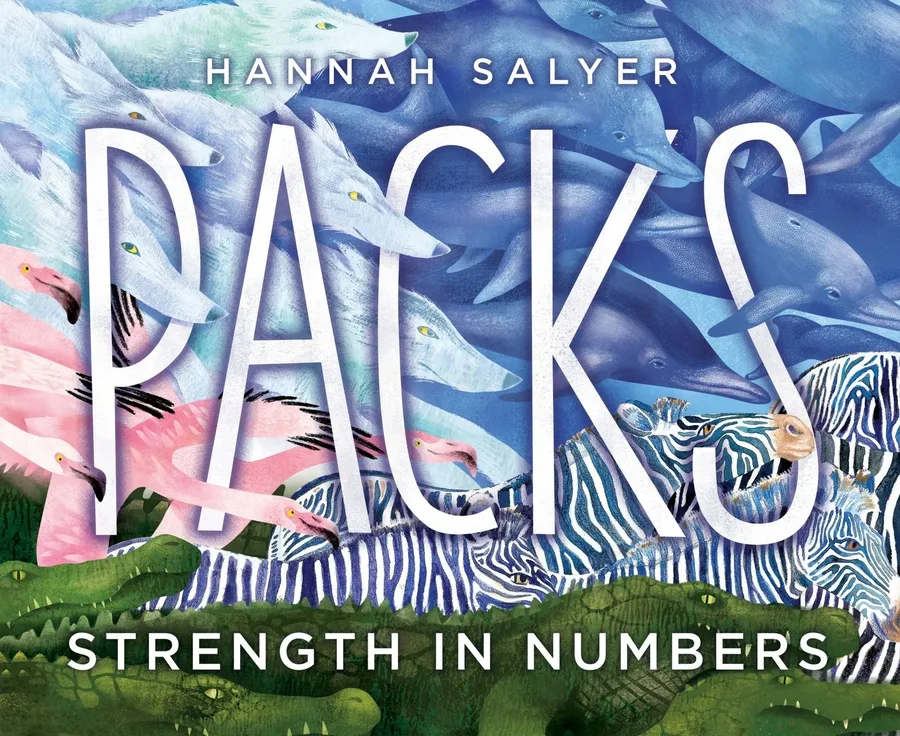 Packs: Strength in NumbersHannah Salyer“We flamingoes can be found in the thousands. We are known as a flamboyance. We do everything together: feed, flock, sleep, and grow. When it’s time to find our mates, we frolic in a fabulous fox trot. Together, we dance.” A terrific narrative perfect for reading aloud highlights both collective nouns and the power of togetherness in the animal world. Striking mixed-media illustrations showing animals that thrive in groups accompany the finely crafted patterned text in which “Together, we…” is repeated to underscore an aspect of collective behavior for the chosen creatures. From a cloud of bats to a mob of mongooses to an implausibility of wildebeests and more, there is much to delight in, while the idea of “together we are better” offered in the opening pages is repeated at volume’s end, this time showcasing human behavior on a page spread in which diverse individuals gather in small groups in a park. A brief note emphasizes the value of our collective togetherness on the earth and the importance of protecting all creatures.Science, Technology and the Natural WorldView book details
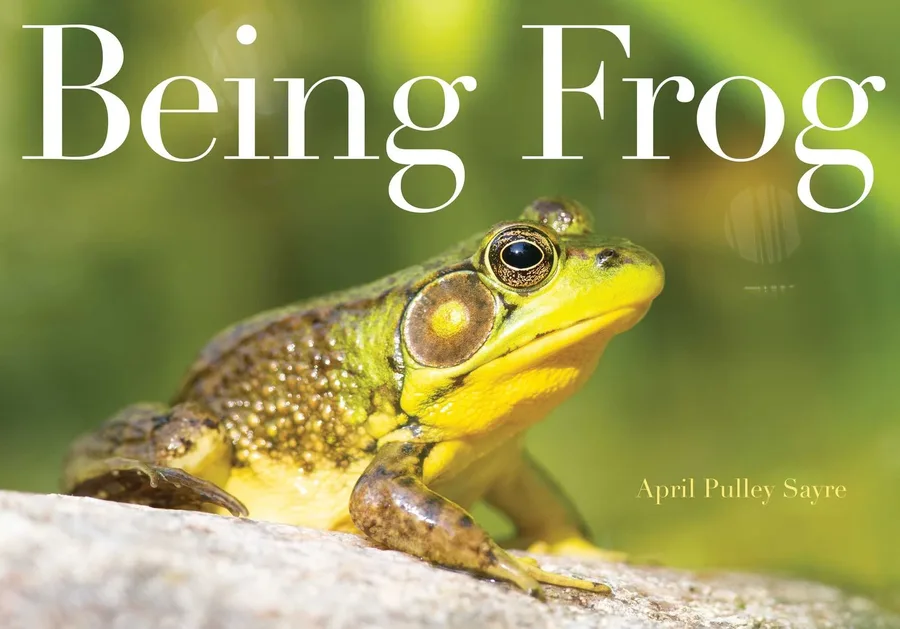 Being FrogApril Pulley SayreIn an unusual photo essay, Sayre has photographed one male green frog and written short rhyming sentences recounting her observations of him in his natural pond environment. The photographs are crisp and clear, the simple text engaging, making this a great early science book to share with a toddler, or to use in a preschool story hour. The author’s note about the difference between observing an individual frog (as she has done) and a scientific study of frogs is eye-opening, and may serve as a springboard for a first discussion with children about scientific methods.Science, Technology and the Natural WorldLexile Text Measure 290LATOS Book Level 2.2View book details
Seasons and Celebrations
7 selections
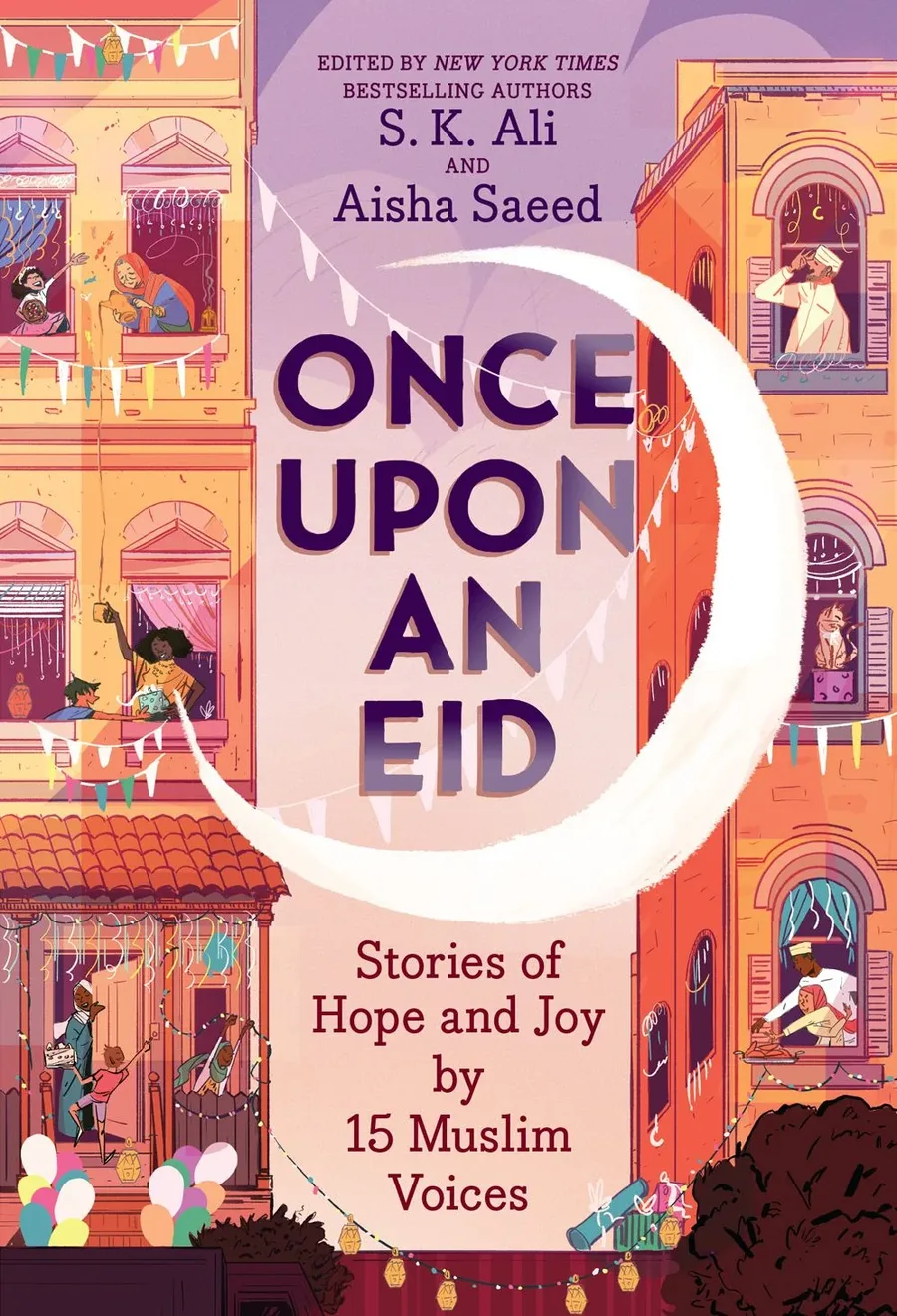 Once Upon an Eid: Stories of Hope and Joy by 15 Muslim VoicesS. K. Ali, Aisha SaeedThe children, young teens, and families at the center of each slice-of-life offering in this vibrant collection come from many backgrounds and live in many different places. Each of them feels distinct, yet familiar and recognizable as they navigate feelings common to many children and teens regardless of faith or circumstance—such as being the new kid at school; or longing for traditions not to change; or feeling like an outsider in one’s own extended, bicultural family. Yet their Muslim faith is an essential part of their identities, and there is power in the breadth of these accumulated stories, all of which are set during one of the two Eid observances: Eid-al-Fitr or Eid-al-Adha. Vivid depictions of food, family dynamics, and friendship are woven into these tales full of hope and generosity that feel genuine to each story. In their introduction, editors Aisha Saeed and S. K. Ali write that this collection offers the “cozy and familiar” for many Muslim readers, while also extending an invitation to non-Muslim readers to join in on the celebration of Eid. This open-hearted offering, comprised mostly of prose stories but also including comics and verse, succeeds beautifully on both counts.Seasons and CelebrationsView book details
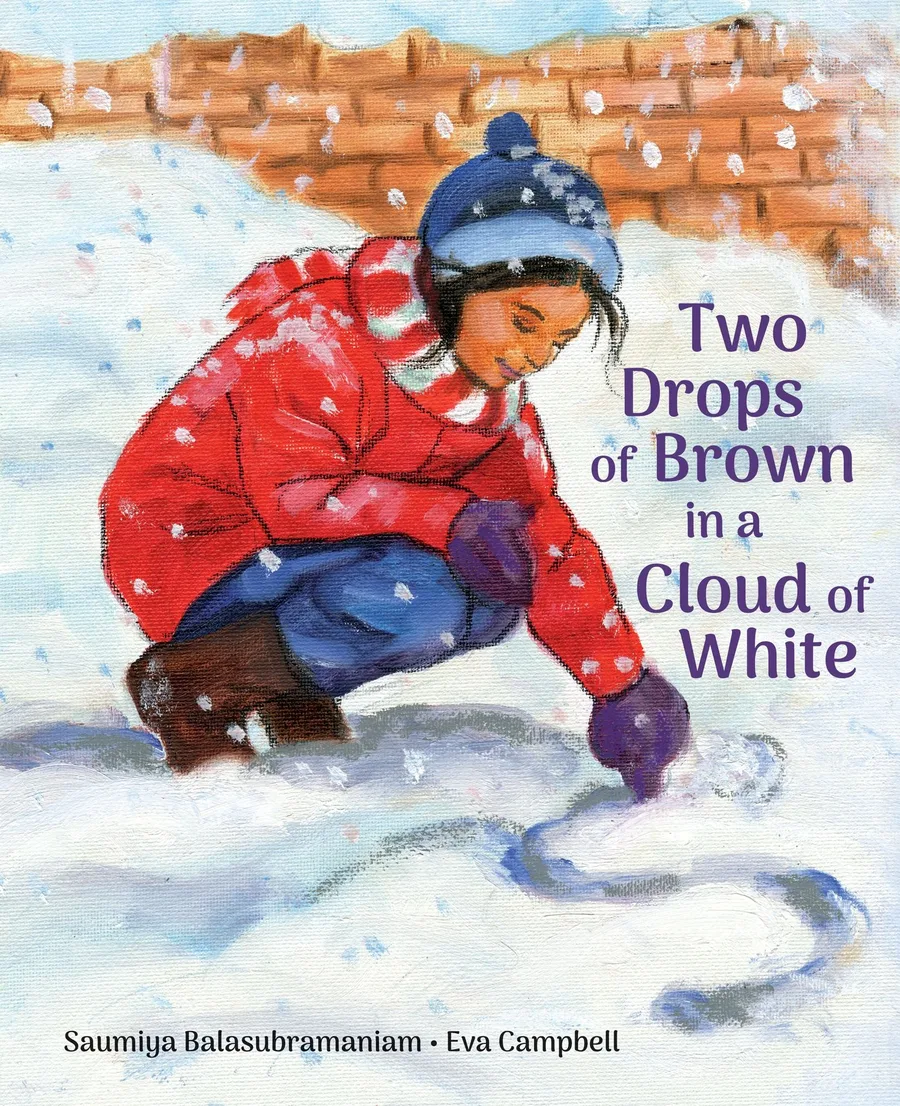 Two Drops of Brown in a Cloud of WhiteSaumiya Balasubramaniam, illustrated by Eva CampbellA young girl who loves snow and winter walks home from school with her immigrant mother, who misses the sun and warmth and colors of home. But for the girl, this winter-white landscape is home. To her mother, the dry brown leaves are like skeletons; to the girl, brown leaves make her think of maple syrup. There isn’t wrongness in their contrasting perspectives as this quiet, observant story progresses, just difference. Eventually, the girl’s buoyant spirit, vivid imagination, and delight in the moment proves infectious. “Ma hugs me tight. ‘When the sun comes out, everything will look so shiny and bright!’” This story featuring a South Asian mother and daughter affirms a sense of both longing and belonging across two generations of an immigrant family. Illustrations in oil and pastel on canvas showcase both the whites and grays of winter and bright punctuations of color and warmth.Seasons and CelebrationsView book details
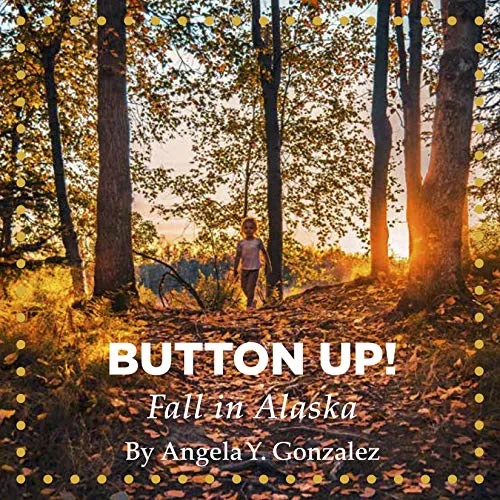 Button Up! Fall in AlaskaAngela Y GonzalezSnow, Carla. Bye-Bye Ice! Springtime in Alaska. Best Beginnings, 2020. 20 pages (978-0-9839719-4-8) Spiess, Joni. Mittens and Mukluks! Winter in Alaska. Best Beginnings, 2020. 20 pages (978-0-9839719-5-5) Toolie-Walker, Yaari. Let’s Play Out! Summer in Alaska. Best Beginnings, 2020. 20 pages (978-0-9839719-7-9) A quartet of inviting board books perfect for small hands celebrates the four seasons in Alaska and diverse, rural Alaskan Native families. “Where I live, we love to be outside,” begins Mittens and Mukluks!, the statement paired with a photograph of a small child holding a grown-up’s hand while pulling a bright red sled across a snowy gray-white landscape, the moon hanging above in the daytime sky. Brief statements about winter outdoor activities (ice fishing, a snowman under the northern lights) and indoor activities (a warm bath, cooking, a holiday table with traditional foods) are featured on the pages that follow, each paired with an engaging photograph. Spring (Bye-Bye Ice!), summer (Let's Play Out!), and fall (Button Up!) all get a similar treatment across the other three volumes in a series that deftly celebrates both universal and unique elements of rural Alaskan life for these children and families as it showcases things most children can relate to (exploring nature, engaging in favorite activities, spending time with loving adults) while also featuring food, activities and other elements that are culturally distinct, and incorporating occasional words in several Alaskan Indigenous languages, including Inupiaq and Yupik.Seasons and CelebrationsView book details
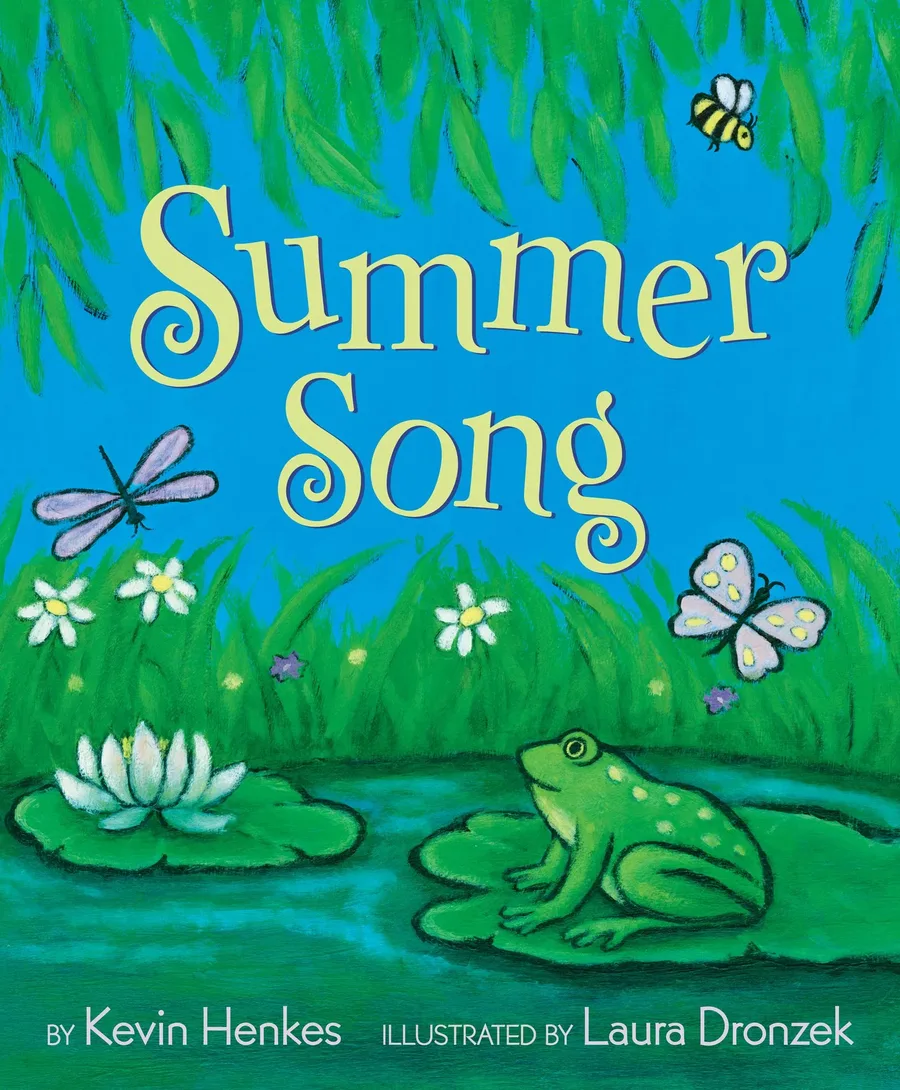 Summer SongKevin Henkes“… summer is green. Green on green on green. Summer is a green song.” It’s a song of leaves, trees, weeds, and grass that can “sound like music” if that grass is tall and the wind is blowing. Other summer things sound like music too: air conditioners and fans, sprinklers and lawn mowers, birds and rain and thunder and bugs. And other colors sing in summer—gray (fog), blue (water and sky). “But the green song is still there.” Eventually the days begin to shorten and the song begins to change, “turning / turning / turning … it’s turning into Fall.” There is such delight and appreciation in this accounting of the sights, sounds, and feel of the season—a sense of the expansiveness and bounty of the natural world, and days that feel wide open and endless. Four diverse children are shown in vibrant full-page and cozy spot illustrations that, along with the text, foreshadow fall’s arrival in the final pages. The transition feels bittersweet, as it often does in real life. Luckily, children and families can turn to the three previously published companion volumes from this author/illustrator duo offering equally observant, playful, appreciative, and surprising accounts of the other seasons.Seasons and CelebrationsView book details
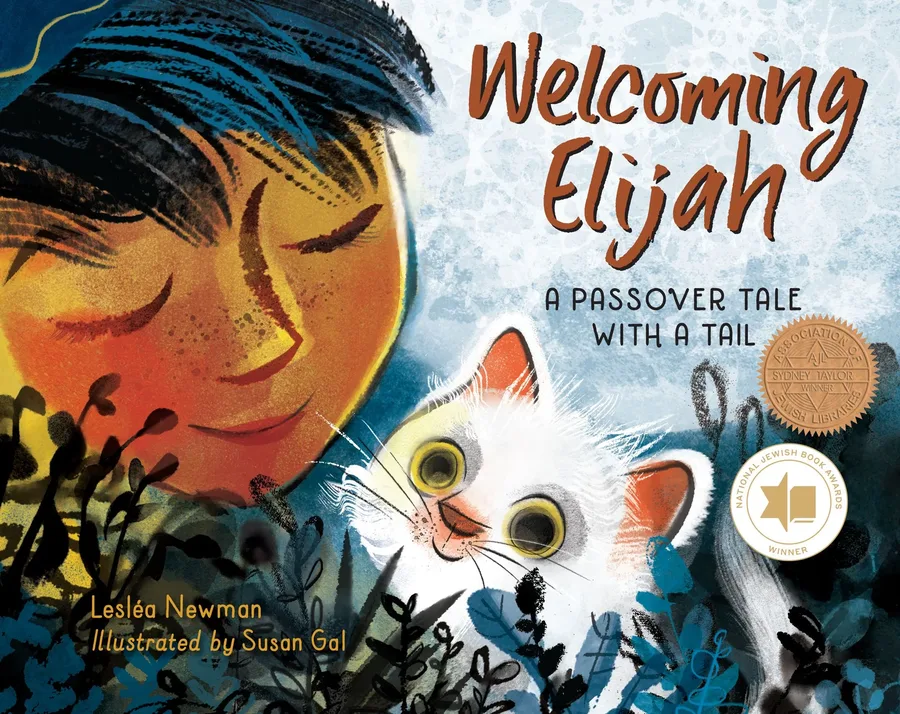 Welcoming Elijah: A Passover Tale with a TailLesléa Newman, illustrated by Susan GalA contemporary Passover Seder alternates between the perspective of a brown-skinned, kippah-wearing boy celebrating inside with a diverse group of friends and family, and a stray kitten outside his home. “Inside, the boy dipped parsley into salt water. Outside, the kitten chewed a wet blade of grass … Inside, the boy heard the tale of the Israelites leaving Egypt. Outside, the kitten heard leaves whispering in the trees.” In contrast to the cold, shadowy blue of the kitten’s quiet surroundings, the boy’s evening glows with warmth and companionship. He participates in traditional Seder rituals as the kitten passes a solitary evening; occasionally the narrative returns to a chorus of “Still the boy waited. Still the kitten waited.” When the boy finally opens the door for Elijah, the kitten is peering inside. “And that’s how Elijah found a home.” An author’s note provides more information about Passover and her memories of childhood Seders, including a boxed list of traditional rituals.Seasons and CelebrationsView book details
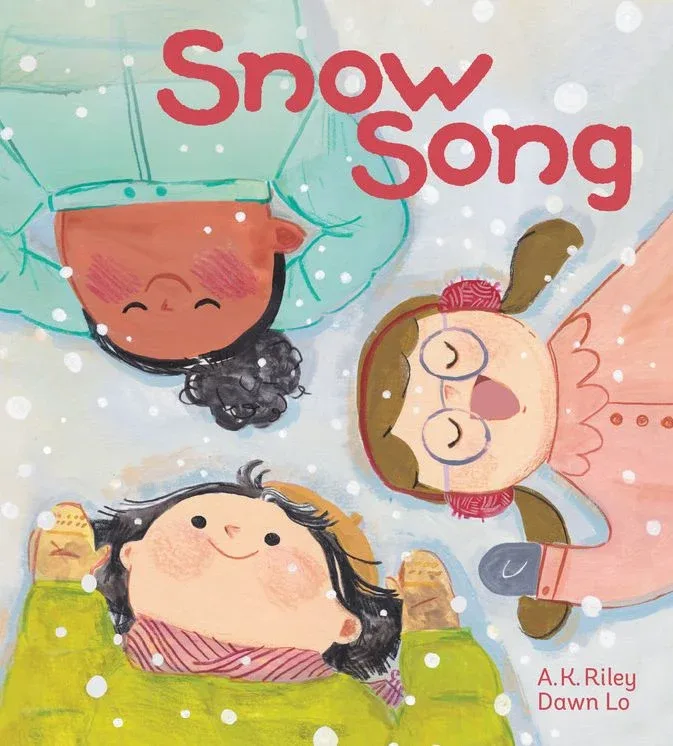 Snow SongA. K Riley, illustrated by Dawn Lo“Fine pearls of snow / Then a twirl of snow. / Around the eaves / A curl of snow.” A young, dark-haired girl, who appears Asian, leaves her city building on a snowy morning and heads to the park to play with friends. The lyrical, sensory-rich rhyming narrative cleverly describes every aspect of her day in reference to snow—what the snow is doing, how it makes things appear, how it feels or makes her feel, and more. Back home at day’s end, in her pajamas, she gazes out her window at “bright falling stars” of snow. Cheerful mixed-media illustrations offer a variety of perspectives across pages showing the girl and snow in the cityscape and in the natural setting of the park, where she plays with a diverse group of friends.Seasons and CelebrationsView book details
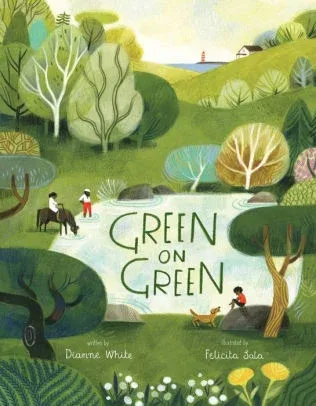 Green on GreenDianne WhiteA clever, vibrant tour through the seasons emphasizes just a few colors for each season in a series of rhyming tercets, each one ending with a different color of green. (“Endless the sun. / Shade between. / Sun and shade and blue on green.”) Watercolor, gouache, and colored pencil illustrations show a brown-skinned, blue-eyed family across the seasons, with the passage of time including the mother’s pregnancy leading to the arrival of a new baby by the end of the year.Seasons and CelebrationsLexile Text Measure 350LATOS Book Level 2.5View book details
Historical People, Places, and Events
16 selections
 A Sporting Chance: How Ludwig Guttmann Created the Paralympic GamesLori AlexanderLudwig Guttmann was a Jewish doctor who fled Germany for England in the late 1930s. At Oxford University he continued some of his previous work in neurology, although no longer working directly with patients. Asked to set up a unit for treating soldiers with spinal injuries at a hospital outside London, his radical approach, counter to all previous accepted practices, transformed medicine for and attitudes toward individuals with paralysis. Refusing to accept warehousing patients and hopelessness as the norm, he focused on helping prepare patients to live, not die. He began physical therapy and training programs. He set up employment training and work opportunities and, inspired by patients who created their own wheelchair polo game, eventually began a sports program. The competition that grew out of this, the Stoke Mandeville Games (named for the hospital), eventually became the Paralympics. This fascinating account, which includes historic photographs and original illustrations, also addresses the anti-Semitism Guttmann faced. Detailed source information, a timeline, notes and index conclude the volume.Historical People, Places, and EventsLexile Text Measure 960LATOS Book Level 6.6View book details
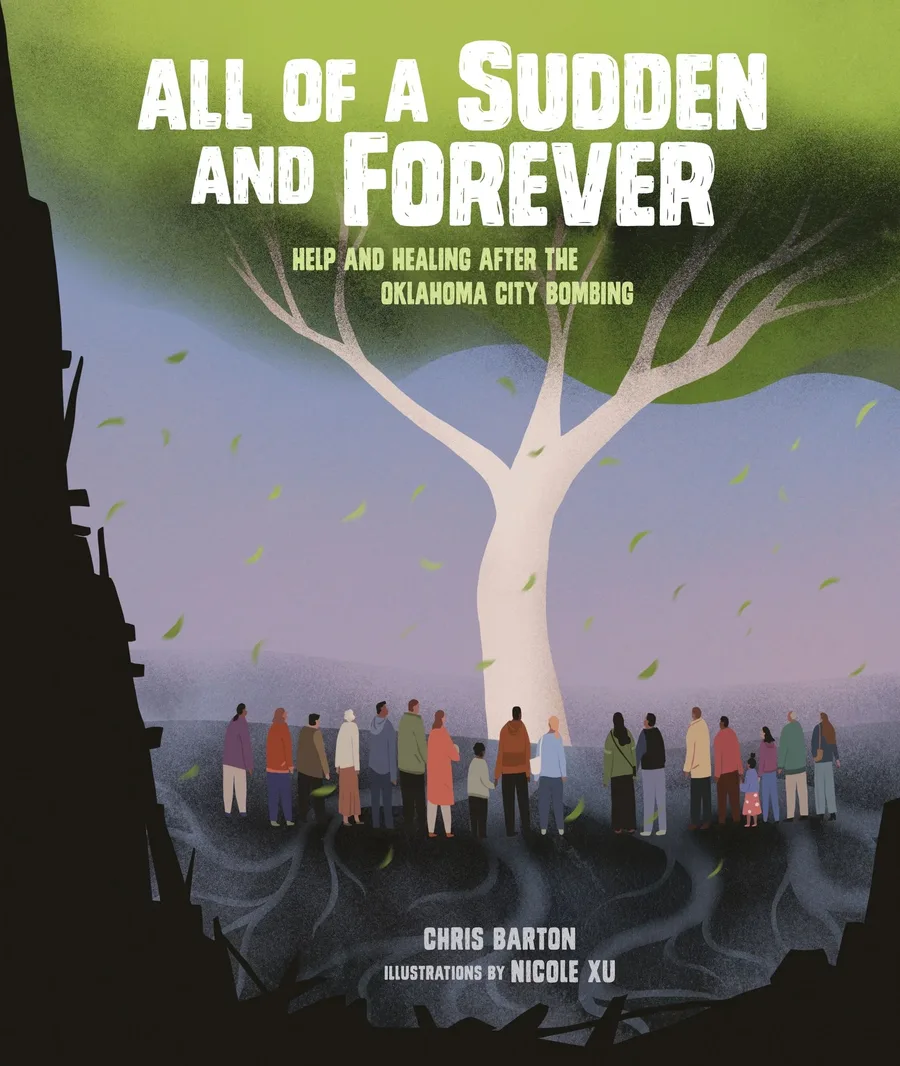 All of a Sudden and Forever: Help and Healing after the Oklahoma City BombingChris BartonA picture book about the Oklahoma City Bombing focuses on the healing and community support that took place after the fact. In April 1995, a bomb planted in a truck exploded, killing 168 people in a nearby office building. The act of domestic terrorism affected not only those who died or were injured, but also their families and friends and others who watched the tragic event unfold on television. While “the awfulness of that moment can never be undone,” the story continues. A nearby American elm tree, which survived the bombing, became a focal point of hope and healing for many. Its seeds were collected and planted, the saplings later given to survivors. Some survivors told their stories. Others offered and received support from one another. Many found solace at a memorial built for victims of the bombing. Perhaps most importantly, “when other terrible things happen,” the act of comforting and supporting one another in the face of tragedy will continue. Survivors of one traumatic event will comfort those affected by another. Although based on a specific event, this sincere narrative of communal healing has broad applicability and the potential to resonate with survivors of various types of trauma.Historical People, Places, and EventsView book details
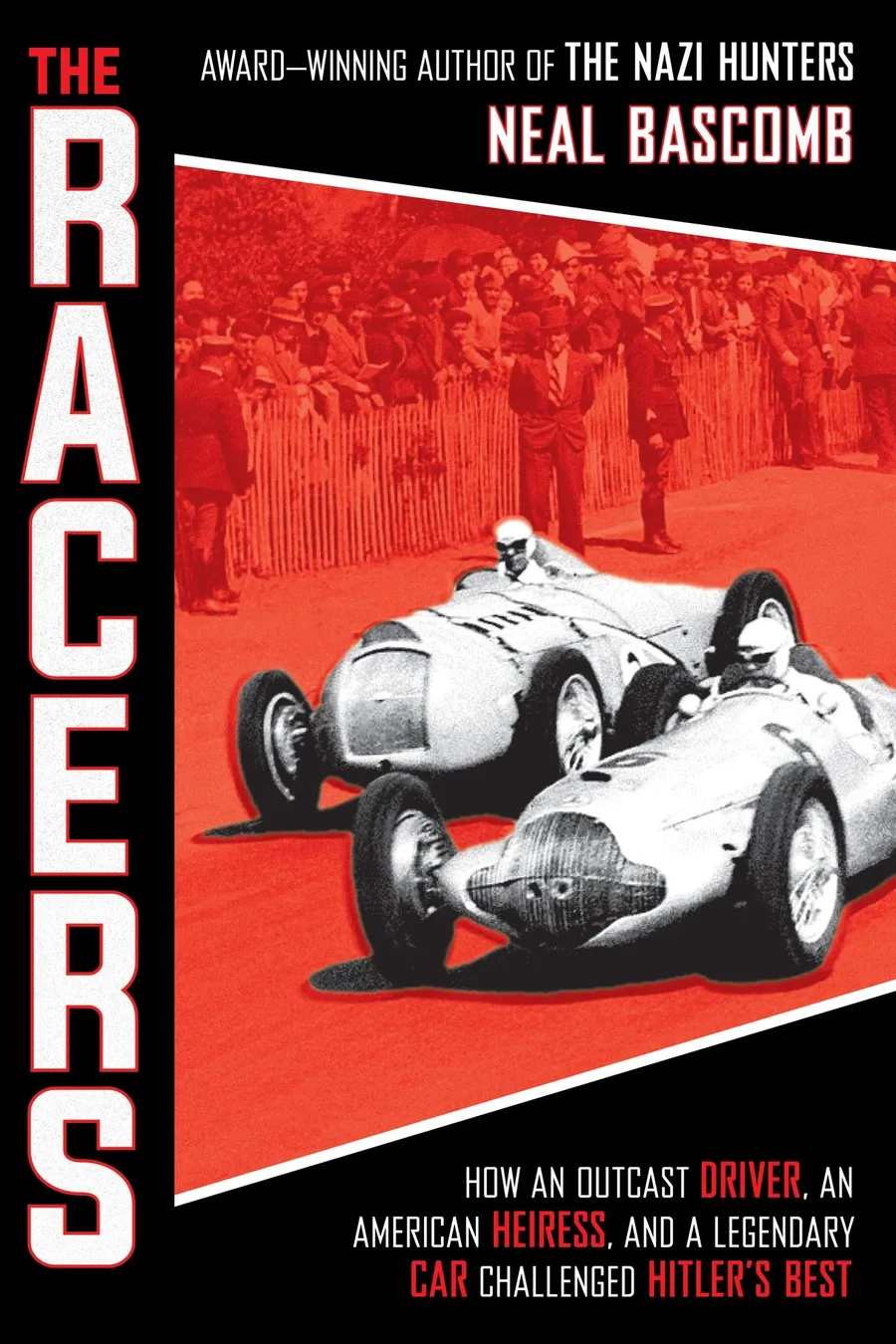 The Racers: How an Outcast Driver, an American Heiress, and a Legendary Car Challenged Hitler’s BestNeal BascombA fast-paced account of Grand Prix racing in Europe in the 1930s and 1940s (the precursor to Formula One) is set against the backdrop of Hitler’s rise in Germany. Two of the drivers who emerged as among the best of the time were Rudi Caracciola, a German who was featured by the Nazi party in their propaganda, and René Dreyfus, a French man of Jewish heritage. This narrative builds to their rivalry with breathtaking accounts of races in which they and others participated, while chronicling technological advances in car design among competing companies. The technology rivalries also take on nationalistic elements, pitting companies in Germany like Mercedes-Benz against one another and against other European makers, including the French company Delahye. The “American heiress” of the subtitle is Lucy Schell, a formidable racer herself as well as the financial backer for a French Delahye team. The paradigm in which these rivalries among individuals and companies are also presented as France and ideals of freedom versus German/Nazi fascism and anti-Semitism is a little forced at times (although more developed in the notes at volume’s end), but it doesn’t detract from what is, above all, a riveting story about sport, technology, and competition. Archival and personal papers are among the many sources cited in the work’s bibliography and notes.Historical People, Places, and EventsView book details
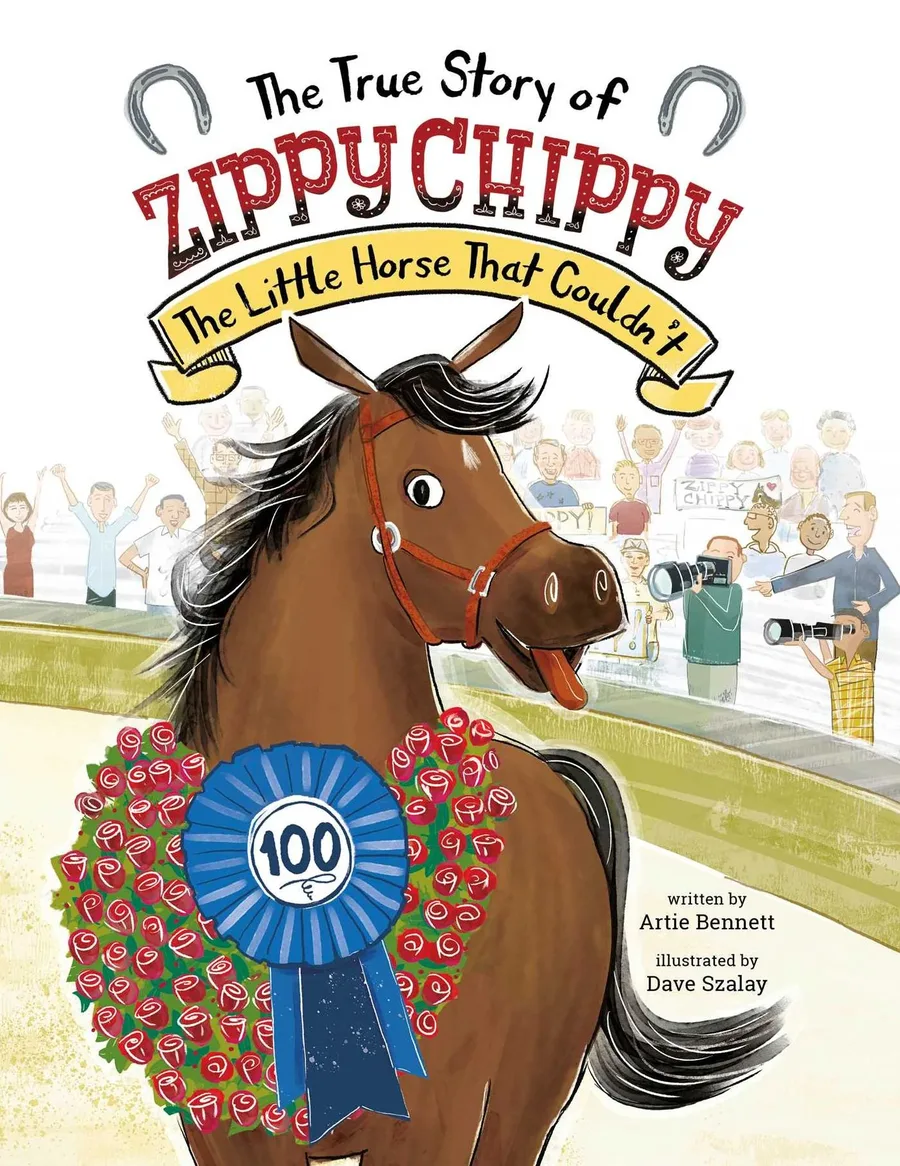 The True Story of Zippy Chippy: The Little Horse That Couldn’tArtie Bennett, illustrated by Dave Szalay“Zippy Chippy was a racehorse, descended from legends that ran like the wind. He was destined for glory …. The only problem was, when Zippy ran … it was more like a gentle breeze.” An unexpectedly charming sports story is about a horse who never won a single race. In fact, he didn’t even always finish his races. Zippy Chippy was spirited and stubborn, which didn't matter to Felix Monserrate, the Puerto Rican man who purchased Zippy Chippy and didn't give up on him. He had a prankish personality and loved sweets. He also loved racing, but always on his own terms. Maybe he’d leave the gate, maybe not. Eventually he was banned from racing at every track but one. But the more races Zippy lost, the more people began paying attention to this quirky horse. They began betting on him … to win! By the time Zippy was retired from racing he was a celebrity in the racing world. Quirky, sweet, but never sentimental, this offbeat account never makes fun of Zippy but instead celebrates his unique personality and spirit, which are reflected in the tone of both the narrative and illustrations. A note tells more of Zippy’s winless yet heralded career and of his current life in retirement.Historical People, Places, and EventsView book details
 Jane against the World: Roe V. Wade and the Fight for Reproductive RightsKaren BlumenthalBefore turning to the Roe v. Wade court case, this narrative examines the history of attitudes and actions around reproductive health care in this country. Early chapters note that women provided reproductive health care for one another for centuries before chronicling the first restrictions to abortion in the United States in the mid-1800s, advances in reproductive health care advocated by Margaret Sanger, and the Clergy Consultation Services on Abortion that began in New York and spread to other cities in the 1960s, helping women access abortion services. At the time of Roe v. Wade, abortion regulations were vague, restrictive and patronizing, making abortion most difficult to obtain for women who didn’t have economic resources or connections to the men on hospital panels who “approved” abortion requests. The Roe v. Wade court case is chronicled in fascinating detail, including the Supreme Court trial (Roe lawyer Sarah Weddington was only 26) and the Supreme Court discussion, which is full of its own drama. The legal content here is admirably accessible, while the author makes sure to address racism and reproductive rights, from Sanger’s connection to the eugenics movement, to incidences of forced sterilization of African American and Indigenous women, to ongoing barriers to abortion today. The increased polarization around abortion —and violence against abortion providers—in the aftermath of Roe V. Wade is the final section of this thoroughly researched, timely and compelling history.Historical People, Places, and EventsView book details
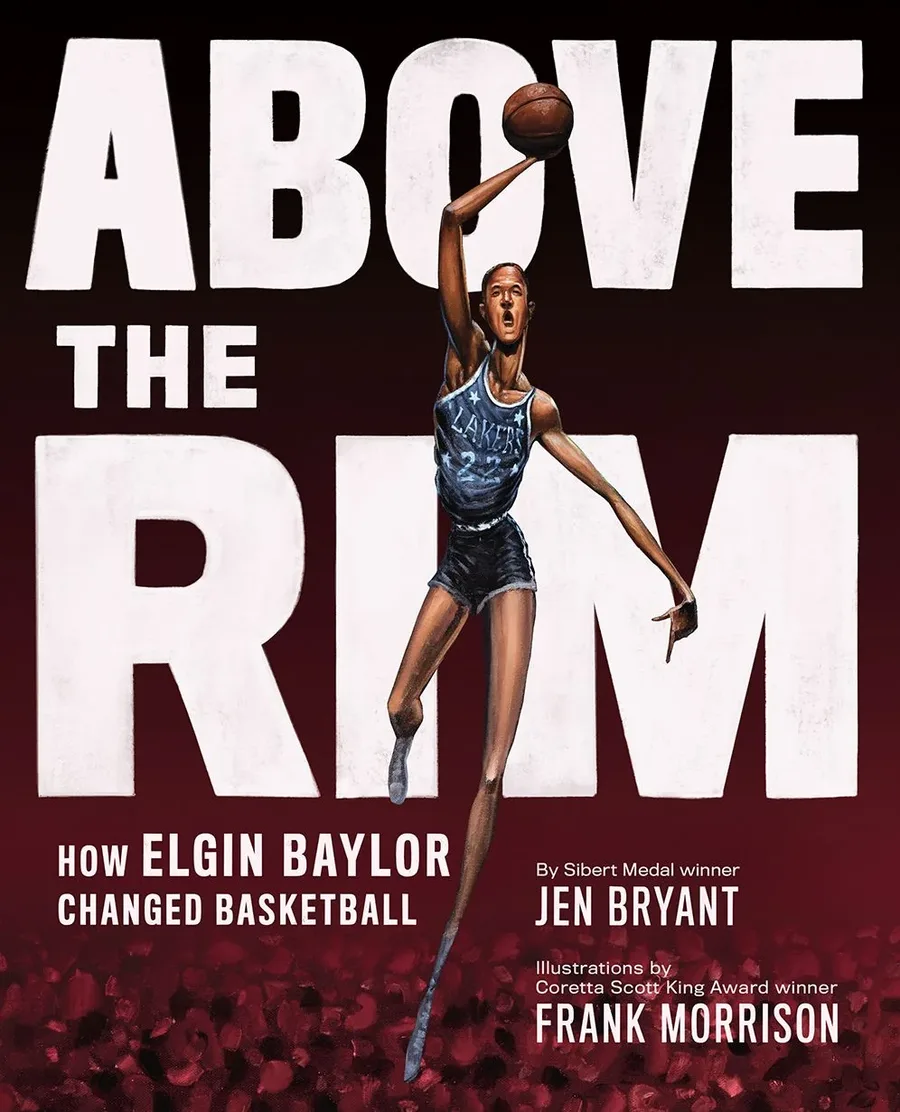 Above the Rim: How Elgin Baylor Changed BasketballJen BryantElgin Baylor faced racial barriers for most of his life, starting with the segregated playgrounds of his Washington, D.C. childhood. But playing street ball with a makeshift hoop in his neighborhood, Baylor first developed the skill he was known for—the ability to jump so high and hang above the rim that he could easily drop the ball through the hoop. Nicknamed “Rabbit” for his jumping ability, he won a college scholarship and was then drafted by the Minneapolis Lakers. But still he faced the same barriers—not being able to stay in a segregated hotel with his white teammates and having to eat cold food in his room while the others ate in restaurants. Baylor used his fame for good by refusing to get up off the bench for a pro game until Black players were treated fairly, which quickly led to a new NBA rule that teams would not be allowed to patronize segregated businesses. Bryant gracefully intersperses her account of Baylor’s life and career with other pivotal events in the Civil Rights Movement of the time, repeating the phrase “People stopped what they were doing and watched.” Her repetition of this and other key phrases throughout lends the narrative a poetic sensibility, as do the elongated bodies of Frank Morrison’s striking illustrations.Historical People, Places, and EventsView book details
 Lifting as We Climb: Black Women’s Battle for the Ballot BoxEvette DionneReading this illuminating history of the women’s suffrage movement in the United States underscores how often the perspective and participation of African American women is missing from other accounts. Beginning with the history of enslavement and its impact on voting/voting rights in general in the United States, this work goes on to document the initial ties and tensions between the abolition and voting movements in the wake of emancipation (were votes for Black men or white women more critical?) and the racism that Black women faced in the women’s suffrage movement. As it chronicles Black women’s struggle and work for voting rights across the abolition, women’s suffrage, and civil rights movements, many sidebars introduce African American women who played critical roles in these efforts. Despite disappointing design elements (matte pages, sometimes grainy black-and-white photos, sidebar placement and font choice) the insightful content of this work is essential. A lengthy bibliography, source notes, and index conclude the volume.Historical People, Places, and EventsView book details
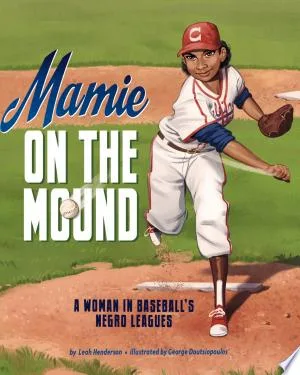 Mamie on the Mound: A Woman in Negro’s Baseball LeaguesLeah Henderson, illustrated by George DoutsiopoulosAfrican American Mamie Johnson was just six years old when her uncle started to teach her about baseball and she soon proved to be a natural pitcher. Her talents were so remarkable that, as a child, she won a spot on the roster of an all-white boys’ team, helping them win two division championships. Though she was able to break the color and gender barrier as a child, Mamie was not even allowed to try out for the segregated All American Girls Professional Baseball League when she graduated from high school, despite her talent. In 1953 she was drafted by the Indianapolis Clowns, making her one of the few women to play in the Negro Leagues, and her small stature earned her the nickname “Peanut.” This well researched picture-book biography brings to life a little-known athlete who deserves much more attention and fame.Historical People, Places, and EventsView book details
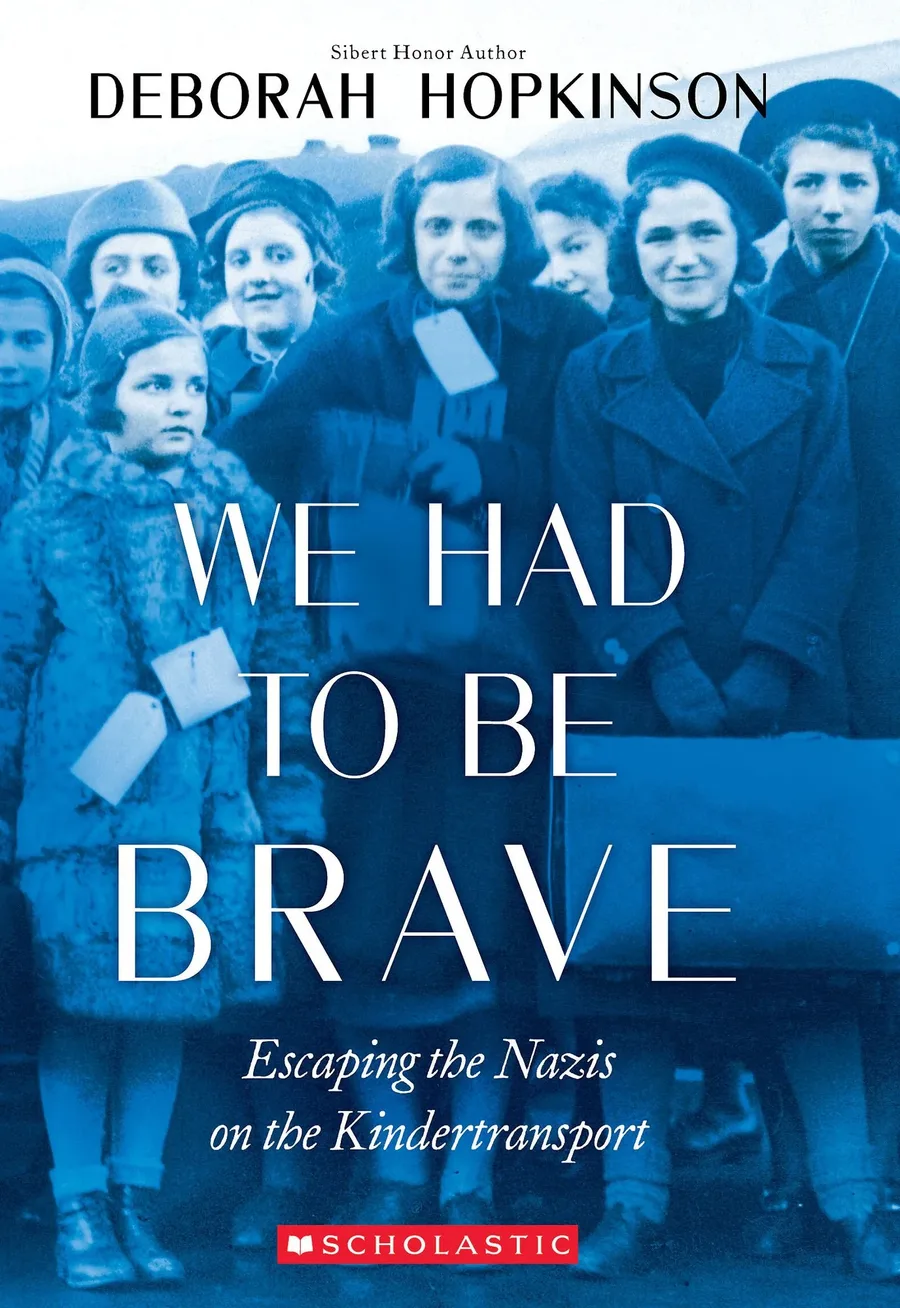 We Had to Be Brave: Escaping the Nazis on the KindertransportDeborah HopkinsonA compelling account of the Kindertransport, the World War II program dedicated to moving Jewish children from occupied countries to relative safety in England, provides context for the wartime efforts by first outlining events from 1925-1938. As Jewish people’s rights were methodically chipped away under the Nazi’s anti-Semitic leadership, the hope that things would get better and a reluctance to separate families was eventually replaced by desperation as parents struggled to protect their children. By the time of the transports in 1938 and 1939, the futility of a family fleeing together was undeniable. This account focuses on three primary individuals whose stories are tracked in detail, and introduces many others in brief. The author’s first- person interviews with two of the primary subjects, and close work with the daughter of the third, give readers access to personal history within the broader context of the time. A final section relates what happened to the Kindertransport children in their new environment; 90% of them never saw their parents again. “Look, Listen, Remember” boxes interspersed throughout the volume cite related online sources and a lengthy postscript includes additional information about people introduced in the book, a timeline, glossary, further resources, and extensive source notes.Historical People, Places, and EventsView book details
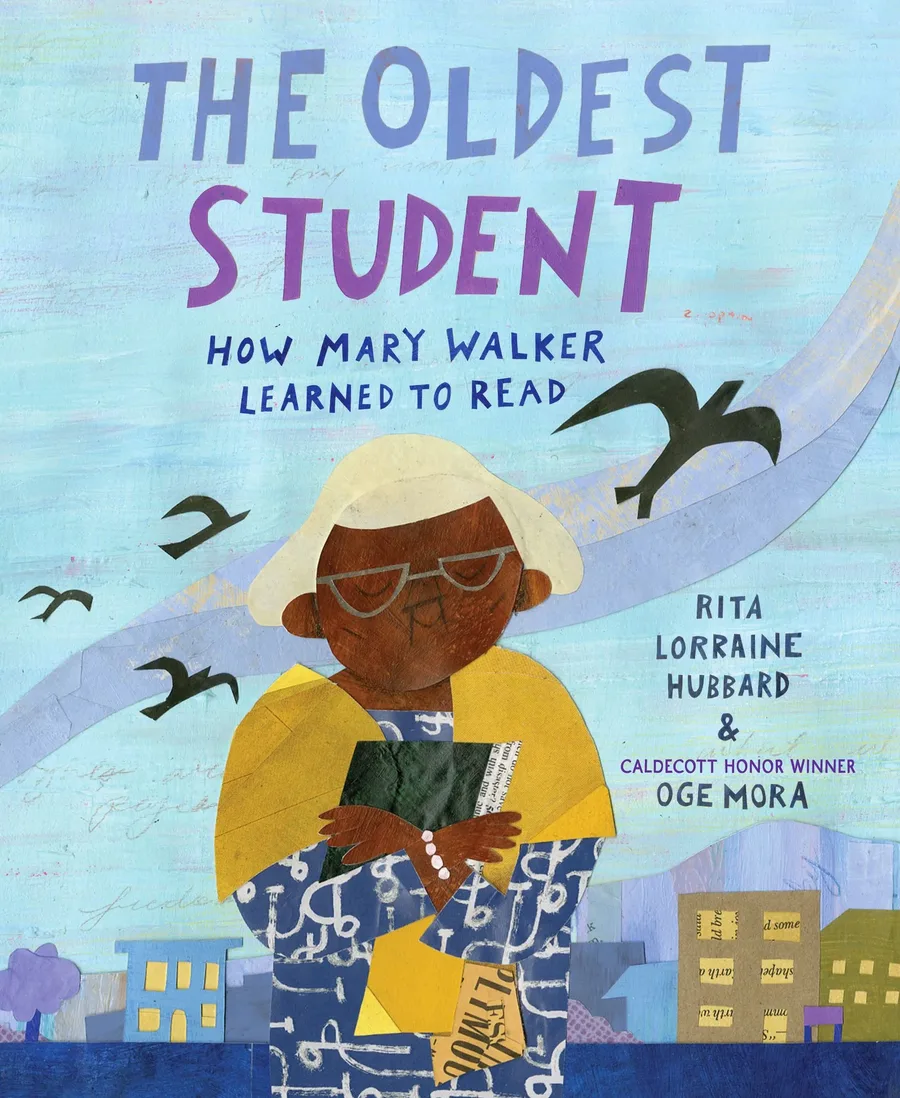 The Oldest Student: How Mary Walker Learned to ReadRita Lorraine HubbardA remarkable woman achieves a lifelong dream in this nonfiction picture book. Gifted a Bible by a group of evangelists, Mary longed to learn how to read but had no time or opportunity to do so. Enslaved until she was 15, Mary later worked to help her single mother support their family; as a married adult she worked as a sharecropper to support her three sons, whose birthdays she marked in her Bible. At 114 years old, having outlived her husband and children, Mary became the nation’s oldest student as she learned to read in her retirement home. Celebrating her birthdays with family and friends, Mary, who lived to be 121, would read aloud from her Bible. Cut-paper collage illustrations accompany the narrative of this impressive, persevering Black historical figure.Historical People, Places, and EventsView book details
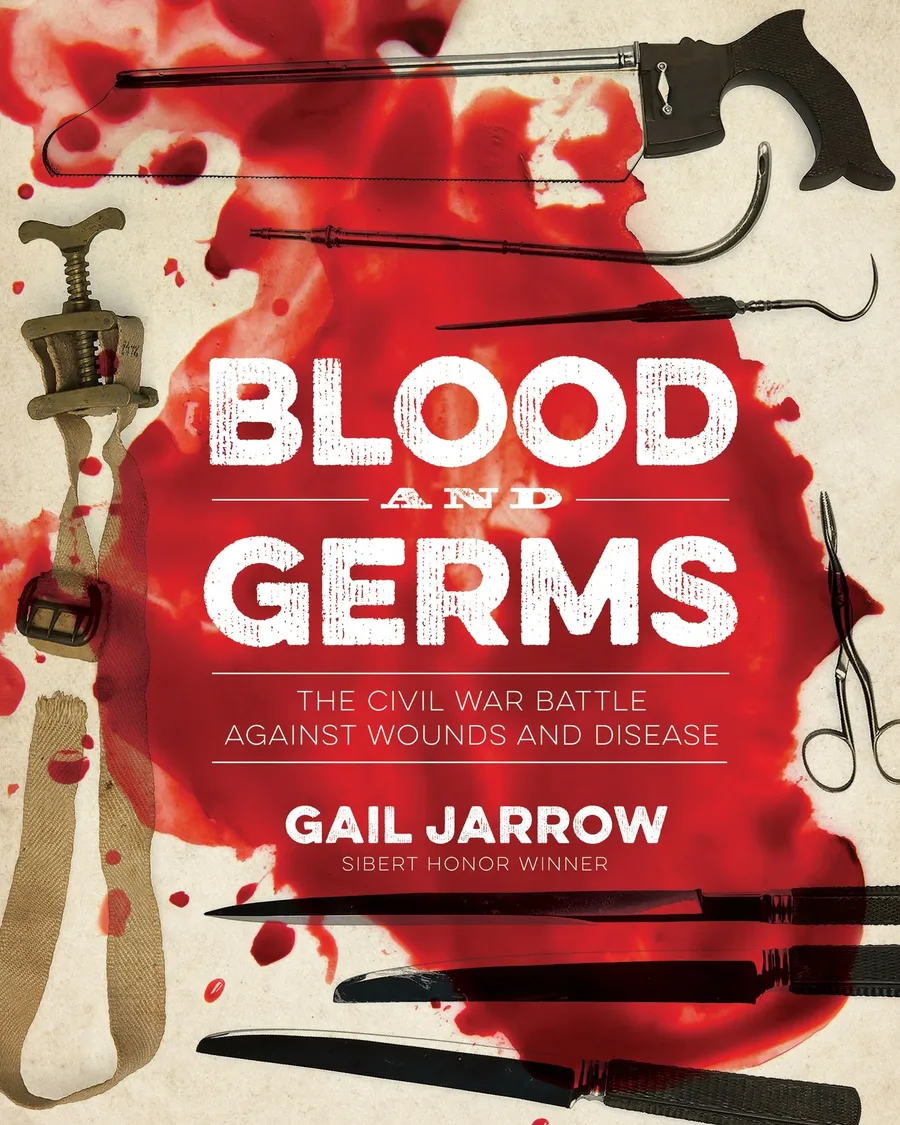 Blood and Germs: The Civil War Battle against Wounds and DiseaseGail JarrowAn overview of the disease, injury, and death of Civil War soldiers shows how the misery and tragedy on and off the battlefield ultimately led to milestone advances in medical practices. Conditions linked to poor diet, hygiene, and sanitation, and contagious diseases prevalent in soldiers’ abysmal living conditions, played a large part in the human devastation, along with injuries received in battle that often led to deadly infections. Thumbnail descriptions of individual experiences, often including a photograph, give depth to the big picture by offering personal stories of Union and Confederate soldiers, surgeons, stewards, nurses, and volunteers. While a scarcity of existing Confederate records prevented an even coverage of the two armies, there is care given to including accounts of Black soldiers and civilians, as well as ways in which women were involved, especially in a new role as nurses. The final chapter looks at some of the others ways the Civil War advanced medical practices, such as battlefield triage, improved hospital facilities, and support for veterans. Plentiful sidebars, photographs, and archival illustrations support the text.Historical People, Places, and EventsView book details
 All the Way to the Top: How One Girl’s Fight for Americans with Disabilities Changed EverythingAnnette Bay PimentelJennifer Keelan-Chaffins was born with cerebral palsy, and faced barriers her entire life. Even crossing the street in her wheelchair was a challenge. When she started kindergarten, she was only allowed to attend in the afternoon, due to her disability. These sort of experiences led Jennifer and her parents to attend meetings with other people with disabilities and at age six, she began participating in protests for disability rights. When Congress was debating the Americans with Disabilities Act, she joined activists in Washington, D.C., and participated in the Capitol Crawl, in which some of the activists crawled up the steps of the Capitol Building to demonstrate how difficult access was there, and by extension in many places. Jennifer wasn’t the only one to make the arduous crawl up the Capitol steps, but because she was just eight years old, her insistence on participating in the climb drew intense attention. This account of her early life provides an excellent introduction to activism, which builds to the dramatic event at the Capitol Building and demonstrates how the Americans with Disabilities Act came about and what it means to us all today.Historical People, Places, and EventsView book details
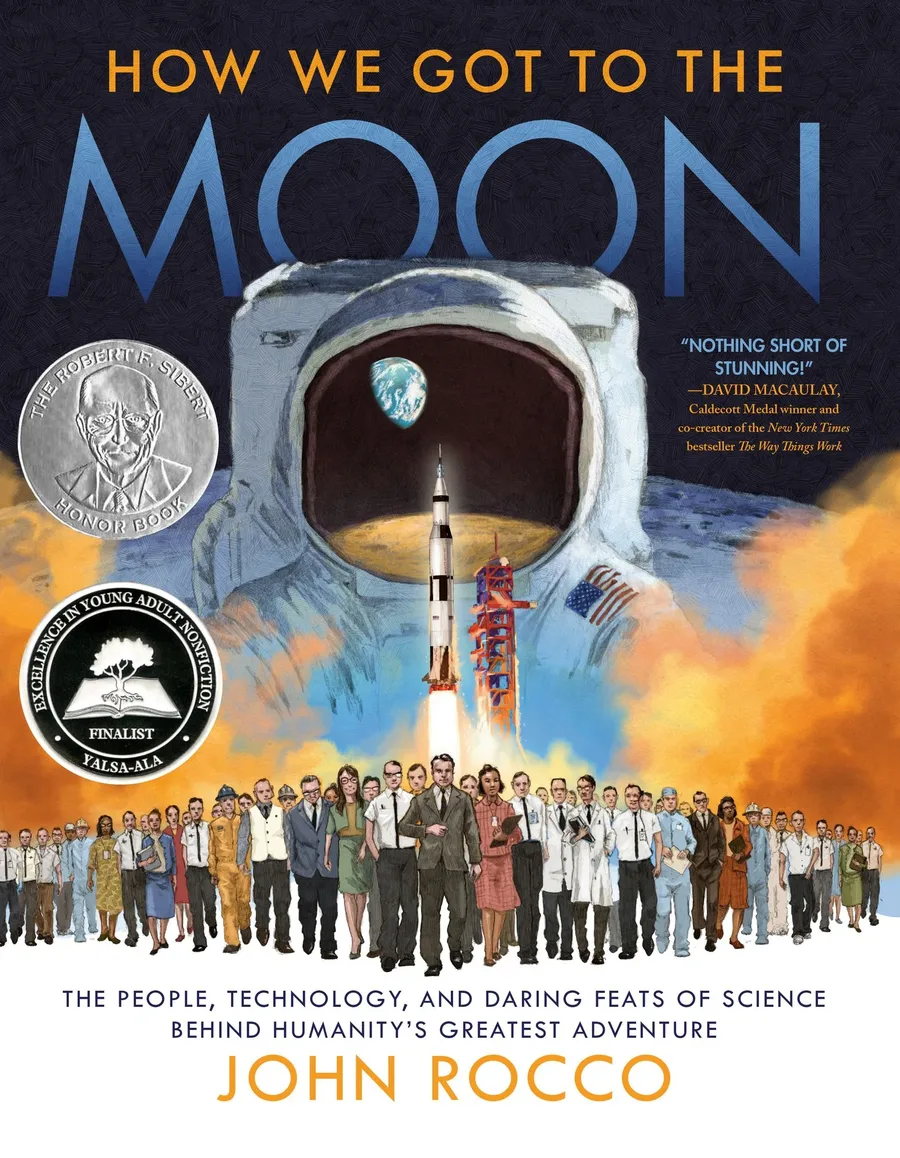 How We Got to the Moon: The People, Technology, and Daring Feats of Science Behind Humanity’s Greatest AdventureJohn Rocco, illustrated by John RoccoA captivating account of how the U.S. space program achieved the goal of landing on the moon blends abundant visuals with a compelling, substantial text that illuminates myriad facets of the effort. While the book moves chronologically from idea to successful outcome, it’s divided into sections that emphasize various aspects of the endeavor: “A Race to the Moon” (the Cold War political context), “Designing a Moon Rocket,” “Building a Launch Vehicle,” “Staying Alive in Space,” “Support on the Ground,” and “We Choose to Go to the Moon.” Throughout, both the technological story and the human story of the Apollo program—including the critical role of human creativity and imagination—are given equal measure, with sidebars offering profiles of some of the people and science and engineering concepts. The volume displays a welcome, intentional effort to include diverse individuals across many components of the Apollo program, scientists to seamstresses, factory workers to engineers to astronauts. The art ranges from schematics, diagrams, and close-ups of equipment to portraits accompanying the profiles to more sweeping views providing context. Individual readers will likely find some aspects more interesting than others, but the format makes it easy to linger where desired, even as it incites eagerness about what every turn of the page will bring in this enticing, impressive volume. End matter includes a list of Apollo missions, research note, sources, and suggestions for “further exploration.”Historical People, Places, and EventsView book details
 The Missing: The True Story of My Family in World War IIMichael RosenMichael Rosen relates his lengthy quest to find out about the fate of his great aunts and uncles in France and Poland during World War II in this short volume of prose and poetry. Jewish Rosen grew up in England after the war. His father didn’t talk much about these relatives, but noted obliquely when asked, “they were there at the beginning of the War, but they had gone by the end.” As an adult, Rosen worked on piecing together what happened, following twists and turns that included moments of breakthrough and inquiries that led nowhere. He started with stories from an aunt and uncle in the United States, later following the leads in letters found by American cousins sent by one of his French great uncles during the war. From there he engaged in research, reading, and trips to France, gradually piecing together the path that led to Auschwitz, and death, for his French great uncles. The Polish relatives were harder to trace; but one, 17 at the start of the war, survived. Each brief prose section describes another discovery in Rosen’s research, and concludes with a poem. A foreword by Marc Aronson and Rosen’s final chapter both note that this story about the Holocaust resonates with the fate of refugees today.Historical People, Places, and EventsView book details
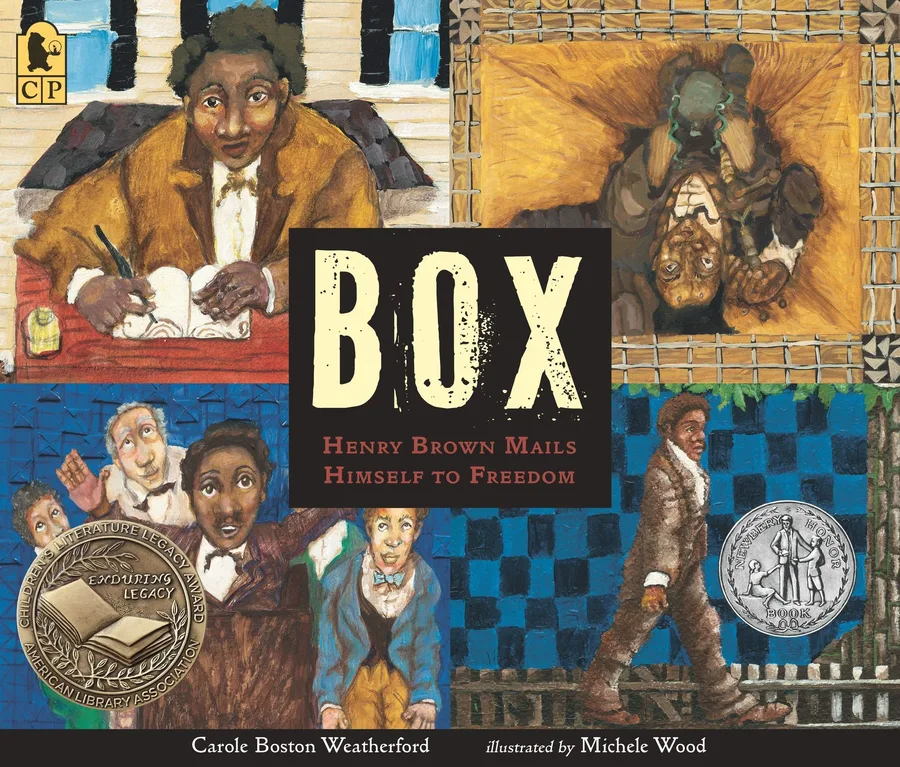 Box: Henry Brown Mails Himself to FreedomCarole Boston WeatherfordBound by slavery, young Henry Brown and his seven siblings performed grueling plantation labor. Moved and abused at the whim of masters and vicious overseers, Henry eventually married, but was soon separated from his wife and children. He struggled to pay the price of their ownership, but they are moved out of state in a slave chain pass. Having lost all that is dear, he received an inspiration for escape as an answer to prayer, and hired a carpenter to build a shipping box just big enough to hold him. His two day trip by wagon, train, steamer, and cart to Philadelphia ended in freedom, but despite selling his book and song lyrics at abolitionist gatherings, the challenge of reuniting with his family remained insurmountable. Henry continued to share his story in a reenactment for anti-slavery audiences, and evaded bounty hunters by sailing to England, where he developed a new one-man show. There he remarried and had a daughter. This remarkable poetic account of devastation, resilience, ingenuity, and perseverance is told in six line stanzas, with each line representing one side of a box, and draws on Henry Brown’s own writings. Masterful mixed media illustrations achieve the artist’s goal of expressing suffering and hope while maintaining dignity and integrity.Historical People, Places, and EventsView book details
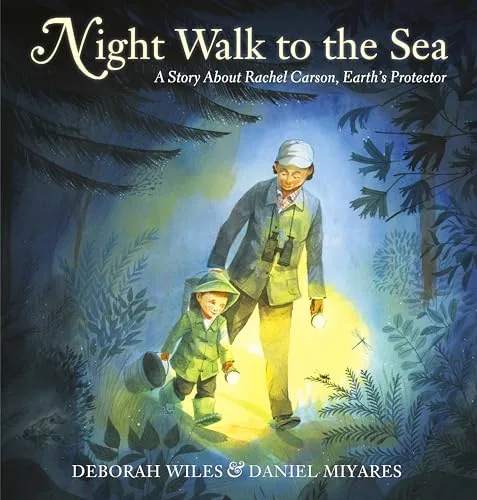 Night Walk to the Sea: A Story about Rachel Carson, Earth’s ProtectorDeborah Wiles, illustrated by Daniel MiyaresWhen the lights go out one night during a thunderstorm, little Roger, clad in Godzilla pajamas, huddles under a blanket with his great aunt (environmentalist Rachel Carson), trying to cover his fear with bravado. His patient aunt suggests a late-night walk after the storm is over, and the two make their way by lantern light through the forest, down to the sea. All the while, Roger, the self-described monster, stomps, roars, and crushes in an attempt to appear brave. But once they reach the sea, he is taken with the ocean’s bioluminescence, which Rachel quietly points out to him, and then helps his aunt rescue a struggling firefly caught in the water. The fictionalized story combines two life events Carson described in her writing, and shows how a child’s sense of wonder must sometimes be nurtured when nature has presented itself as something scary. The prose crackles with descriptive language that appeals to all five senses, and Miyares’ expressive, stormy illustrations heighten the sense of the storm and the wonder.Historical People, Places, and EventsView book details
Biography, Autobiography, and Memoir
14 selections
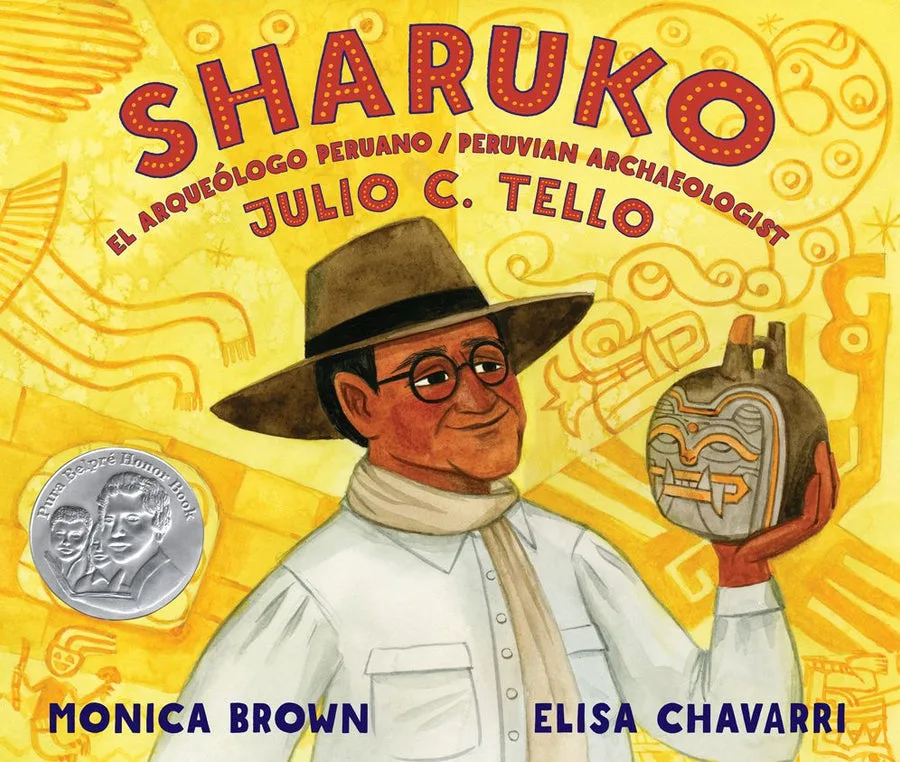 Sharuko: El arqueólogo Peruano Julio C. Tello / Peruvian Archaeologist Julio C. TelloMonica BrownJulio Tello, born in 1880 just outside Lima, Peru, was nicknamed Sharuko as a young boy, which means “brave” in Quechua, his native language. As a child, he explored the caves in the foothills of the mountainous area where he grew up, and he uncovered ancient tombs there. These discoveries piqued Sharuko’s curiosity, and he grew up to be a well-known archaeologist whose scholarship helped others worldwide understand the scientific achievements of ancient Peruvian cultures, which developed irrigation systems and surgery more than 2500 years ago. The clear, concise bilingual (Spanish/English) text is well researched and gives a good sense of the life and work of Dr. Tello, while the watercolor and gouache illustrations by a Peruvian artist provide a visual context that gives us a good sense of time and place.Biography, Autobiography, and MemoirView book details
 The Rise and Fall of Charles LindberghCandace FlemingCharles Lindbergh was widely celebrated for his accomplishments as an aviator, having made the first solo nonstop transatlantic flight from New York to Paris when he was just 25. He was promoted in the press as a quiet, courageous American hero, a romantic, and, later, a family man who suffered an unspeakable tragedy when his young son was kidnapped and killed. But Fleming is not one to wallow in Lindbergh’s glory or tragedy. Through meticulous research, she uncovers details about the man that sharply contrast with his popular image; in truth, he was a controlling, racist, Nazi sympathizer who became a star speaker at “America First” rallies. Fleming is skilled at presenting both sides of this complex man, warts and all, by building his life story through a series of scenes and judiciously chosen quotations. Written with grace and fluidity, it’s a hard-to-put down work even without the parallels to contemporary events that will resonate with many young readers, whether or not they know—or think they know—about this popular “hero” of the 20th century.Biography, Autobiography, and MemoirView book details
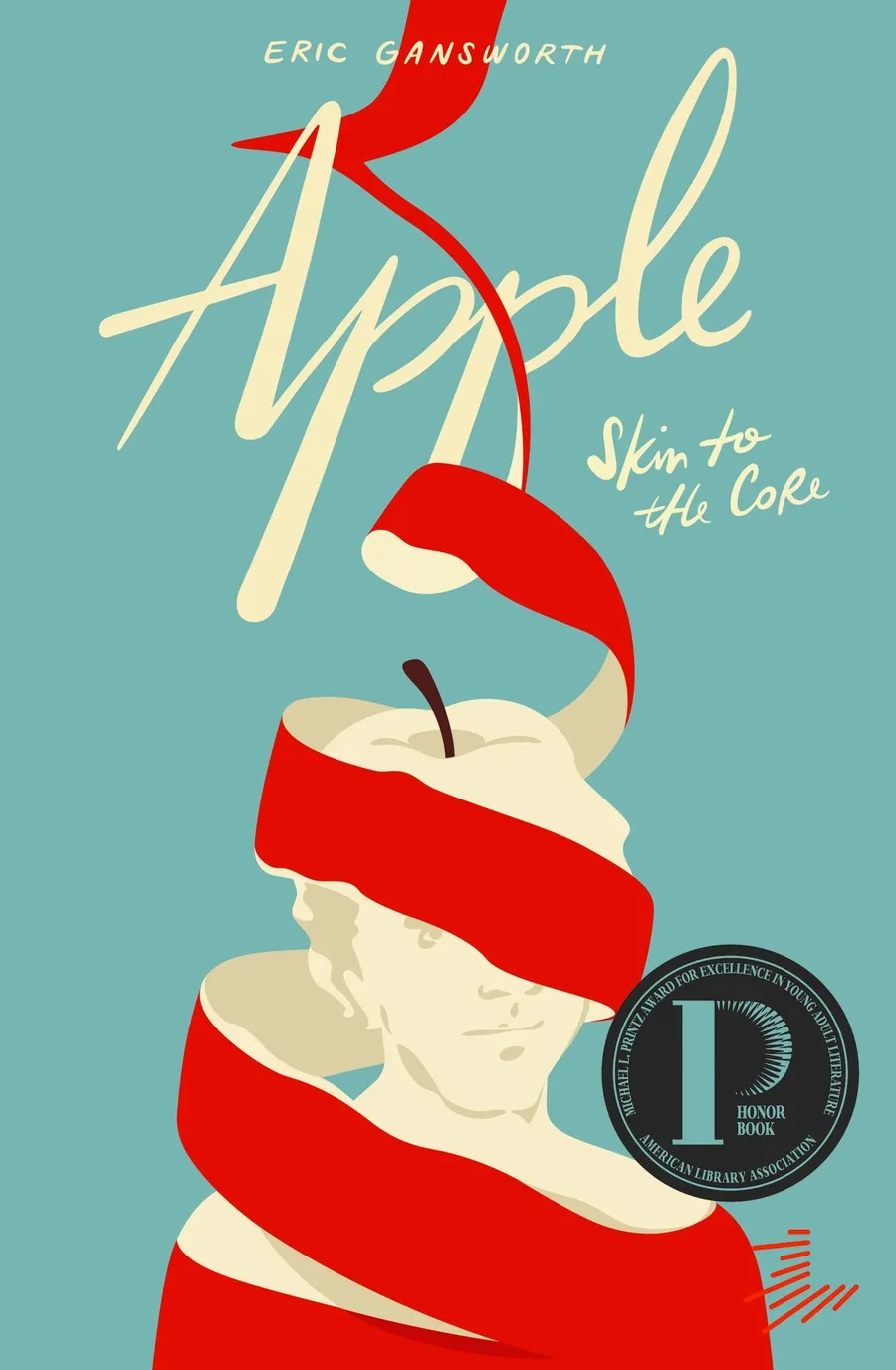 Apple (Skin to the Core)Eric Gansworth, illustrated by Eric GansworthPoems recounting family and personal history, twined with artwork and musical references, accompanied by occasional photographs, Eric Gansworth’s memoir is a love letter to his family and Native community—he’s an enrolled Onondaga born and raised at the Tuscarora Nation. His poems tell stories buoyed by keen, poignant details bringing people and places and events into sharp focus. His mother is a compelling, enduring presence, but even individuals who make fleeting appearances come alive on the page. Poverty is an indelible character, too, while the setting, especially Dog Street (Mount Hope Road), the main road that ran through the reservation and his youth, and the house that was his home, are vividly realized. A visual artist too, Gansworth’s pieces include a rendering of Dog Street echoing the cover of the Beatles’ Abbey Road but with self-portraits in place of the musicians. It’s one of many ways the importance of music in his life, especially the Beatles, is incorporated throughout the structurally complex narrative following him from childhood into college. “Liner Notes” at book’s end provide additional information on the musical connections, narrative structure, and some of the imagery, including the “apple” of the title, a derogatory term among Native people meaning “red on the outside, white on the inside,” and also the Beatles’ record label icon. Gansworth speaks truths about survival, include adaptation in a world in which Indigenous people and cultures have faced attempts at erasure and ongoing racism yet endure.Biography, Autobiography, and MemoirView book details
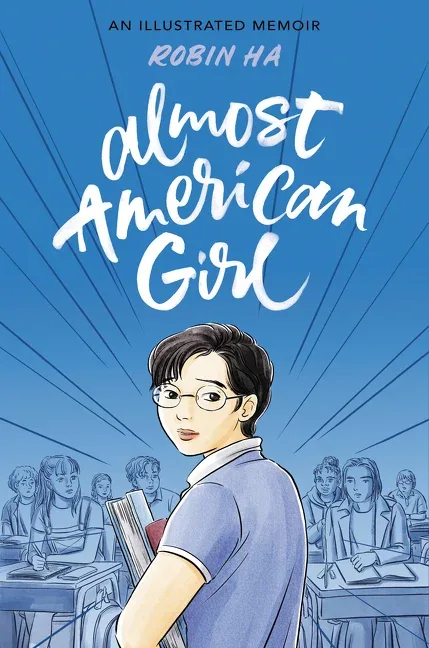 Almost American GirlRobin HaAn only child raised by her single mother, Chuna lives happily in Seoul, South Korea. On a vacation to Huntsville, Alabama, Chuna is stunned and devastated to learn that they will not be returning home; her mother plans to marry the man they’re visiting, a recent immigrant from Korea. Thrust into a mostly white school with no language-acquisition program, Chuna is miserable and lost. Her new stepfamily is cold and resentful, and classmates either ignore or bully her. Her one escape is art; she enjoys drawing her favorite Korean comics heroine. When her mom finally enrolls her in a comics-drawing class, Chuna befriends Jessica, a kindred spirit and biracial (Japanese/white) girl. But life truly improves only once Chuna (who takes the American name Robin) and her mom move north, and Chuna enrolls in a diverse high school where she makes Korean American friends. Scenes from Chuna’s childhood, including mistreatment at the hands of a teacher, are neatly woven into the main narrative. Ha’s close but contentious relationship with her fiercely protective mother, who faced discrimination and was socially ostracized as a single mother in Korea, lies at the heart of this affecting graphic memoir.Biography, Autobiography, and MemoirLexile Text Measure 511LATOS Book Level 3.4View book details
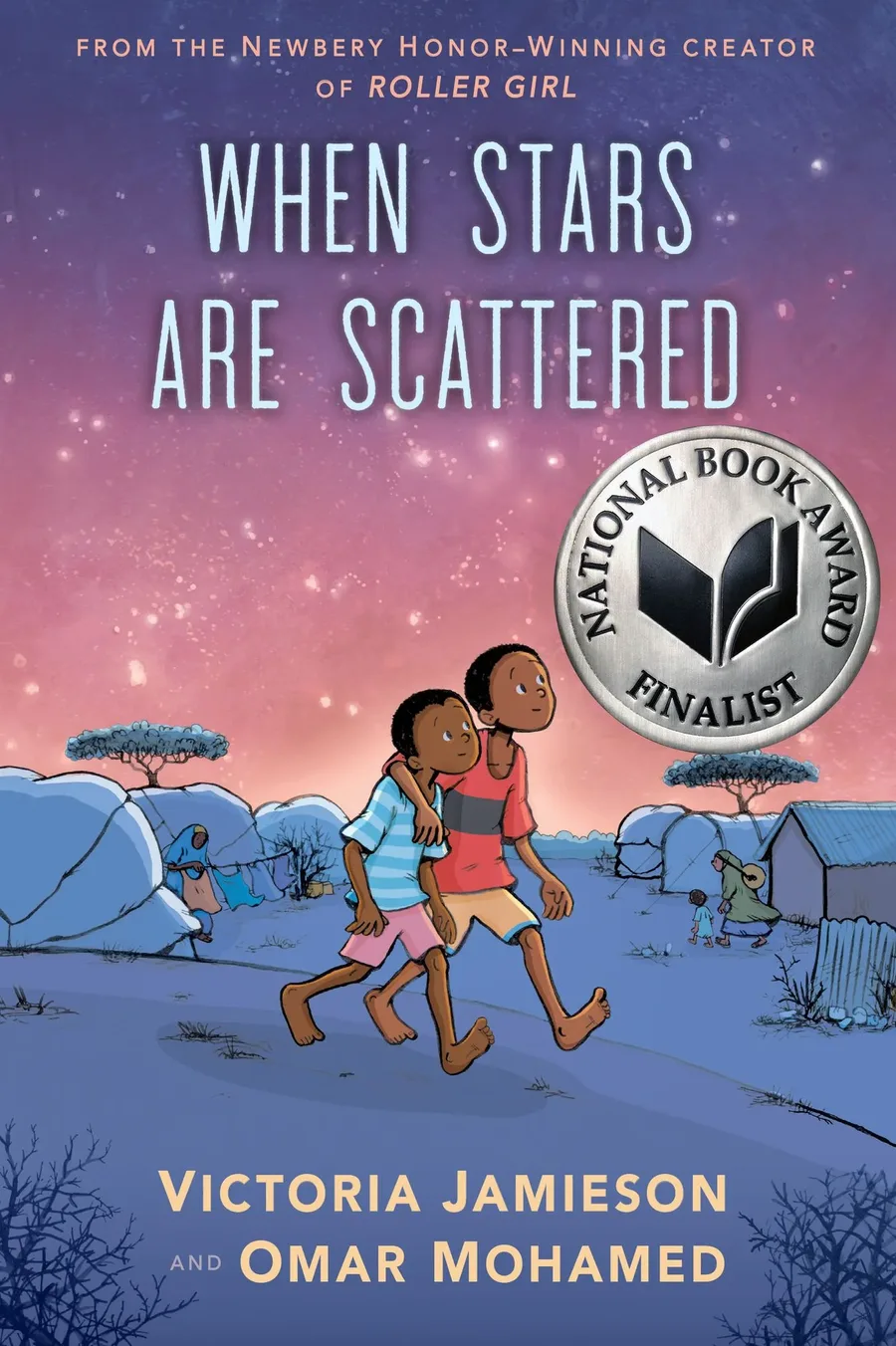 When Stars Are ScatteredVictoria Jamieson, Omar MohamedSeparated from their mother when soldiers attacked their Somalian village, Omar and his brother, Hassan, live in a sprawling refugee camp in Kenya, watched over by loving foster mother Fatuma. Fiercely protective of Hassan, who has a developmental disability and experiences seizures, Omar hesitates to begin school, but excels in his classes once he does. School provides structure to the otherwise long, monotonous days, which become years, of waiting: to be called for an interview, to be told they can be resettled in North America or Europe, to be reunited with their mother, whose fate is unknown, although Omar searches for answers every chance he has. This personal memoir, a collaboration between Omar Mohamed, who now works in refugee resettlement, and graphic novelist Victoria Jamieson, details the specifics of Omar and Hassan’s lives, including their friendships with others in the camp. In doing so, it illuminates the hardships of refugee life in general—crowding, food and water shortages, hopelessness—the challenge for people with disabilities, and the particular situations of girls and women. Colorful, expressive illustrations, a satisfying ending, and Mohamed’s illuminating author’s note with photographs, balance the very real trauma and pain of this moving story.Biography, Autobiography, and MemoirView book details
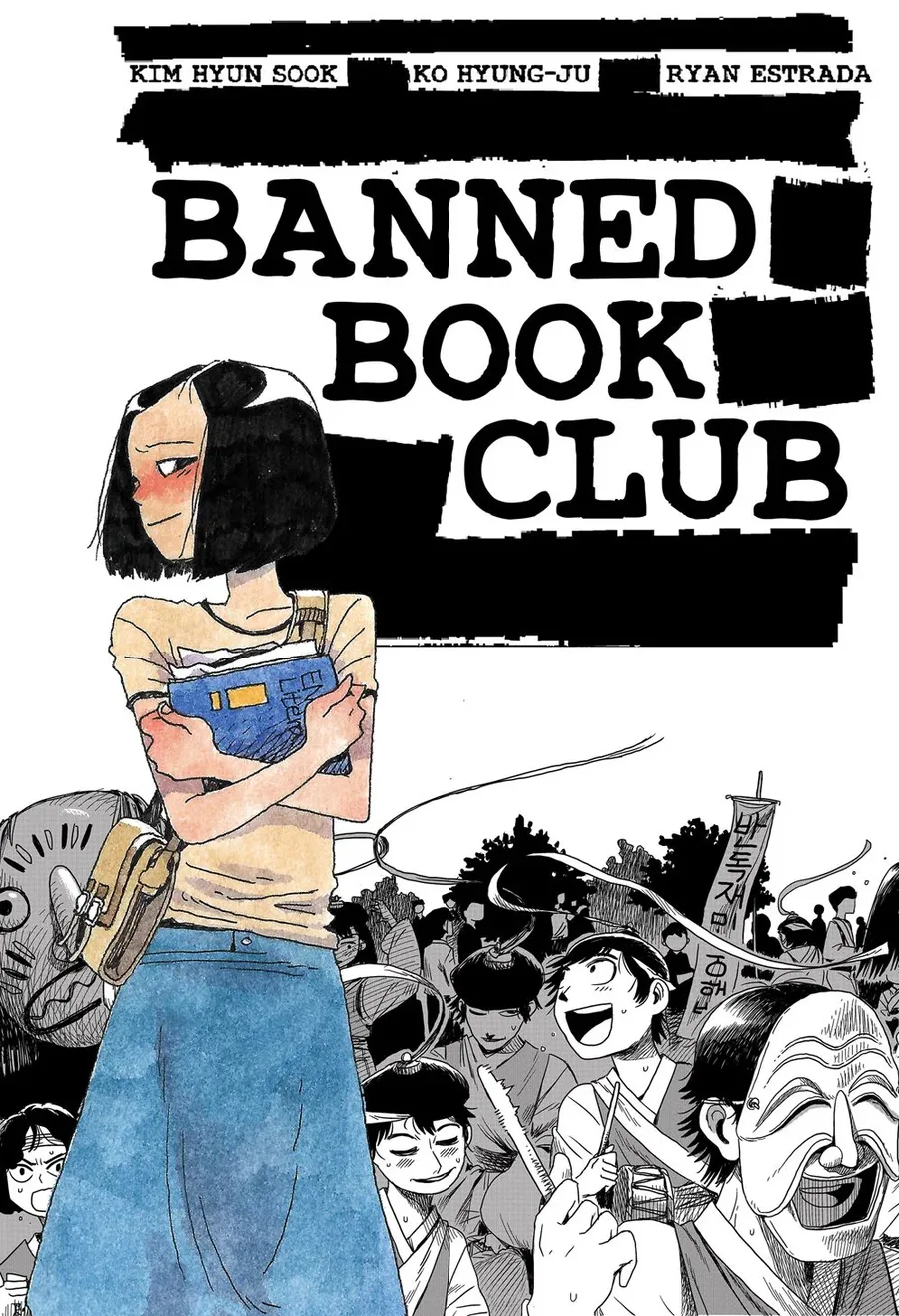 Banned Book ClubKim Hyun Sook, Ryan EstradaA graphic memoir set in 1983 in South Korea describes events during the author’s freshman year of college at Anjeon University. Kim Hyon Sook is a serious student who wants to succeed academically, so she’s surprised, and rather annoyed, on the first day when she has to push her way through a student protest against President Chung to get into the building where her classes are. She loves her young, charismatic English literature teacher and is attracted to Hoon, the smart, cute boy who sits next to her in one class. When Hoon, who turns out to be a leader in the student movement, invites her to attend one of his book club meetings, she readily agrees—what could be better than Hoon and books together? But the students aren’t discussing just any books, they’re discussing books that have been officially banned by the South Korean government. Through the discussions, Hyon Sook is exposed to radical ideas and develops a much deeper understanding of why change is needed, a transformation that defies expectations of her parents in spite of their own break with tradition (they own an American-style steakhouse). Then members of her Banned Book Group, now her friends, start getting arrested. This fascinating portrait of one young woman’s political awakening has clear parallels with young people’s activism in the United States and around the globe today. Dynamic black-and-white artwork shows a range of visual perspectives.Biography, Autobiography, and MemoirView book details
 Dream Builder: The Story of Architect Philip FreelonKelly Starling LyonDuring his Philadelphia childhood, Philip Freelon was part of a family of art appreciators that included his grandfather, a Harlem Renaissance painter. Always creative, Phil sketched, built models, sculpted, and wrote essays and poems. At school he excelled at math and science, but struggled with reading. His businessman father told his son about having to sleep in different Southern hotels than his white colleagues while traveling for work, and other discriminatory and racist incidents. As a college student, Phil read on his own about Black and Islamic architects and builders, subjects absent from his classes at North Carolina’s State University of Architecture. All of these experiences and observations eventually shaped the design focus of his own firm, with its concentration on projects he felt could positively impact the world. Philip Freelon served as lead architect for the National Museum of African American History and Culture, which opened in 2016. This accessible biography celebrates Mr. Freelon’s remarkable career and the integrity and cultural vision at its foundation.Biography, Autobiography, and MemoirView book details
 Everything Sad Is Untrue (a True Story)Daniel NayeriNayeri’s poignant, engaging memoir begins with a vivid childhood memory of a visit to his grandparents when he was still a little boy knowns as Khorsou living in Iran. The world, as far as he knew then, revolved around him. A few years later, Khosrou, his sister, and mother flee Iran after his mother converts to Christianity, her life at risk because of government persecution. They leave almost everything behind, including Khosrou’s father, who chooses to stay. Their refugee journey, propelled by his mother’s relentless pursuit of safety, opportunity, and a home for her children, eventually takes them to Edmonds, Oklahoma. Khosrou, now Daniel, regales his teacher, middle school classmates—and readers—with stories about his life in Iran and Persian culture, using The Thousand and One Nights as both reference point and inspiration. Daniel finds much about life in the United States strange, and misses Iran and his father, a loss amplified by lingering questions and the presence of his mother’s new husband, who beats her. Nayeri’s unique, often funny conversational voice, punctuated by moments of meta-narrative, is captivating, full of both childlike innocence and longing (not to mention a fair share of bathroom humor), and moments of adult-like observation. Nayeri notes that he condensed his middle school classmates to types, while the adults, especially his parents, stepfather, and teacher, come through in full-relief in this distinctive, memorable work.Biography, Autobiography, and MemoirView book details
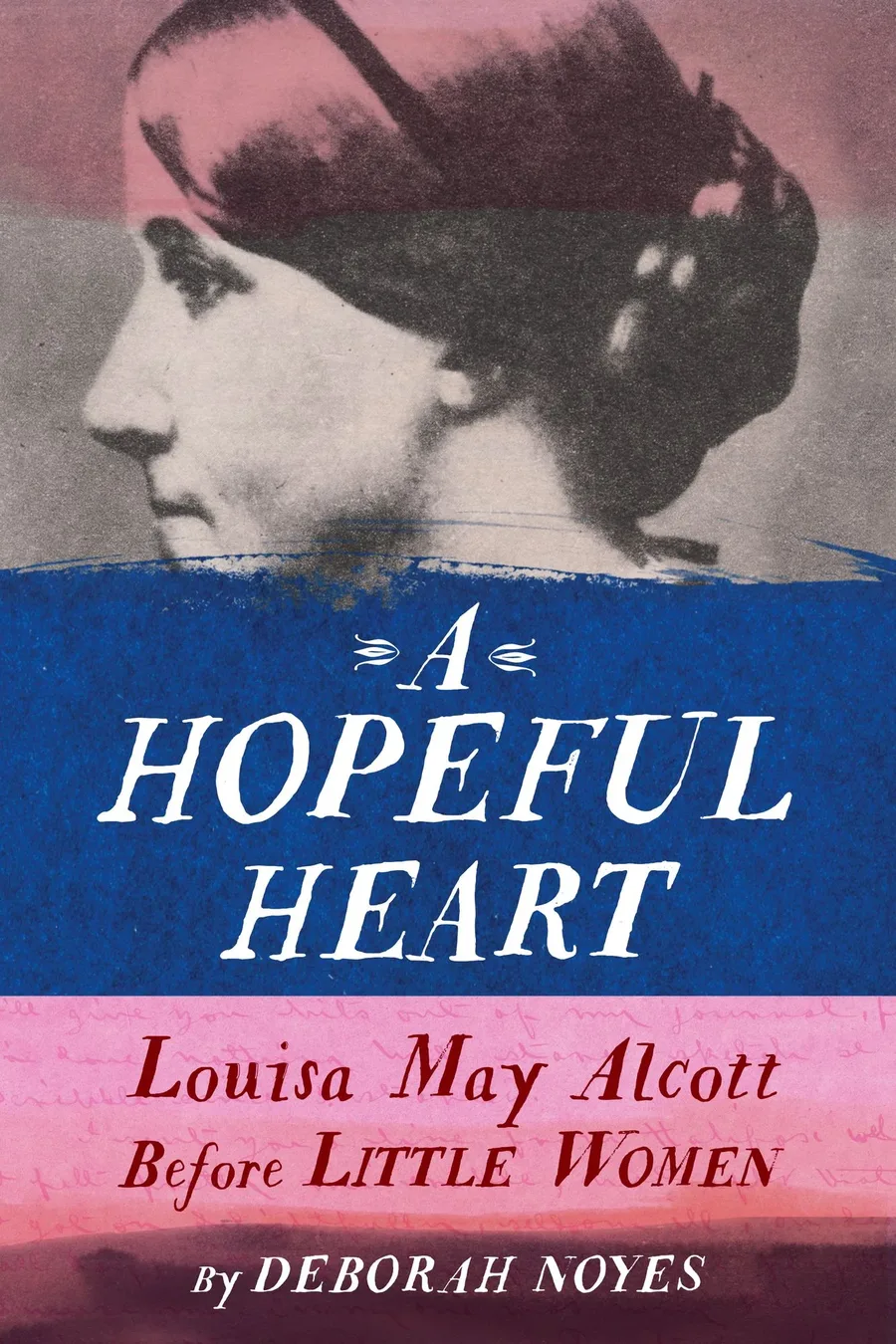 A Hopeful Heart: Louisa May Alcott BeforeDeborah NoyesA delightful and intriguing look at the life of Louisa May Alcott makes clear her headstrong nature shone from early childhood. Louisa’s mother, Abby, understood her willful, adventurous daughter. Still, both she and, especially, Louisa’s father, Bronson, admonished and encouraged Louisa to be “good.” Bronson, an educator, strove to shape his children morally and had a hard time when Louisa was young equating her forthright spirit with his understanding of a moral life. For all that her father scolded, however, both Louisa’s parents clearly adored her. Their home was loving, but circumstances often challenging. Bronson’s idealism led him from one job and plan to the next. There was little money, a lot of debt and moving, and a great deal of work, especially for Abby, and this did not go unnoticed by Louisa. At Fruitlands, the utopian community the family helped establish that was anything but ideal, the dissonance between idealism and reality was particularly apparent. As an adult, Louisa worked at her writing career both to follow her dreams and to support her family, earning money as a writer of what we would now call pulp stories, under a pseudonym. Ending with the publication of Little Women, this insightful offering underscores how Louisa May Alcott found her own way both in spite and because of her family. A comprehensive bibliography and notes are included.Biography, Autobiography, and MemoirATOS Book Level 8.1AR Interest Level Middle Grades Plus (MG+ 6 and up)View book details
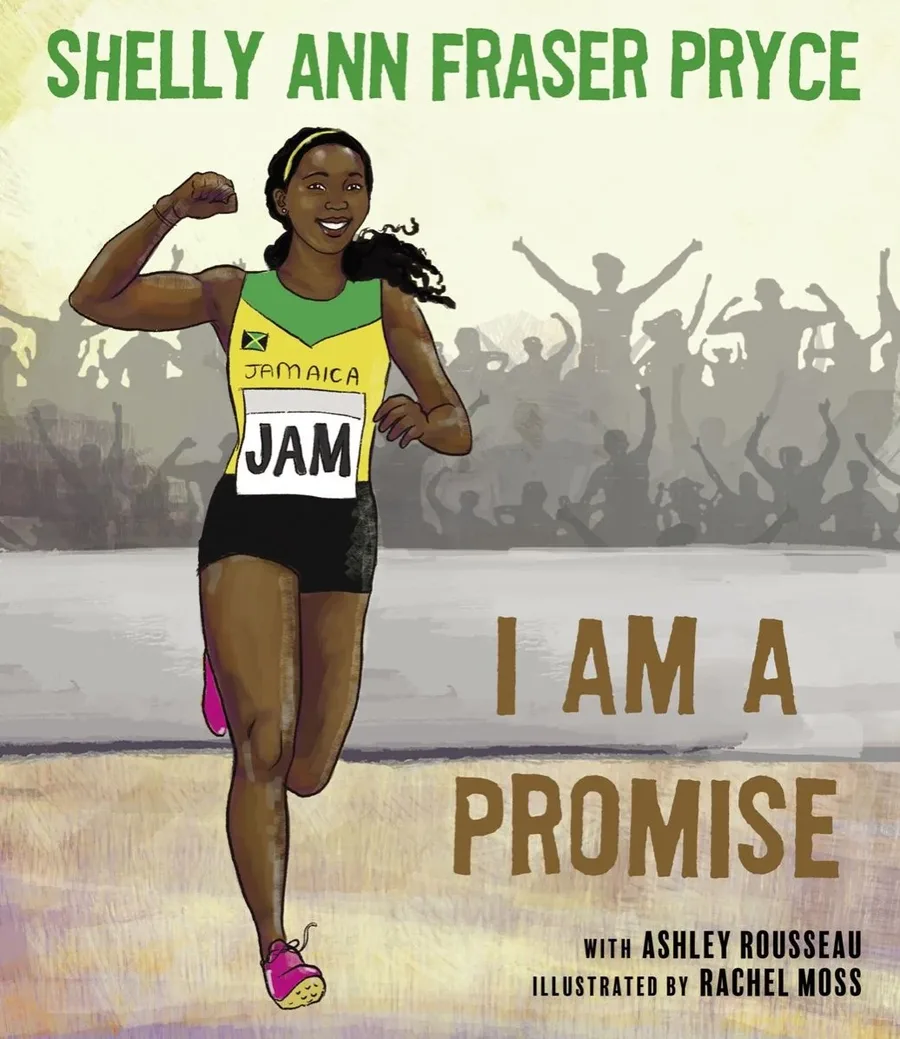 I Am a PromiseShelly Ann Fraser, with Ashley Rousseau Pryce, illustrated by Rachel MossA runner since childhood, Jamaican Shelly Ann Price was baffled at a young age when her grandmother called her a promise. Shelly continued to run through adolescence, and was selected to represent Jamaica in the 2008 Olympics. An eventual three- time Olympian and holder of six Olympic medals, Shelly Ann Price set numerous women’s track records in competitions all over the world. As an adult, she came to understand why her grandmother and others described her as a promise: To her nation and her supporters, to her family, and to herself, she was a promise to “always be the best I can be.”Biography, Autobiography, and MemoirView book details
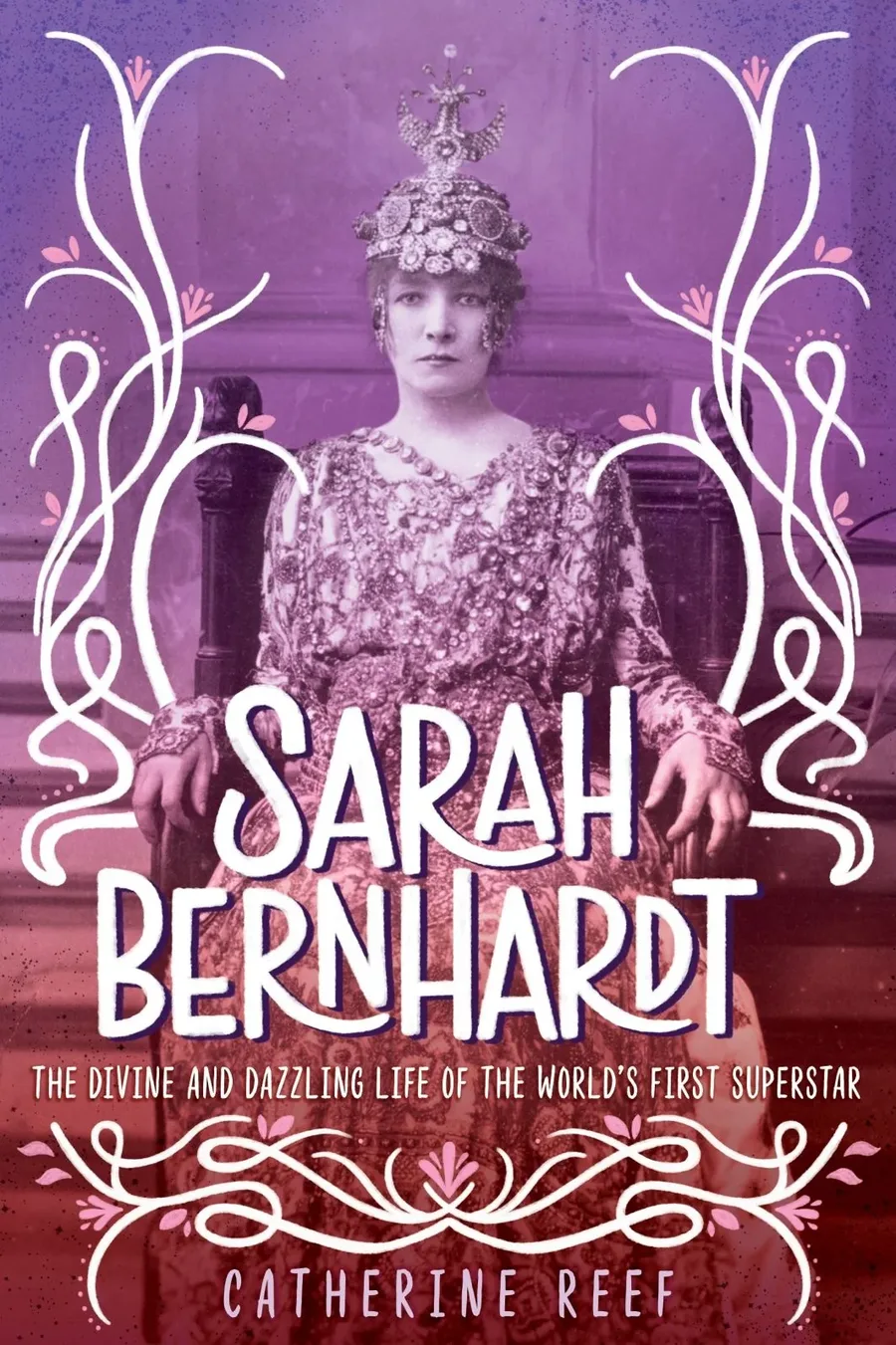 Sarah Bernhardt: The Divine and Dazzling Life of the World’s First SuperstarCatherine ReefActor Sarah Bernhardt was a stage and cultural icon of the 19th and early 20th centuries; hers is a name still sometimes referenced in theater circles and beyond. A woman defined by a strong will and generous character, the fascinating Bernhardt was born and raised in France, the daughter of a courtesan in a society where this was not harshly judged. Bernhardt’s talent was apparent by the time she was a young woman and she pursued a career on stage with intelligence and passion, while her compassionate off-stage endeavors included volunteering during the Franco-Prussian War. During the Dreyfus Affair, when anti-Semitism saw Alfred Dreyfus scapegoated in a military scandal with far-reaching societal implications, Bernhardt, of Jewish descent, staunchly defended Dreyfus, even at the expense of her relationship with her beloved only child. Following an injury late in life, Bernhardt lost a leg, but like all the challenges that had come before, she met it with fortitude, continuing to take charge of her career and perform. A visual as well as performing artist, Bernhardt’s electric talent and drive are palpable in this account that includes occasional black-and-white photographs, and an author’s note, timeline, sources, and bibliography.Biography, Autobiography, and MemoirView book details
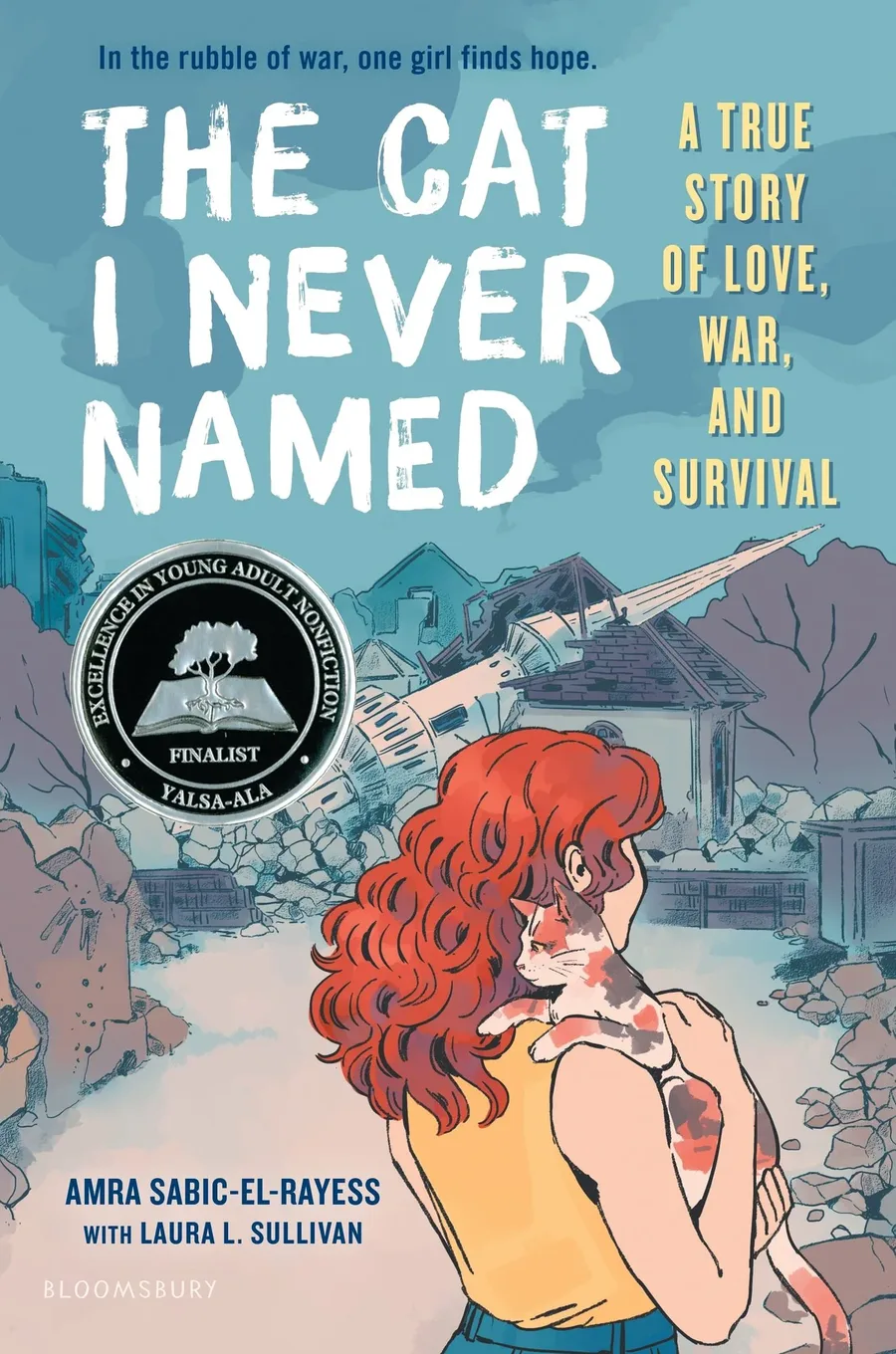 The Cat I Never Named: A True Story of Love, War, and SurvivalAmra Sabic-El-Rayess with Laura L. SullivanAmra Sabic-El-Rayess was a Bosnian teenager in the city of Bihać in the early 1990s when Bosnians, Serbs, and Croats were at war. This account chronicles the fate of her family and the small calico cat, Maci, which she finds early on in the conflict and becomes a good luck talisman throughout the period of brutal ethnic cleansing and the gradual improvement of their lives. Amra’s family, secular Muslims, was spared the worst of the genocide, but knowledge that many men and boys are being killed by Serbs, and of what often happens to women and girls during times of conflict, makes her fear palpable. The war disrupted Amra’s pursuit of education, but she sought out every possible opportunity. And war didn’t get in the way of falling in love, a young romance she thought would last. Above all, this is the story of family love, however, and their experience through displacement, threat of starvation, a return to home, and efforts to carve out a new means of survival. This account would have benefited from a preface providing an overview of the war for young adult readers today, but that doesn’t detract from its impact. An author’s note explains how she took creative liberty with her personal timeline as it relates to some events.Biography, Autobiography, and MemoirView book details
 Chance: Escape from the HolocaustUri ShulevitzShulevitz describes his experiences during and after World War II in a narrative recounting his life from age four to young teenager. During that time, he and his parents, Jews, fled Poland for Russia, ending up in a work camp in Siberia. When they were released from the camp they made their way south, eventually settling in Turkestan for the duration of the war. After the war they went first to a displaced person camp in Germany and then to France before immigrating to Israel. Hunger is a recurring theme; even with all his parents did to try to feed and protect him, his longing for food was constant. While the narrative tone is not childlike, it is written with a remarkable matter-of-factness that captures the sense of a child witnessing, experiencing, and describing events that he doesn’t always fully comprehend (and in some cases, still doesn’t today). The many wonderful visual elements incorporated throughout include stick figures echoing his early childhood works to drawings and sketches that show his development as a young artist to graphic panels with dialogue. There are also a handful of photographs. Larger-than-typical typeface makes for a hefty but accessible volume.Biography, Autobiography, and MemoirView book details
 Exquisite: The Poetry and Life of Gwendolyn BrooksSuzanne SladeGwendolyn Brooks grew up in Chicago, in a poor family who nonetheless “owned great treasure—a bookcase filled with precious poems.” Her love of poetry took root in these early years, when her father would recite poems to the family. By age seven, Gwendolyn was writing poems of her own, her passion encouraged by her mother, who believed she would be a great poet someday. She was prolific, writing about everything, submitting a few poems to a newspaper when she was 11, which became her first published work. She continued to write (while holding other jobs) through adulthood, drawing inspiration from her South Side Chicago neighborhood, eventually landing a book deal, and winning the Pulitzer Prize for her second volume of poems. Slade’s lyrical picture-book biography captures both the poetry and the persistence of a remarkable woman who always found time to work on craft. Cabrera’s expressive acrylic paintings show the poet at work—always observing, thinking and writing, wearing her trademark black horn-rimmed glasses.Biography, Autobiography, and MemoirView book details
Contemporary People, Places, and Events
10 selections
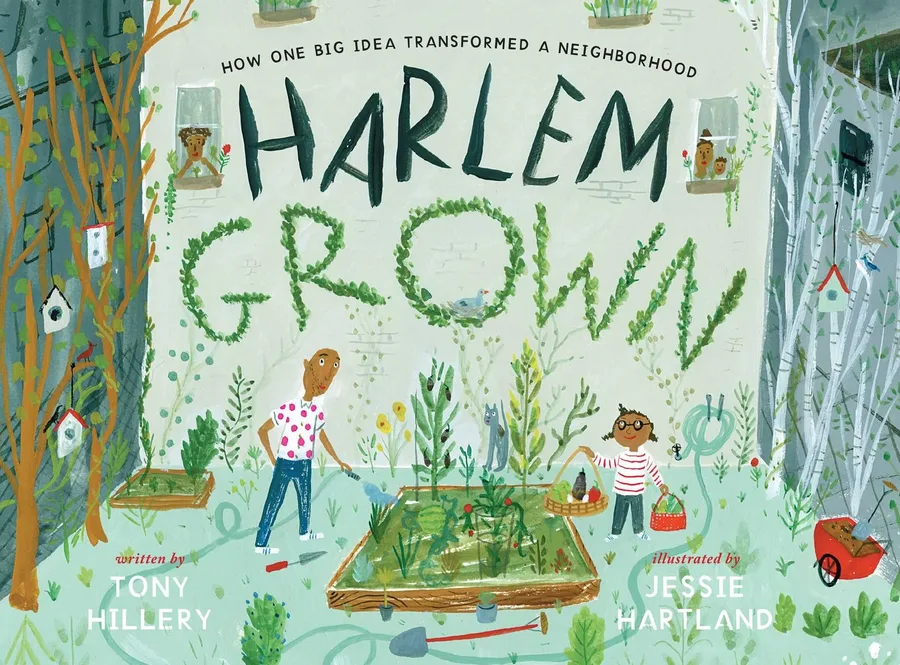 Harlem Grown: How One Big Idea Transformed a NeighborhoodTony Hillery“Once, in a big city, in a bustling neighborhood…” an empty lot full of trash sat across the street from a school. The city was New York, the school was P.S. 175, and Mr. Tony was a volunteer at the school. Mr. Tony looked at the lot, and the kids, and saw a problem he wanted to fix and possibility he wanted to inspire. Mr. Tony, who is African American, spearheaded the effort to transform the garbage-strewn lot into the Harlem Grown community garden, involving the kids from the school and others from the community. This lively account by Tony Hillery (aka “Mr. Tony”) of the Harlem Grown garden project he started and still leads today is paired with sprightly, stylized illustrations. An afterward from Tony Hillery tells more about the project, including how little he know about gardening when he began, and how large it’s grown since then (12 sites across Harlem). There is also information on how to “Start a Garden Anywhere.”Contemporary People, Places, and EventsLexile Text Measure AD540LATOS Book Level 2.4View book details
 Call Me American: The Extraordinary True Story of a Young Somali ImmigrantAbdi Nor Iftin. Delacorte PressAbdi’s family, of Somalia’s Rahanweyn clan, lived a content, nomadic life before a drought in the 1970s forced his parents to the city of Mogadishu. When Abdi was six, a short war with Ethiopia followed by a tribal civil war brought utter devastation. Abdi’s infant sister died of starvation, while Abdi spent his childhood days looking for ways to earn money to buy food for his family. He hated school, where he was beaten if he failed to memorize passages of the Quran, and loved American movies— watched at night on a neighbor’s tiny tv. His love for Black American culture and music earned him the nickname “Abdi American.” As a young adult he met an American journalist and began recording a “diary” for an NPR program. This led to an American woman organizing “Team Abdi” to help him fulfill his dream of immigrating to the United States. Still, it took years, incredible determination, and luck to finally get a U.S. visa. In Maine, living with his generous sponsor, life was better but not easy; Abdi faced racism that he likened to the tribalism of Somalia. Abdi’s compelling account is an incredibly balanced perspective —he never makes sweeping generalizations about anyone or anything—in a memoir revealing how difficult it can be to enter the United States.Contemporary People, Places, and EventsView book details
 Stand Up! Speak Up! A Story Inspired by the Climate Change RevolutionAndrew Joyner. Schwartz, Wade BooksTwo-word phrases ending with “up” (Wake up / Meet up / Signs up / Rise up / etc.) show a young white girl joining other children in a climate change protest. After she and her parents “stay up” to watch the news coverage of their protest, she can’t stop thinking about the images she’s seen on the news about climate disasters and she talks her parents into joining her at a town hall meeting to get adults involved in the movement. The black-and-white cartoon illustrations with touches of green leave a lot of space for children to interpret and talk about what is happening on every page (including what the girl is feeling) as the story chronicles her involvement and growth an activist. The book concludes with a short profiles of fourteen diverse young climate change activists from around the world.Contemporary People, Places, and EventsView book details
 In Search of Safety: Voices of RefugeesSusan KuklinFive refugees who’ve settled in Nebraska tell the stories of their lives before coming here, and of their journeys to and lives in the United States. Fraidoon, from Afghanistan, worked for years as a translator for the United States military and private contractors and ended up with a fatwa on his head. Nathan, a member of the Karen ethnic group in Myanmar, was born in a refugee camp in Thailand because of persecution of Karen people in their homeland. Nyarout grew up in South Sudan, in the midst of civil war. Recent arrival Shireen is Yazidi from Iraq; she was captured and tortured by ISIS. Diudonné, from Burundi, is mixed Hutu and Tutsi; he escaped to a refugee camp during the massacre of Tutsis by Hutus. Once here, each has faced new challenges, and their ability to cope and thrive is influenced by many things, from cultural considerations to past experiences to ongoing support. Some, like Nathan, who came when still a child, feel at home here. Some, like recent arrival Shireen, struggle with the immense trauma they’ve experienced. Some, like Diudonné, have found and created lasting community. These five individuals have very different stories but collectively they illuminate some of the dangers, violence, and other traumas from which refugees are fleeing when they seek asylum in our country.Contemporary People, Places, and EventsView book details
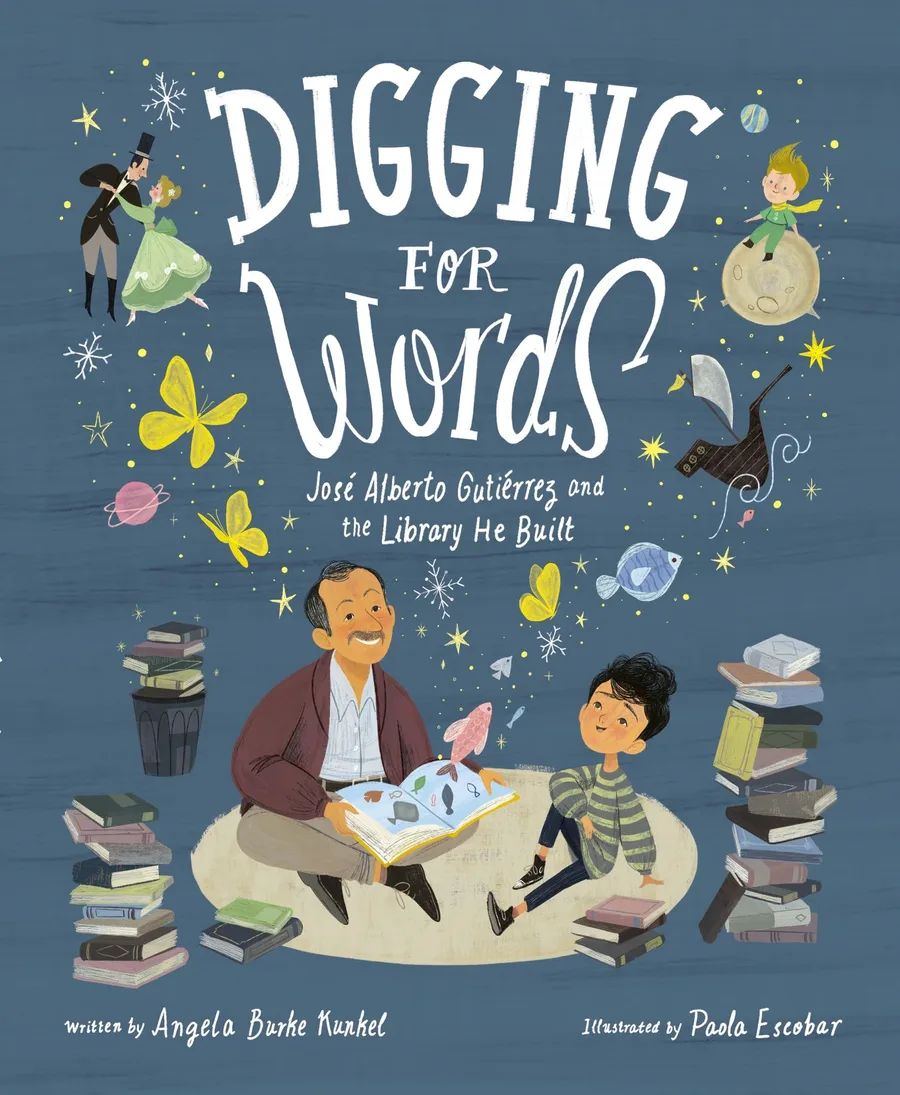 Digging for Words: José Alberto Gutiérrez and the Library He BuiltAngela Burke KunkelA fictionalized story based on José Alberto Gutiérrez, a man who, in his job as a garbage collector in Bogotá, Colombia, began collecting cast-off books and started a library for his neighborhood. The narrative begins with a small boy, also named José, eagerly awaiting Saturday before introducing his friend, Señor José, and his work. Although Bogotá has libraries, it doesn’t have enough to reach the huge population, including the barrio where Little José lives, and he looks forward to visiting Señor José’s library every weekend. The engaging writing uses descriptive language to bring the people and the city they live in to life. The often captivating artwork give readers a good sense of the vibrant Colombian capital, and the particular neighborhood where the two Josés live. An author’s note offers additional information about the real José Gutiérrez, including photographs of him in his truck and greeting local children in his library.Contemporary People, Places, and EventsView book details
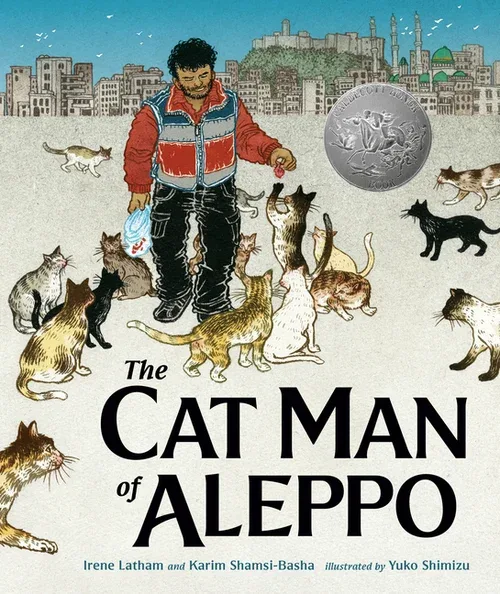 The Cat Man of AleppoIrene Latham, Karim Shamsi-BashaAlaa is an ambulance driver who stayed in his beloved city of Aleppo through the bombings during the Syrian war and has made it his mission to save the cats left behind when many people were forced to flee. In this lightly fictionalized account, the language is simple and straightforward as it describes his efforts, which led to an outpouring of financial support from around the world, enabling him to construct a building to house the cats. Alaa soon branched out to save other abandoned animals and then expanded his efforts to build a children’s playground. Excellent ink-and-watercolor illustrations bring the people and setting to life in this engaging account. Each person (and cat) is distinctive, and readers will be easily able to identify the central character by his stocky build and red sweater. While the story is heartwarming, it doesn’t ignore the human toll caused by the war in Aleppo, nor does it minimize the harsh realities of surviving there. Notes in the back of the book describe the research done by the book’s creators.Contemporary People, Places, and EventsLexile Text Measure AD610LATOS Book Level 3.6View book details
 Stamped: Racism, Antiracism, and You: A Remix of the National Book Award-Winning gJason Reynolds, Ibram X. KendiThis necessary book for our time is labeled a “remix” of Kendi’s 2016 National Book Award winner published for adults, Stamped from the Beginning. It’s an accurate description: Reynolds’ adaptation is intimate and conversational, a significant departure from the original academic tome. Frequently speaking directly to young readers in his distinctive and recognizable voice, Reynolds makes hard truths accessible in the tone of a trusted friend breaking it down with honesty, and even occasional humor. After documenting the origins of racist ideas, he introduces three categories of people based on their beliefs: racist, assimilationist, and anti-racist. This is followed by a chronological exploration of the racial politics of United States, from the Puritans through the Obama era. Along the way are examples of historical people, from Cotton Mather to W.E.B. DuBois to Angela Davis, showing how each exemplified the definitions of racist, assimilationist, and anti-racist. The narrative stops just before 2016, but readers have been given the foundation to begin to evaluate our current era on their own. Although Stamped is a real departure from Reynolds’ fiction and poetry, it still bears his trademark style, which will make it extremely appealing to his fans, and may even win him some new ones. An Afterword written directly to teens is especially moving and powerful.Contemporary People, Places, and EventsLexile Text Measure 1000LATOS Book Level 7.4View book details
 How to Solve a Problem: The Rise (and Fall) of a Rock-Climbing ChampionAshima ShiraishiThe 19-year-old Japanese American author is a climbing phenomenon who started entering elite competitions at age eight, and has broken bouldering (free climbing) records from the time she was ten, making climbs most adults can’t accomplish. In her own voice she tells us that boulders are called “problems.” She goes on to describe how she solves one particular problem, visualizing each section as concrete imagery. And she also reflects on what she learns from each failure (fall). The cartoon- style illustrations tackle the challenge of depicting visual thinking in an unusual narrative that serves as a great metaphor for other kinds of problem-solving and perseverance.Contemporary People, Places, and EventsView book details
 All Thirteen: The Incredible Cave Rescue of the Thai Boys’ Soccer TeamChristina SoontornvatThe rescue of 12 young Thai soccer players and their assistant coach, trapped in Tham Luang Nang cave for more than two weeks in 2018, was an effort of compassion, courage, and international cooperation. It was a feat of technology and engineering, problem-solving and logistics. Above all, it was, and is here, a riveting human story about the 12 boys and their coach and some of the many people who worked to bring them out alive. British and other divers with the requisite cave diving experience worked with Thai and U.S. military personnel to navigate the deep water and tight passages. A Thai American engineer and entrepreneur figured out a way to stem the flow of water into the cave system. Several locals organized support services for volunteers and families of the trapped players. There was far more tension and worry than moments of triumph, especially early on, and rescue was not certain—these complexities and dangers were underscored when Thai Navy Seal Saman Kunan died. Communication was challenging, not only because of the scale of the effort but because of cultural differences between Thais and westerners. Thai American author Soontornvat was visiting family in Thaliand at the start of the crisis and she, like all of Thailand, and much of the world, followed the story closely. Her thorough research, original interviews, and nuanced cultural understanding are all essential elements to this fascinating and substantial account buoyed by photographs and other visual material.Contemporary People, Places, and EventsLexile Text Measure 1020LATOS Book Level 7.2View book details
 Dragon HoopsGene Luen YangPart memoir, part history, and part riveting sports story, Yang opens his humorous graphic novel with a confession: He’s always hated sports. He’s classed himself as a nerd since childhood and even as a high school teacher hangs out with other nerds. In fact, it seems all the teachers hang out with kindred spirit groups from their own teen years. But he’s drawn to cross the divide by the power of story in 2015, when he begins hearing about the school basketball team’s current season. Seeking out the coach, he discovers they have a lot in common. Yang moves back and forth between chronicling the rest of the season—he becomes an avid follower and fan—and the lives of African American Coach Lou Richie, Richie’s former coach and mentor, Mike Phelps, and key players on the Bishop O’Dowd varsity team, the Dragons. As he relates pivotal moments that spurred each person forward, he weaves a narrative offering great depth in terms of story, plot, and characters, integrating historical context—about basketball, about society—throughout an account that is also an action-packed sports story. Yang also displays the creative side of what he’s doing as a writer and an artist, openly grappling with ethical decisions about who to include and how much to tell—or not to tell—in this fascinating, funny, and ultimately triumphant book.Contemporary People, Places, and EventsLexile Text Measure HL550LATOS Book Level 3.9View book details
Understanding Oneself and Others
7 selections
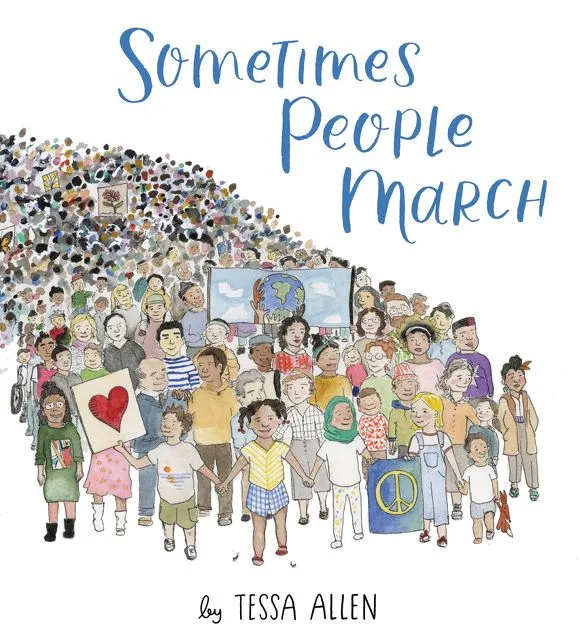 Sometimes People MarchTessa AllenAimed at a young audience, a clear, uncluttered picture-book text looks at marches and other protest activism through a positive filter. “Marching is something people do together when they want to resist injustice or when they notice the need for change.” The ink and watercolor illustrations make good use of white space, and showcase diversity in both contemporary and historical examples, including voting rights, child labor, the environment, LGBTQ, disability, migrant agricultural workers, Black Lives Matter, and more. There are recognizable spot illustrations of Colin Kaepernick taking a knee, the Newsies Strike, and marchers on the Edmund Pettus Bridge. It ends with a message of strength in numbers and the willingness to act. A two-page endnote lists “Movements, Marches & Key Figures in the Art” with a sentence or two about each, and the relevant page number.Understanding Oneself and OthersView book details
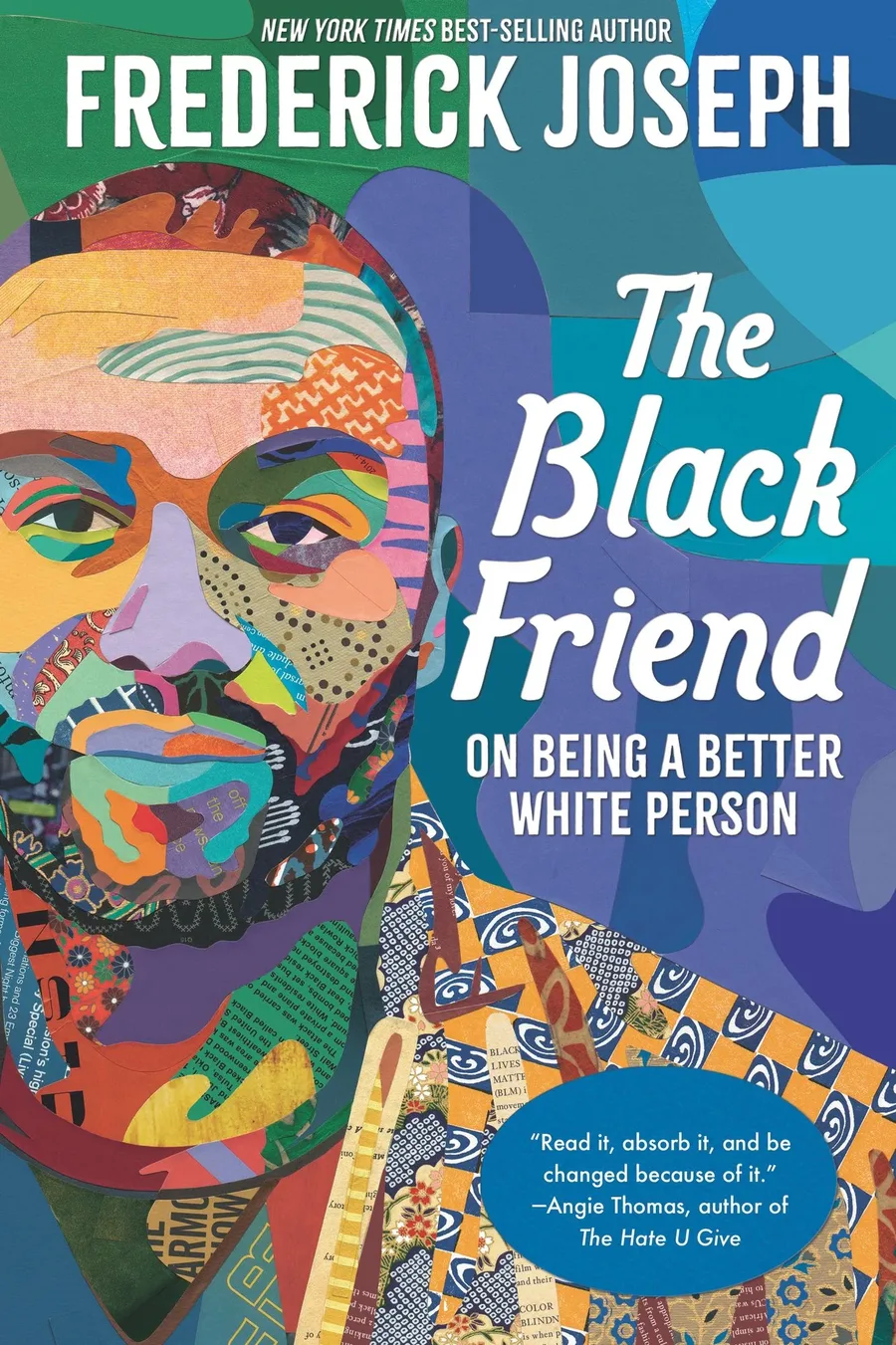 The Black Friend: On Being a Better White PersonFrederick JosephUsing vignettes of his own experiences with racism to delineate his message, author Joseph crafts a highly accessible and engaging guide to racism and anti-racism for young white people. This guide covers it all. From basics (stereotypes, cultural appropriation, the necessity of correctly pronouncing people’s names, terms one should and should not say) to more complex situations and concepts (intersectional oppression, responding to a friend’s racism, recognizing bias and assumptions), Joseph challenges readers to become not an ally, but an “accomplice” in fighting racism. Short interviews with activists, writers, rappers, lawyers, and others peppered throughout the book provide additional perspectives and insight. In the back matter, “an encyclopedia of racism” and lists of people to research, books to read, movies to watch, and songs to listen to encourage continued learning. Genuine and direct, Joseph points out that it is not the duty of Black people to educate white people; rather, this book is “a gift, in the form of an opportunity.”Understanding Oneself and OthersView book details
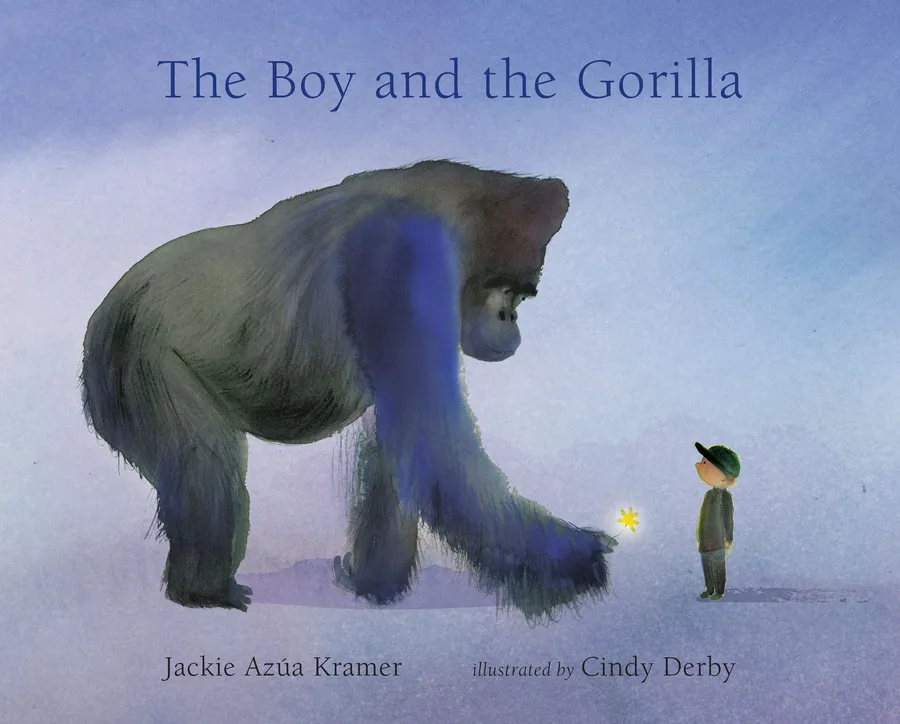 The Boy and the GorillaJackie Azúa KramerWhen a young white boy is grieving over his mother’s death, a gorilla appears to act as a comforting presence and to answer the boy’s questions. “How do you know when someone dies? A person’s body stops working. Like their heartbeat? Yes.” All the while, the boy’s father is in the scene, also obviously grieving quietly on his own. Eventually, he replaces the gorilla as the comforting presence who can answer his son’s questions. The gorilla is not anthropomorphized and he’s huge, like grief itself, in this lovely, tender story reminiscent of Charlotte Zolotow’s Mr. Rabbit and the Lovely Present in the presence of a wise but easy-going animal companion who answers a child’s innocent but difficult questions. The soft-edged illustrations perfectly complement the gentle, restrained tone of the narrative.Understanding Oneself and OthersLexile Text Measure 92LATOS Book Level 1.2View book details
 Where Lily Isn’tJulie PaschkisWhen a young white girl’s beloved dog, Lily, dies, she misses her terribly. She thinks about all the daily activities where Lily is missing. Lily isn’t on the rug next to the girl’s bed when she wakes up in the morning, and she’s not next to her chair at breakfast, waiting for some food to fall on the floor. When the postal carrier comes, there’s no barking —“The mail just drops through the slot and falls.” While there have been many picture books about a child facing the death of a pet, what makes this one distinctive is the child’s realistic observations of changes in the ordinary daily routine. There’s sadness, but the book’s focus is the quieter emotion of an ongoing absence (rather than the tears and harsh grief at the time of the loss), as well as the fact that there’s no new puppy at the end —because often times there isn’t. The understated art, created with hand-cut stencils and gouachef, is a good match for the emotional tone of the book.Understanding Oneself and OthersView book details
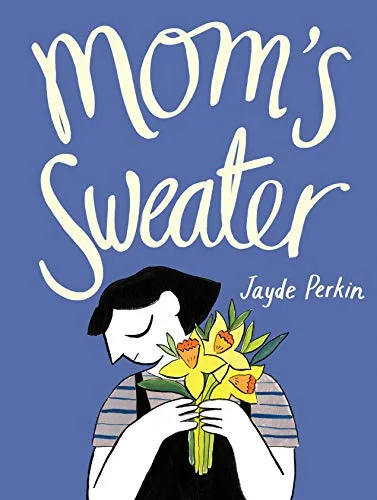 Mom’s SweaterJayde PerkinSoon after visiting her mother at the hospital, a young girl and her father get the news that her mother has died. Both the blur of activity and the grief that follow are the subject of this spare, straightforward first-person narrative. Once everything else gets back to normal, grief begins to follow the girl, a dark space around her. Eventually, it settles into one of her mother’s old sweaters that the girl begins to wear. Her dad tells her that the grief “is like Mom’s sweater. The sweater stays the same size but I will eventually grow into it. The grief may stay the same size. But my world will grow bigger around it.” It’s an apt and hopeful metaphor in a picture book distinct for the directness with which it deals with death, grieving, loss and healing. Stylized illustrations show the girl and her family as white, living in an ethnically diverse community.Understanding Oneself and OthersView book details
 Outside, InsideLeUyen PhamA gently reassuring narrative explores the hardships and triumphs of the COVID-19 pandemic lockdown without directly naming the virus. “Something strange happened on an unremarkable day…” A diverse neighborhood street, once filled with pedestrians, bikers, shoppers, and vehicles, becomes silent and empty. “Everybody who was outside… went inside. / Everyone. Everywhere. All over the world.” Detailed illustrations offer a realistic window into people’s lives as they adjust to the sudden change. Family members conduct their daily lives in small, shared spaces. Hospital scenes show essential workers caring for, and sometimes losing, patients. Despite challenges, worry, and grief, people are creative and resilient. Birthday parties become drive-by events. Encouraging signs pop up next to empty playgrounds. “Outside, the world kept growing. / Inside, we kept growing too.” Ending on a hopeful note, the narrative reminds readers that the world sheltered in place because it was “the right thing to do.”Understanding Oneself and OthersLexile Text Measure AD470LATOS Book Level 3.2View book details
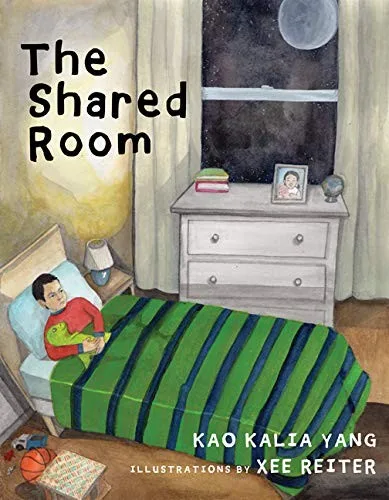 The Shared RoomKao Kalia Yang, illustrated by Xee ReiterA Hmong family in St. Paul, Minnesota, copes with grief several months after the death of one of the four children. Everything is quiet in their home and sadness fills all the rooms: “The day she died now existed as a bubble above all the other days on the family’s calendar, a fragile and fierce floating thing, untethered to the earth, well below the clouds but beyond anyone’s reach.” The girl’s bedroom remains just as she had left if on the summer day she drowned, while the two brothers share a bedroom in their three-bedroom house, and their baby sister sleeps in their parents’ room. One “balmy winter day” the mother asks the oldest boy if he’d like to move into his sister’s room. He would. But when he begins to hear his mother’s answers to his questions (Where will I sleep? In your sister’s bed. Where will I put my clothes? In her drawers), he breaks down, shedding tears he’s been holding in for a long time. Still, he helps his mother clean out his sister’s room and falls asleep that night looking out the window, realizing he now has the same view his sister had had for so many years. This beautifully written story provides a remarkable portrait of a particular family’s grief. The illustrations by a Hmong artist include many specific cultural details that will especially resonate with Hmong families.Understanding Oneself and OthersView book details
The Arts
6 selections
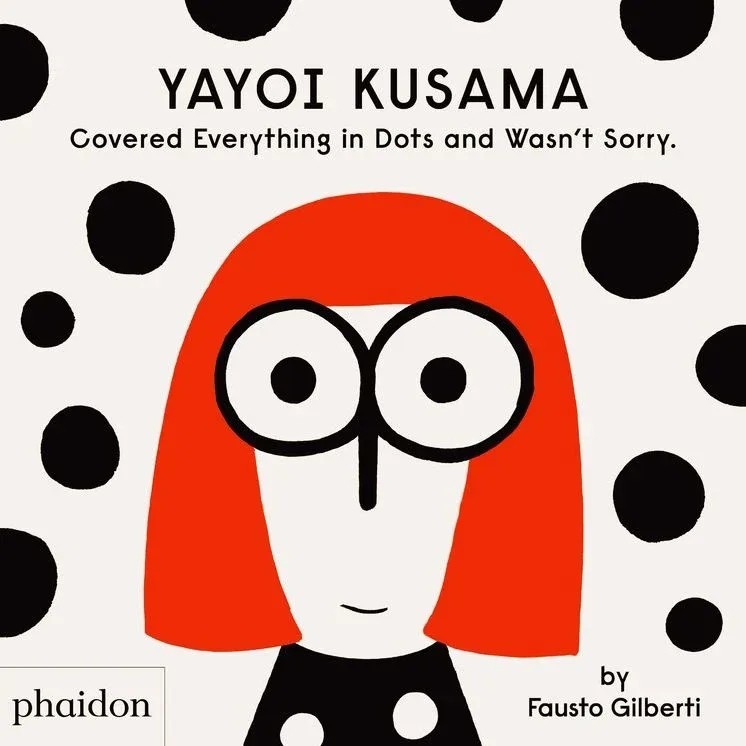 Yayoi Kusama Covered Everything in Dots and Wasn’t SorryFausto Gilberti“My name is Yayoi. I’m an artist and I’d like to tell you my story.” So begins the fictionalized first-person narrative about the life and work of avant-garde artist Yayoi Kusama who left Japan as a young woman to come to the United States “where artists were doing exciting new things.” Yayoi’s “new thing” was dots. She put them everywhere in her art, and then expanded to “soft, cushioned shapes …which I used to fill rooms, boats, and shoes, and cover couches, armchairs, and hats…” Today she continues to make her daring art and she continues to be a celebrated artist. Gilberti depicts Kusama and her work entirely in black-and-white, and still manages to capture the distinctive nature of the unusual artwork of this singular visionary.The ArtsView book details
 World of Glass: The Art of Dale ChihulyJan Greenberg, Sandra JordanA lively text and stunning color photographs offer insight into the life and work of the iconic glass artist, whose installations are featured in museums and public spaces all over the world. Chihuly would be the first to say that as a young man he was rather aimless, a lazy student who drifted from place to place, trying to find his niche. In a weaving class he began to experiment with color and form, incorporating glass into his weaving. His first experience with blowing glass led him to a lifetime of working with teams of fellow glass blowers who would help bring his visions to life. After a brief account of Chihuly’s life story to-date, Greenberg and Jordan focus on Chihuly’s techniques, and then introduce many of his magnificent installations, which are found mostly in urban areas and the natural world. The authors based much of their book on in-person interviews with the artist and the rare opportunities they were offered to watch the maestro at work. (Chihuly received his MFA from UW- Madison.)The ArtsView book details
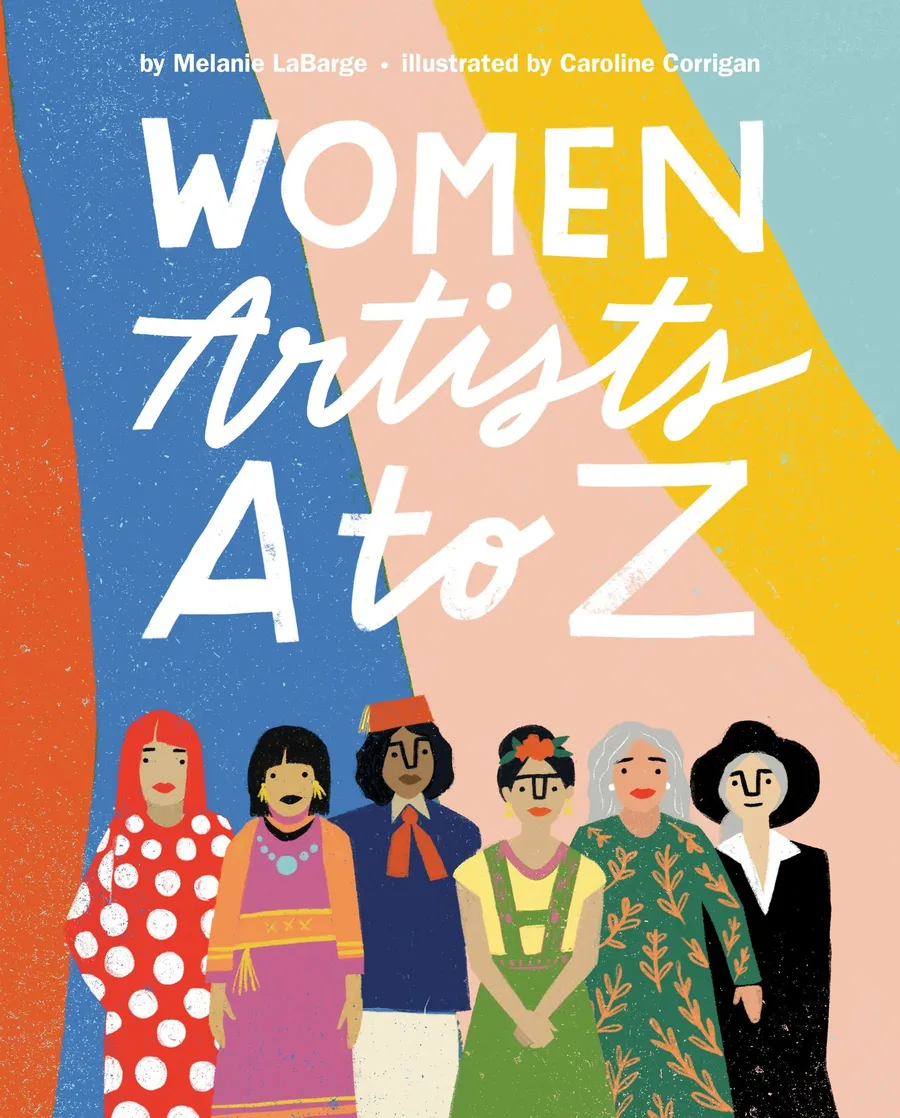 Women Artists A to ZMelanie LaBarge, illustrated by Caroline CorriganIn this accessible and arresting alphabet book for older readers, the alphabetical elements highlight artistic themes, media, and techniques as a way to engagingly introduce racially and culturally diverse women artists. “A is for Angel” in the paintings of Mirka Mora. “H is for Horse” in the art of Jaune Quick-to-See Smith. “I is for Ink” in the work of Elizabeth Catlett. “P is for Pottery” in clay pieces by Maria Martinez. “V is for Veil” in the paintings of Helen Zughaib. Each page spread focuses on a single artist or, in one case, group of artists (“Q is for Quilt” features the Gees Bend Collective) and provides a brief introduction to their work. Short biographical sketches of the artists appear at volume’s end. (Most but not all lived during the 19th and 20th centuries). Matte, digitally rendered illustrations provide a unifying visual sense across the volume even as they also emphasize distinctive elements called out in the artists’ work. A framing visual story shows a girl and woman viewing a “Women Artists A to Z” exhibit.The ArtsView book details
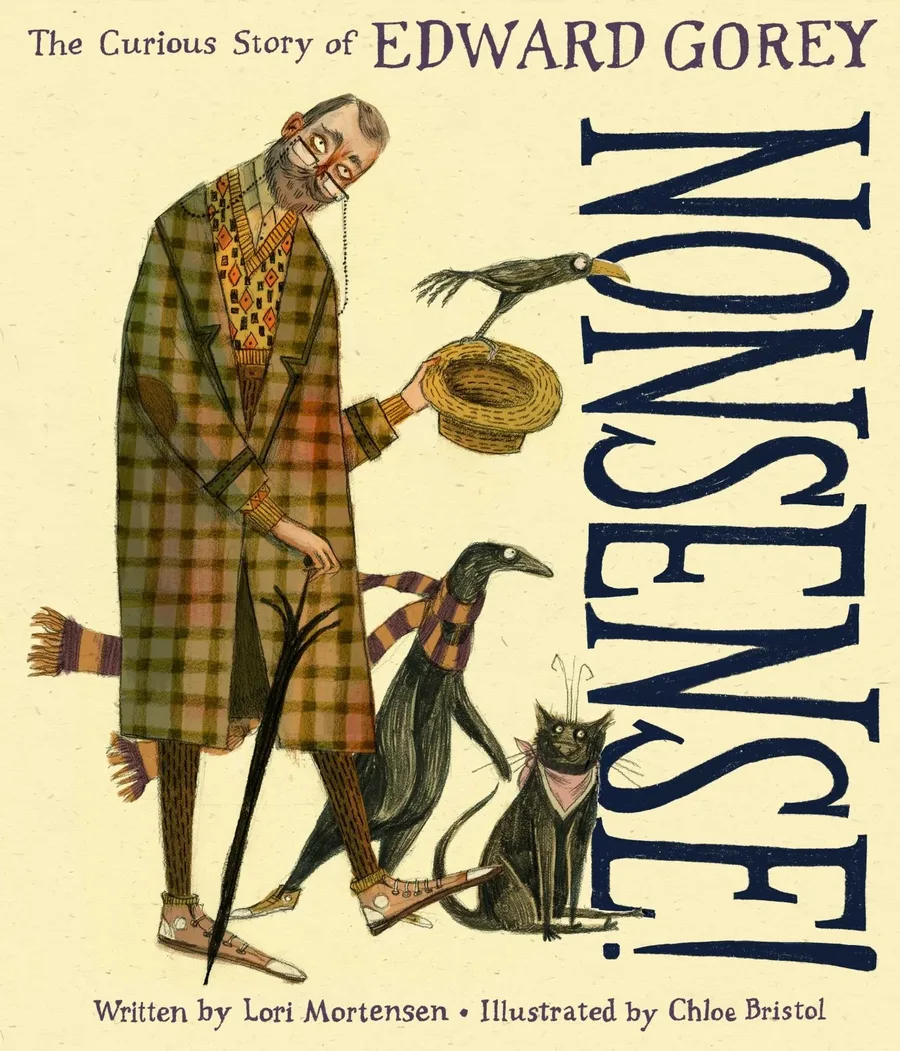 Nonsense! The Curious Story of Edward GoreyLori MortensenFrom the opening welcome of “Greetings, Dear Reader!” this clever biography invites children to share the experiences and influences that shaped the unique creative output of writer and illustrator Edward Gorey. From a precocious boy who taught himself to read, to an army clerk, and then an eccentric Harvard student, Edward wasn’t sure what he wanted to do with his life (“Alas and alack, he did not”), but through it all, he wrote. It wasn’t until working in a publisher’s art department that Edward began writing and illustrating his own books. Although everyone was not a fan of his “odd and unfortunate endings,” Edward “liked writing and illustrating stories that made readers uneasy.” Dark hues and elongated figures pair comfortably with a distinctive conversational narrative, working together to capture Edward Gorey’s sensibility as a writer and artist while celebrating his singular intersection of silly and sinister.The ArtsView book details
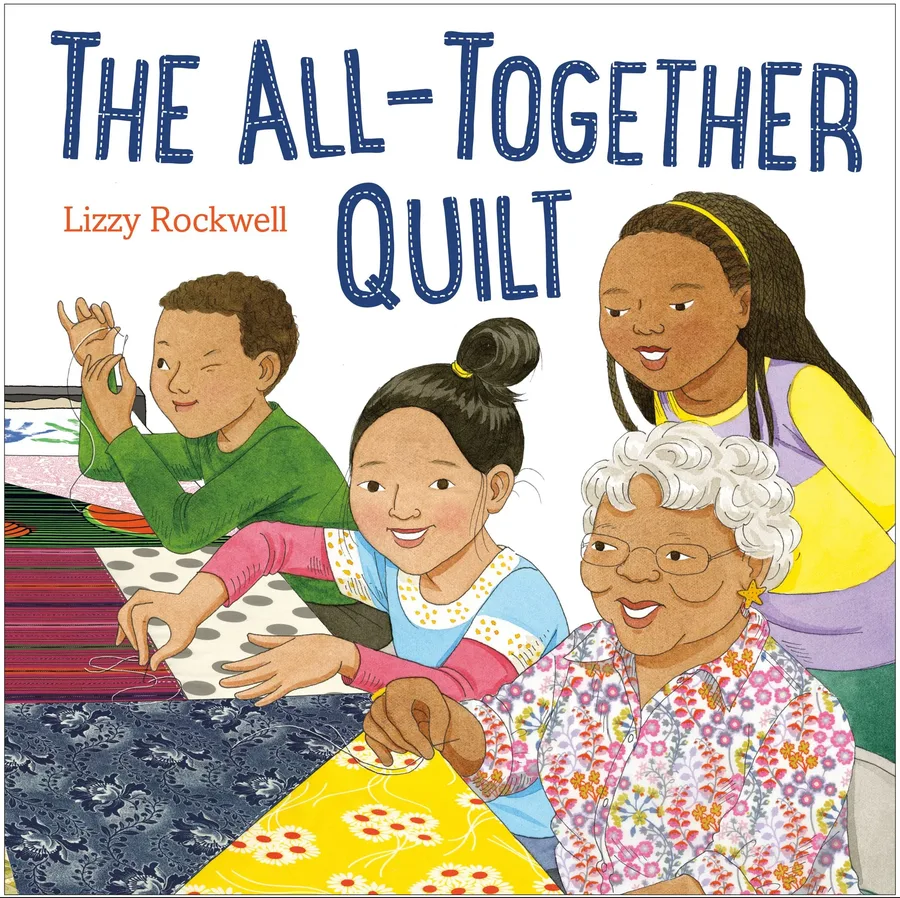 The All-Together QuiltLizzy Rockwell, illustrated by Lizzy RockwellEvery Friday Jennifer and friends meet at the community center to work on making a quilt. Each boy and girl is paired with an older adult who helps them with tracing, cutting, pinning, and sewing their squares until they have eight pairs of squares, and a center square with a peace symbol created by one quilter. With all the pieces ready, they put them together to form nine possible combinations before agreeing on the one they like best and starting work on a border that will feature the children’s own handprints. The diverse, mixed-age group of quilters portrayed here is based on a real community quilt project at a Senior Housing Complex in Norwalk, Connecticut, a photo of which is included at the back of the book. The endnotes also include nine classic quilt blocks and information about each fabric shown in the book.The ArtsView book details
 R-E-S-P-E-C-T: Aretha Franklin, the Queen of SoulCarole Boston Weatherford, illustrated by Frank MorrisonA single word introduces the rhyming couplet on each page of this notable singer, musician, and activist’s biography. “M-U- S-I-C: Hand-clapping gospel—The Franklins’ pedigree. / Parents, children praise the Lord in stirring harmony.” Born into a musical family, Aretha made her first gospel album at the age of 14, later expanding into rhythm and blues. As a voice of the civil rights movement, she worked to raise funds and performed at political events, and decades later sang at President Obama’s inauguration. Generously-sized pages and oil paint illustrations honor the immense talent and success of the Queen of Soul, while an author’s note fills in details of her life and includes a list of Aretha Franklin’s greatest hits.The ArtsATOS Book Level 4.0AR Interest Level Middle Grades (MG 4-8)View book details
Poetry
8 selections
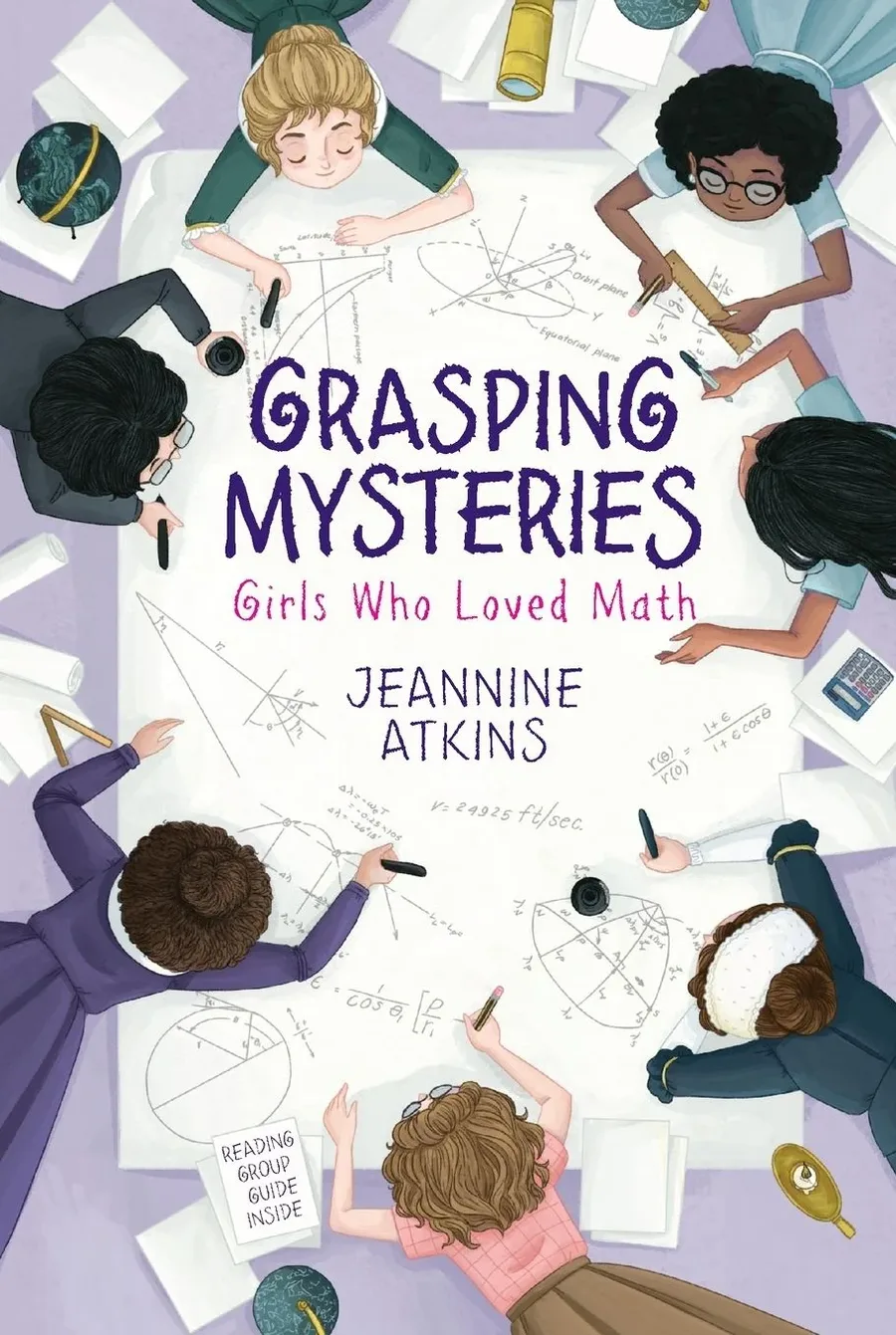 Grasping Mysteries: Girls Who Loved MathJeannine AtkinsAtkins profiles seven women whose groundbreaking work drew on their love of and aptitude for math: Caroline Herschel (1750-1848; discovered comets, mapped stars); Florence Nightingale (1820-1910; used math to create charts showing how sanitary practices impacted outcomes for patients during Crimean war, changing medicine); Hertha Marks Ayrton (1854-1923; math major at Girton, one of first British colleges for women; electrical engineer and inventor); Marie Tharp (1920-2006; mapped the ocean floor); Katherine Johnson (1918-2020; NASA “computer”/mathematician who did critical work on Apollo and other programs); Edna Lee Paisano (1948-2014; statistician with U.S. census bureau who used her understanding of Native peoples as a member of the Nez Perce nation to change bureau practices in order to encourage Native people’s participation in the census); and Vera Rubin (1928-2016; astronomer who discovered evidence for existence of dark matter in the universe). The individual poems are wonderfully crafted; collectively they give sense of each women’s life and work while also making thematic connections to one another, and other groundbreaking women. Johnson is African American, Paisano Nez Perce, the others are white (Rubin Jewish). A fine companion to her previous volume Finding Wonders, about women in science, this inspired work concludes with notes and a brief description of her research into each woman.PoetryView book details
 A Place Inside of Me: A Poem to Heal the HeartZetta ElliottA single illustrated poem touches on the multitude of feelings—joy, sorrow, fear, anger, pride, peace, compassion, hope—that all live deep inside a young Black boy as he moves through the world on his skateboard. The background images show scenes occurring in the boy’s life, and in the Black community at large, that inspire each of the emotions he talks about in a narrative that concludes with the boy making a statement of affirmation of self-love. The shifting perspectives of the robust illustrations underscore the multidimensional feelings and thoughts that affirm the complexity of the narrator’s emotional reality.PoetryView book details
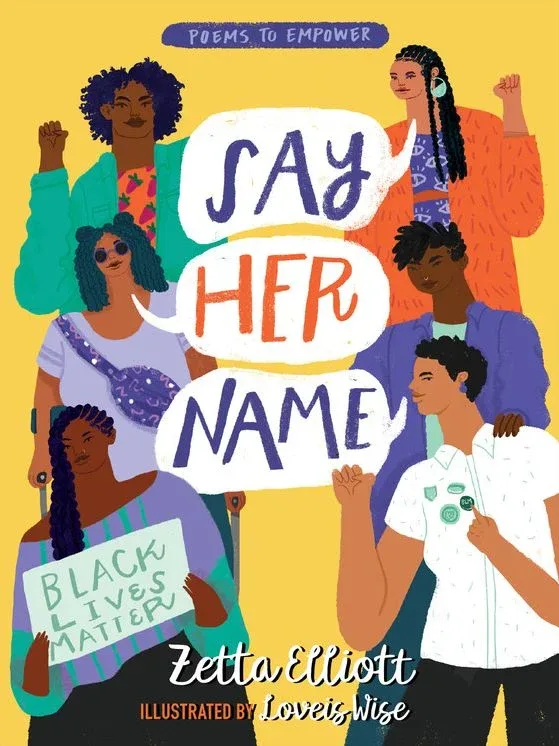 Say Her Name: Poems to EmpowerZetta Elliott, illustrated by Loveis Wise“Black girl / you are more than magic / you are a miracle …” (from “Black Girl Miracle”). A collection of poems centered on Black female experience explores themes of racism, violence, body image, misogyny, but also, so importantly, self-love, sisterhood, strength, and the miracle of survival. The majority of the poems are original works by Elliott, but four offerings Elliott refers to as “mentor poems” are from poets Lucille Clifton, Nikki Giovanni, Audre Lord, and Phyllis Wheatley. Across the collection, poems call out individual Black women and their achievements, as well as individual Black women whose lives were cut short at the hands of police or who were victims of other racist oppression. She also addresses disrespect Black women have faced by some Black men in this accounting. “This book is my way of bearing witness,” she writes in the introduction, referring to unconscionable police violence. But in this volume that is so much more than pain, she also bears witness to that miracle of survival, even as she makes clear Black women and girls should not require miracles to survive, and thrive. Notes at book’s end provide additional information about each poem, including people and events referenced and aspects of their remarkable crafting in a work also graced by spot and full-page illustrations by Loveis Wise.PoetryView book details
 Whoo-Ku Haiku: A Great Horned Owl StoryMaria GianferrariA narrative comprised of haiku follows a great horned owl family, beginning with their repurposing of an abandoned squirrel nest high in a pine tree. “Mama lays an egg / In the starlight it glistens / A moon of its own.” That egg is joined by two others, although one later falls from the nest during a crow attack and is lost to a raccoon. Eventually two owlets hatch, and are fed and protected by their parents, until the fledglings fly off to establish homes of their own. Avian daily life and natural world drama are captured in the poetic text and gorgeous ink and watercolor illustrations. Additional information about great horned owls and suggested resources are offered in an endnote.PoetryView book details
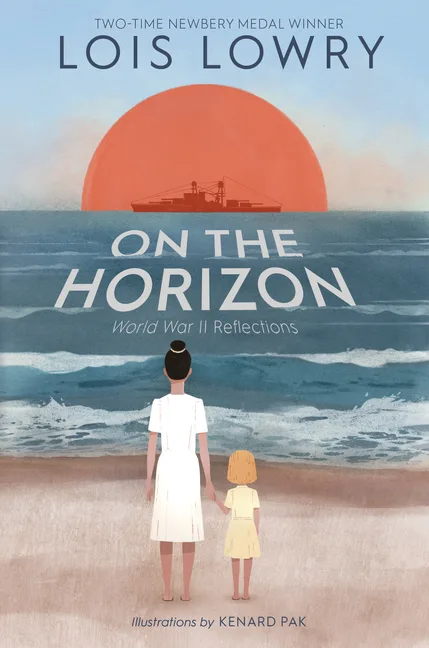 On the HorizonLois LowryPersonal and global history collide in this collection of poems that is part memoir and partly drawn or imagined from the lives and experiences of others. It begins with Lowry’s memories of her young childhood in Honolulu in the early 1940s, moving back and forth between her own recollections and tributes to individuals who’d been stationed aboard the U.S.S Arizona, which exploded and sank with over 1,100 crew members aboard when Pearl Harbor was bombed. Part 2 begins with the bombing of Hiroshima and gives brief, moving glimpses into a few of the tens of thousands of lives ended or traumatized. It also introduces a young boy named Koichi Seii, who felt the blast and saw the mushroom cloud from miles away. In Part 3, Lowry is living in Tokyo, where her father was stationed, after the war. Koichi Seii was living in Tokyo, too. One day Lowry, riding around on her green bike, watched Japanese children in a school yard, including Koichi Seii. In the final poem, she writes: “We could not be friends. Not then. Not yet. … Till years had passed, until we met / and understood the things we’d feared … / Until the cloud dispersed and cleared.” Lowry’s author’s note concluding this deeply moving book tells more about Pearl Harbor and Hiroshima, and recounts her first meeting with author/illustrator Allen Say in 1994, when they both realized they’d been living in Tokyo after the war, and that the girl Say remembered seeing outside his school yard with a green bike was Lowry.PoetryLexile Text Measure HL580LATOS Book Level 4.2View book details
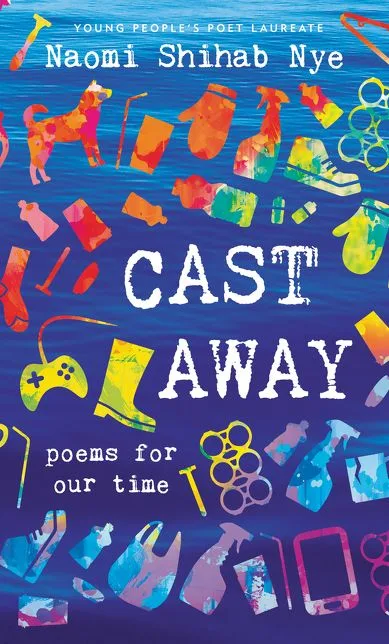 Cast Away: Poems for Our TimeNaomi Shihab Nye. Greenwillow BooksLifelong litter picker upper Naomi Shihab Nye documents and reflects on the leavings of our existence in keenly observant, probing, unabashed poems. Nye ruminates on the explosion of trash in our world and on related environmental issues, such as plastics in the ocean; on how so much is designed to be thrown away after one use (plastic straws and bottles, post-it notes …); on the mindset of those who litter, assuming picking up is someone else’s job. She also looks at the concept of “trash” through other lenses: the way something found can be a treasure or a surprise or a brief, mysterious glimpse into another life; how people are sometimes viewed as throw-away; and trash talk, including online: “People finding one another across the miles. / And plenty of trash scattered across the air. / You could disappear in there, / get lost so easily, / hours compressing into clicks.” (from “Lately the Moon”) There is despair, not only because of the trash itself but in references to disregarded lives, especially in today’s political climate, but she finds respite in quiet moments (“It’s fine not to know how to solve everything / It’s still a room to sit in”—from “Pine Cones”) and hope in surprise, and in children and teens today: “Nothing a child / ever does / is trash. / It is / practice.” (“Nothing”) She closes with “Ideas for Writing, Recycling, Reclaiming.”PoetryView book details
 Everything Comes Next: Collected and New PoemsNaomi Shihab NyeDivided into three sections, “The Holy Land of Childhood,” “The Holy Land That Isn’t,” and “People Are the Only Holy Land,” this collection includes many poems previously published in Nye’s work for youth, as well as thoughtfully chosen poems from her books published for adults. Several essays also previously published, including the often-shared, uplifting “Gate A-4,” a balm of open-hearted optimism, and the hilarious “Museum,” recounting a teenage mishap, are seamlessly woven in. Nye embraces many identities across her writing: observer, reader, reflector, friend, neighbor, kindhearted stranger, immigrant’s child, Palestinian American, activist, compassionate citizen of the world. Grounded in the value of connection, her writing embraces small moments and big ideas with equal ease across this collection that is designed with ample white space, giving a sense of airiness and light that is not unlike the feeling one gets when reading her work.PoetryView book details
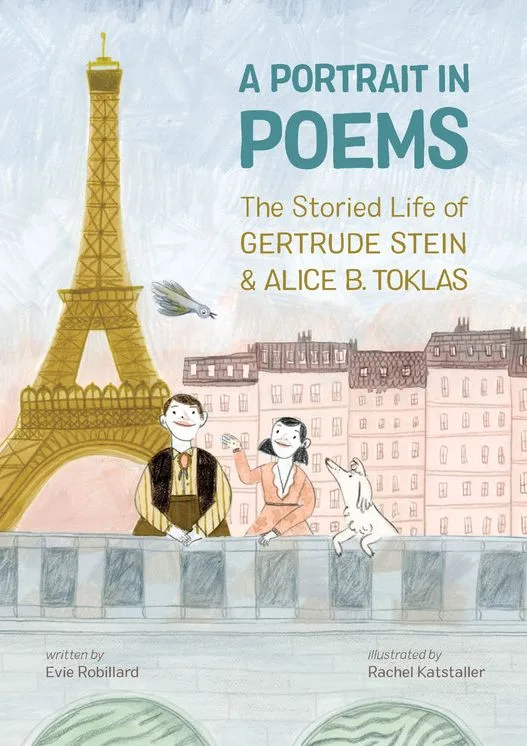 A Portrait in Poems: The Storied Life of Gertrude Stein and Alice B. ToklasEvie Robillard, illustrated by Rachel KatstallerA pitch-perfect picture book about Gertrude Stein’s life in Paris focuses on her art collection, her writing, her famous Salon, and her relationship with Alice B. Toklas. Not a word is wasted in this engaging, masterful account. Wisconsin author Robillard’s well-rounded portrait of Stein (and Toklas, too) includes just the right excerpts from Stein’s writing to give readers a sense of her singular style, her wit, her Steiny-ness. The gouache and colored pencil illustrations flawlessly echo the tone of the poems that comprise the text—both playful and profound, rather like Stein and Toklas themselves. They also extend the sense of place that was so important to Stein and her kindred spirits: Paris, specifically 27 rue de Fleurus “…a place that was once filled with paintings— / bright, bold, wild, impossible paintings. / And in that place lived a woman named Gertrude Stein / and her brother Leo. / And later on, her partner, Alice.”PoetryView book details
Concept Books
3 selections
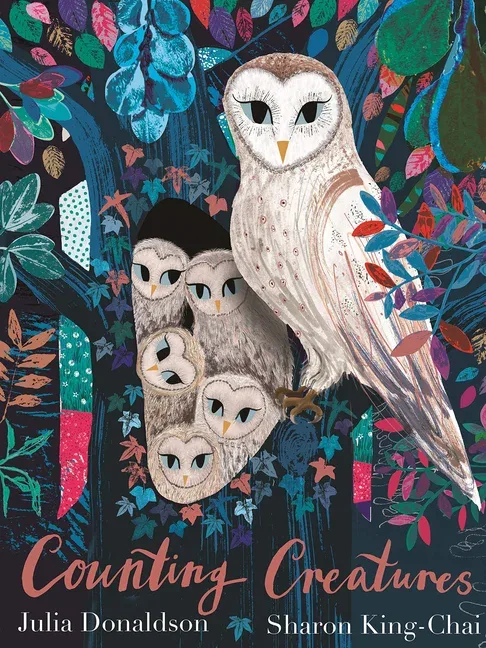 Counting CreaturesJulia Donaldson, illustrated by Sharon King-ChaiA counting book that opens showing a bat with one baby features a variety of baby animals as it counts by ones up to ten (two baby lambs, three leopard cubs, four wild dog pups, through ten potbelly piglets) before jumping to 15 turkey poults, 20 caterpillars, 25 tadpoles, and then a multitude of spiderlings. The patterned, brief text engages young children by introducing each animal’s number of babies (“This owl has” …), and a rhyming description (“five owlets / Huddled together, warm in cold weather”). It then asks “Who has more babies than that?” A beautifully elaborate book design uses intricate die-cut, lift-the- flap pages to reveal the babies after introducing each mother. As an added treat, there’s a search-and-find feature for readers to go back and track down some of those spiderlings on each double-page spread.Concept BooksLexile Text Measure 390LATOS Book Level 2.7View book details
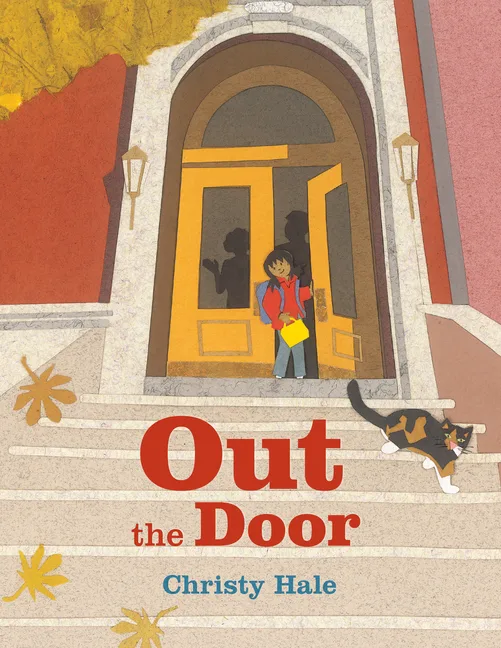 Out the DoorChristy HaleA brown-skinned girl and her dad leave their brownstone building in the morning, journeying through the busy city, including a ride on a crowded subway, to her school and classroom. Their progress is tracked completely in a narrative comprised of prepositional phrases (“across the street, outside the station, at the booth, beyond the turnstile / below the ground…” ). The striking collage illustrations are filled with the buzz of a busy big city, but amid all the details, readers will always be able to find the protagonist in her bright red shirt. While school is her ultimate destination, a double-page illustration at the end of the book retraces her return trip at the end of the day and takes her right up until bedtime. With a turn of the final page, she’s “out the door” again as a new day begins.Concept BooksLexile Text Measure NP0LATOS Book Level 0.1View book details
 Circle! Sphere!Grace LinLin, Grace. The Last Marshmallow. (Storytelling Math) Charlesbridge, 2020. 14 pages (978-1-62354-126-2) Lin, Grace. Up to My Knees! (Storytelling Math) Charlesbridge, 2020. 14 pages (978-1-62354-123-1) Lin, Grace. What Will Fit? (Storytelling Math) Charlesbridge, 2020. 14 pages (978-1-62354-125-5) Each of the board books in this quartet feature the same three young children who demonstrate simple math concepts in real- life scenarios through the four seasons. In the spring, Mei plants a sunflower seed and then uses her body (toe, knees, waist, shoulders) to measure the growth of the sunflower in Up to My Knees! In Circle! Sphere!, Manny joins Olivia and Mei in the summer to introduce elementary geometric shapes as they blow bubbles in the backyard. What Will Fit? has Olivia exploring spatial reasoning by considering how different fruits and vegetables do (or don’t) fill her basket at an autumn farmers’ market. And when Mei and Olivia come inside on a cold winter day in The Last Marshmallow, they warm up with hot cocoa and figure out how to divide three marshmallows into equal shares. Olivia is Black, Mei is Asian and brown-skinned Manny is likely Latino; all are engaged, curious children exploring their everyday world through math. Each book concludes with a double- page spread for adults that includes more about the concept introduced in each volume and a practical “Try This!” section with tips on ways to extend the math exploration with children.Concept BooksLexile Text Measure AD280LATOS Book Level 2.2View book details
Picture Books for Young Children
38 selections
 A Polar Bear in the SnowMac BarnettBlack text on a white, two-page spread announces the presence of “a polar bear in the snow.” A smudgy black nose and mouth cleverly and unexpectedly appear against the white of the next spread as the bear “lifts his nose to sniff the air.” Another page turn reveals two black eyes as the bear wakes up. “Where is he going?” The polar bear, whose white-paper body casts shadows against the white background, traverses the snowy landscape. “Is he going to visit the seals? No, he is not hungry.” He passes a cave (layers upon layers of white paper), roars at a human, crosses mountains, and finally arrives at his destination: the cool blue sea, where he enjoys a playful swim. Afterward, back on the snow, the bear’s round back end is seen retreating. He leaves only shadowy footprints behind as he heads toward a new, unknown destination. Verbal clues direct young readers to study clever illustrations full of depth and texture in this story time-friendly picture book.Picture Books for Young ChildrenLexile Text Measure AD360LATOS Book Level 2.6View book details
 Moonbeams: A Lullaby of the Phases of the MoonAnn Bausum, illustrated by Kyung Eun Han“I see the moon. Can the moon see me? / Tell me, half moon, what do you see?” Page spreads anchored by this repeated refrain with slight variations to accommodate changes in the moon’s appearance (e.g, new moon, crescent moon, growing moon, round moon, etc.) are paired with rhyming quatrains that tell more about the moon while placing its appearance in a specific geographic setting or context. “Although a half seems to appear, / you view a quarter of my sphere, / I cast my glitter on the ocean / riding waves of soothing motion.” Inviting, beautifully composed illustrations in warm hues show landmarks and landscapes from around the world referenced in the narrative (e.g., Taj Mahal, Eiffel Tower, Mongolian plains, coast of Greece, etc.). End matter of this elegant picture book includes information about the moon and lunar cycle, a glossary, and further reading, as well as a personal note from Wisconsin author Bausum.Picture Books for Young ChildrenView book details
 Where’s My Turtle?Barbara Bottner, illustrated by Brooke Boynton HughesArcher can’t find his pet turtle, Kevin. At his mother’s urging, he starts to look, first in his room and then out in his yard. Archer is easily distracted but with his mother’s continued urging he’s finally cleaned his room, but still no Kevin. “Think like a turtle,” suggests his mother, so he does, putting out fresh turtle food and water. Then he waits, and waits, and watches and watches. Finally Kevin comes out from the corner where he had been hiding. Throughout, Archer’s mom encourages him to problem- solve on his own, helping him refocus and making suggestions but never telling him what to do. Both Archer and his mom appear white or light-brown-skinned in a picture book that has a lot for young readers to observe in the visual storytelling; astute children will find Kevin hiding in a different place on every page in the detailed illustrations that are filled with visual red (or, in this case, green) herrings.Picture Books for Young ChildrenView book details
 Tummy Time FriendsPat Brisson“You’ll grow stronger / every day / when Tummy Time friends / come out to play!” Beautiful photographs of beautifully diverse babies spending time on their tummies grace the pages of this inviting board book. Their bright-eyed, friendly faces are sure to capture the attention of babies and very young children. The photographs are accompanied by a simple text with pleasing cadence and rhyme. The accordion format allows the book to be unfolded so a gathering of friends is visible to young lookers and listeners.Picture Books for Young ChildrenView book details
 Two Little TrainsMargaret Wise BrownA rhythmic text charts the progress to two trains —a steam engine (“chug chug chug”) and a diesel engine (“puff puff puff”) as they make their way west across the United States. Through all kinds of weather and terrain, the two trains keep going until they reach the big blue ocean “…beyond the land in the West.” A new edition of a book first published more than 60 years ago will still hold the interest of train-crazy toddlers through its quick staccato text and its uncluttered monochromatic illustrations, which were created with created with rubber stamps and Photoshop to give them an appropriately retro feel.Picture Books for Young ChildrenView book details
 Brown Baby LullabyTameka Fryer Brown, illustrated by AG FordThis sweet, rhyming bedtime story opens on a Black family of three heading inside for an evening together as the sun sets. In their home, the busy baby crawls around and bangs on pots and pans while his mother cooks dinner. At the table, the family says grace before enjoying spaghetti and meatballs (“Hands together as we bless / Food that will wind up a mess”), and then it’s bath time, dance time (they play John Coltrane), and story time before bed. Spanish words are naturally incorporated into a text that affirms Black pride in very young children by specifically calling out and praising the baby’s brownness. “Ten brown fingers, ten brown toes / Love and cherish all of those / Papi’s brilliant baby.” Above all, the love and caring of this family is palpable in both words and illustrations as both parents delight in the small activities of their child’s bedtime routine. “Lie you down and tuck you in / Buenas noches, baby / We love you… / Sweet brown baby.”Picture Books for Young ChildrenLexile Text Measure NP0LATOS Book Level 2.9View book details
 One Little Bag: An Amazing JourneyHenry ColeThe story in this wordless picture book begins on the opening end papers, showing a forest drawn in ink pen, with one tree highlighted in paper bag brown. That judicious use of color continues as the tree becomes a log sent to a mill, transformed into a giant roll of paper, and then manufactured into a paper bag, easily tracked through the process by its singular hue among the greys, blacks, and cream of each scene. A touch of red is added as the plot progresses, in the form of a heart drawn on the outside of the bag—now a boy’s lunch bag, and later a convenient container for whatever he needs to carry as he grows up, attends college, falls in love, and becomes a parent. Later his biracial (brown-skinned/white) child adds even more red hearts to that same long-lived bag. Finally, having traveled full circle, the bag holds a tree seedling that the family plants in the woods. An author’s note relates how issues of conservation and recycling inspired him to re-use a paper bag for school lunch for three years, before willing it to a younger friend at graduation. Suspending disbelief about the longevity of the book’s bag is worth the effort, in order to savor the clever design, intricate illustrations, and a gentle call for conservation.Picture Books for Young ChildrenView book details
 This Is a DogRoss CollinsAstute readers will notice that something’s up right from the get-go once they see that the original title of the book, My First Animal Book, has been crossed out by a scruffy crayon-wielding dog and retitled This Is a Dog. And indeed it is, as every double-page spread attempts to introduce a different animal species with the monotonous line “This is a…” only to have a cat, monkey, rabbit, squirrel, crocodile, giraffe, elephant, bear, and gorilla each upstaged by a dog. The story, after all, really is about the dog. When the other animals have finally had enough, they all chase the dog across the page, and the pictures tell the whole story while the text plods on with its “This is a…” description. A rollickingly fun tale draws its humor entirely from the visual depiction of the dog’s antics and the other animals’ reactions to them.Picture Books for Young ChildrenView book details
 Sorry (Really Sorry)Joanna Cotler, illustrated by Harry BlissOn a morning when Cow is in a bad mood, she kicks mud in Duck’s face (“And I’m not sorry.”), setting off a chain reaction of hurt feelings and sorry behavior as Duck insults Frog, Frog tells Bird her tweets stink, Bird tells Goat to get out of her tree, etc. Finally, Dog serves as the peacemaker and each animal in turn apologizes to the animal they upset. There is nothing subtle in this picture book that is perfect for using with older toddlers and preschoolers to talk about feelings and behavior. Each instance of cause-and-effect will require an intellectual leap on the part of preschool-aged readers, but happily the humorous ink and watercolor cartoon illustrations offer visual clues that make this possible.Picture Books for Young ChildrenLexile Text Measure AD520LATOS Book Level 2.2View book details
 Let’s Play Monsters!Lucy CousinsThree-year-old Gabriel uses specific descriptive details as he implores various family members to pretend to be monsters and chase him. He asks Nonna to be “a monster made of bright-pink jelly, with big round eyes and feet that are smelly,” while Mommy monster has “spikes on your back, who eats little boys with your teeth that are black.” The accommodating humans (as well as a pet and even a potted plant) are pictured chasing Gabriel as requested, while chanting their own monster-y threat (“Schlop, schlap, schlup! I’ll gobble you up!”), to which Gabriel always responds “Hee, hee, hee! But you can’t catch me!” Gabriel appears white; his family members are both white and brown-skinned in this romp in which the rhyming text, cheery palette, and smiling monsters keep the imaginative game from ever becoming too scary. Generously sized pages and bold black outlines make it a book ideally suited to a story-hour read aloud.Picture Books for Young ChildrenView book details
 Just Like a MamaAlice Faye Duncan, illustrated by Charnelle Pinkney Barlow“My mother and father live far away. / I wish we lived together. / I wish that they were here. But I live with Mama Rose right now.” This phrase is repeated three times throughout the narrative in the voice of a small African American girl who describes her life with her beloved Mama Rose. Just like a mama, she takes care of her needs, teaches her things (including how to dribble a basketball), makes her behave, and loves her. The watercolor illustrations show the child as a light-skinned girl with a lot of curly hair and missing her front tooth, and Mama Rose is a dark-skinned middle-aged woman. The text never tells us why her parents live far away or how she came to live with Mama Rose, which makes this applicable to many different family situations. The author’s note mentions the African American tradition of “fictive kin”—made-up or invented relatives who step into a caring role when needed. The illustrations, rendered in watercolor, gouache, colored pencil, and gel pen, were created by a granddaughter of Jerry Pinkney, making this the debut of the third generation of artists from the Pinkney family.Picture Books for Young ChildrenLexile Text Measure AD440LATOS Book Level 2View book details
 A Space for MeCathryn Falwell, illustrated by Cathryn FalwellIt’s just not fair that Alex’s big sister gets her own room and he has to share one with his younger brother, Lucas, who is boisterous and messy and always around. Alex never has any place to himself, so he builds a tent by a tree in the backyard, where he enjoys spending time all alone, until he realizes that Lucas isn’t being intentionally annoying, he only wants to be with him. The two brothers come up with a solution: sometimes they play together and sometimes play separately. Falwell’s vivid cut-paper collage illustrations show curly-haired, brown-skinned children problem-solving both together and independently in order to make things work.Picture Books for Young ChildrenView book details
 The Bold, Brave BunnyBeth Ferry, illustrated by Chow Hon Lam“Teetu the bunny lived in a small burrow with his mother and father and sisters and brothers and aunts and uncles and cousins. There were so many bunnies. It. Wasn’t. Even. Funny.” When Teetu can no longer take the cottontail crowd, he sets off on his own one night to explore the wider world, creating a book that shows everything he sees there. Away from the warren, however, he eventually realizes that he misses home. But how to get back? Luckily, his extended family has sent out a search party consisting of one very long line of bunnies that extends from home to Teetu in order to lead him back. The distinctive monochromatic illustrations capture the eeriness and adventure of Teetu’s nighttime outing, while the narrative is fresh and original in a book that draws much of its humor from understatement.Picture Books for Young ChildrenLexile Text Measure AD480LATOS Book Level 1.9View book details
 Bedtime for Sweet CreaturesNikki GrimesThe challenge of bedtime touches on familiar obstacles and a mother’s creative efforts to coax her reluctant toddler to sleep. Animal imagery abounds throughout as the child growls while climbing into bed with a toy bear, and then coils “beneath the quilt, silent as a snake.” After an under-the-bed monster check, and a favorite book, the youngster hangs on like a koala to receive a final kiss. Despite all the evening rituals, including a glass of water and one last trip to the bathroom, the child (and a parade of animals) ends up in bed with both parents on the final pages. Realistic illustrations of a Black family contrast with stylized, patterned animals in fanciful hues.Picture Books for Young ChildrenView book details
 Sun Flower LionKevin Henkes, illustrated by Kevin HenkesIn six short chapters, this gloriously uncluttered volume first introduces the sun, a flower, and a lion, using the same basic central shape to connect their similarities from one chapter to the next and always asking readers if they can see each one. The story morphs into the lion’s dream of being in a field of flowers as big as the sun, and those flowers suddenly become cookies. The lion eats them all before waking up hungry, running home to his family for supper, and then to sleep. “He is happy. Can you see him? Yes, you can.” The palette is limited to two shades of yellow, a muted warm white, a little gray, and bold black outlines, which work in perfect harmony with the playful narrative showcasing Henkes’s mastery of language, structure, timing, and child appeal.Picture Books for Young ChildrenView book details
 Like the Moon Loves the SkyHena KhanTwo parents welcome their baby with love and the words “Inshallah you are all that is gentle and good.” On each of the following double-page spreads, an illustration of that baby growing through toddler years into middle childhood is accompanied by a parental wish for their well-being, beginning with “Inshallah.” An opening author’s note extends the Arabic word for “if God wills it” beyond Muslims to include many religions’ concept of a greater power. Safety, kindness, strength, faith, friendship, and truth are all part of this heartfelt prayer, and the volume closes with “Inshallah you are loved, like the moon loves the sky.” Striking illustrations glowing with warm hues follow the brown-skinned girl, her family, and a diverse cast of friends, as they move through the outdoors, school, celebrations, and home.Picture Books for Young ChildrenWord Count 121View book details
 Hat TricksSatoshi KitamuraKitamura’s signature thick black lines illustrate a funny story about a rabbit magician named Hattie, and the increasingly larger (and more impossible) animals she pulls out of her magic hat, from a cat to an elephant. A bit of each animal is shown emerging from the hat before Hattie says her magic words, “Abracadabra, katakurico…” encouraging toddlers to guess what will be next. The gentle, funny story ends with a surprise inside the hat that helps to build a whole new world around Hattie and the animals that have emerged from her hat with her sleight of hand … or paw.Picture Books for Young ChildrenLexile Text Measure AD340LATOS Book Level 2.5View book details
 A Kid of Their OwnMegan Dowd Lambert, illustrated by Jessica LananWhen a new goat and her kid join the barnyard, Clyde (star of A Crow of His Own) is jealous of the amount of attention the kid is getting, especially from Roberta, the motherly goose who had always been Clyde’s ally. On top of that, Clyde’s now being admonished for his loud crowing, which wakes the kid. Clyde’s response is to crow louder and more frequently to wake the baby up. All gets resolved after a heart-to-heart with wise Roberta. Throughout the story, the cartoon-style watercolor illustrations show Farmer Jay and Farmer Kevin, both white, getting ready for their own soon-to-be adopted baby, whom they bring home at the end of the book. The subtle visual story about a gay-parented family runs parallel to the funny, pun-filled barnyard story that also is about adjusting to change and making space for a new baby.Picture Books for Young ChildrenView book details
 Bye, Penguin!Seou Lee, illustrated by Seou LeeA small penguin is separated from its community when the ice on which it’s standing breaks away. The penguin floats on its bit of ice under Southern Lights, through ice caves, past the Christ the Redeemer statue in Rio de Janeiro, the Statue of Liberty, and the Sydney Opera House. Throughout the journey, the ice chunk gets smaller and smaller. Just in time, the penguin meets a brown-skinned child with a surfboard. A few pages later the penguin triumphantly returns home on the surfboard, while far away the child holds the remaining chunk of ice. The nearly wordless story, which opens with a “Craaaack Snick!” as the penguin’s ice raft breaks away, communicates so much emotion through the expressions on the penguins’ faces and the simplicity of the illustrator’s understated style. There’s a subdued message about climate change in that breakaway ice for those who look for it, but the pleasure of this fantastical journey is accessible to all.Picture Books for Young ChildrenView book details
 When My Brother Gets HomeTom LichtenheldA brown-skinned preschooler imagines the adventures she and her older brother will have when he gets home from school. All the fun things she describes the two of them will do together are humorously exaggerated by her vivid imagination: attending their own comic book convention (sitting in a tree reading comic books), climbing Mt. Kilimanjaro (scaling a playground slide), building the biggest castle in the neighborhood (constructed of empty cardboard boxes). The spirited little sister keeps herself busy with tall tales while anticipating her brother’s return. When he finally does return, it’s clear that they both enjoy playing together, a refreshing change from the usual sibling conflict stories. There’s a pitch-perfect interplay between text and pictures, with the concise text representing her wild imaginings and the appealing cartoon illustrations showing reality. (Ages 3-7) Little Feminist. We Are Little Feminists: Families. Little Feminists, 2020. 12 pages (978-1-7341824-2-2) Little Feminist. We Are Little Feminists: Hair. Little Feminists, 2020. 12 pages (978-1-7341824-0-8) Little Feminist. We Are Little Feminists: On-the-Go. Little Feminists, 2020. 12 pages (978-1-7341824-1-5) A trio of board books celebrates a remarkable range of human diversity with joyful affirmation through rhyming texts and clear color photographs. In Families, groupings of all sorts are present, crossing age, race, gender, sexuality, and body type. Photos of adults snuggling their children accompany the words “All our love piled in a heap / A comfy place for me to sleep.” Hair on bodies and heads (or no hair at all!) across shades, types, and styles, is equally celebrated in Hair. Mobility is the focus of On- the-Go, with photographs of mostly young people jumping, climbing, biking, riding, walking, and running, some making use of prosthetics, wheelchairs, crutches, and other mobility support. “I might need a little help / or I get there by myself. / Look at all the ways / I can go!”Picture Books for Young ChildrenLexile Text Measure AD350LATOS Book Level 2.5View book details
 ‘Ohana Means FamilyIlima Loomis“This is the poi for our ‘ohana’s lū‘au” begins this cumulative rhyme styled on “The House That Jack Built,” in which a group of Native Hawaiians prepares for a shared meal. A note in the back matter elaborates on poi, a smooth purple paste made from ground kalo, a plant deeply entwined in Hawaiian tradition and legends. “This is the kalo to make the poi for our ‘ohana’s lū‘au.” The text paints a picture of the plant’s environment: There is “the water, clear and cold” in which the plants are submerged, located on “land that’s never been sold,” flooded by a “stream of sunlit gold.” In the earth-tone illustrations there are the humans, young and old, who cultivate and harvest the kalo; hands that pluck it from the ground; a line of people in a field filling and passing crates and baskets. Judicious use of alliteration and assonance in a rhyme that encompasses tradition, community, setting, and culture make this an absolute pleasure to read aloud.Picture Books for Young ChildrenLexile Text Measure AD710LATOS Book Level 3.8View book details
 Plenty of HugsFran Manushkin“Every worm has a wiggle, and every cow has a moo. / There’s a leap for each frog, and a peek for each BOO!” A small boy in a multiracial family enjoys spending a day with his two moms, playing outside, taking a bike ride to the zoo, and then coming home to a supper and a bath, a story and then a kiss good night. A gently rhyming text reveals the closeness of the three family members and the love they share. The pencil drawings, colored digitally, show each character as distinctive individuals. One mom as Asian and the other as white, and their young son is brown-skinned.Picture Books for Young ChildrenView book details
 Evelyn Del Rey Is Moving AwayMeg Medina“A big truck with its mouth wide open is parked at the curb, ready to gobble up Evelyn’s mirror with the stickers around the edge, her easel for painting on rainy days, and the sofa that we bounce on to get to the moon.” Evelyn Del Rey is Daniela’s best friend, and the book focuses on how the two best friends spend Evelyn’s moving day. The van is being loaded and the apartment emptied, while the girls use an empty box to pretend they are driving around the city in a bus. Their sadness as Evelyn drives away with her parents is as strongly evoked as the delight of their earlier escape into play. The final page shows an older Daniela with a box of letters, clearly still friends with Evelyn. There are many books about a best friend moving away but Meg Medina portrays this reality with vivid emotions and childlike details. Sonia Sánchez’s digital illustrations are filled with texture, character, and color, reminiscent of the picture books of Ezra Jack Keats. Both girls are Latina, and Evelyn Del Rey is also of African descent.Picture Books for Young ChildrenLexile Text Measure AD700LATOS Book Level 3.4View book details
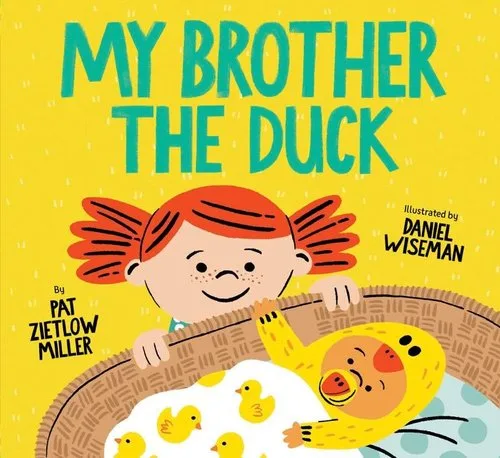 My Brother the DuckPat Zietlow Miller, illustrated by Daniel WisemanStella Wells is certain her new baby brother is a duck. After all, his name is Drake! And it doesn’t help that he has a duck-bill pacifier and is wrapped in a ducky bright yellow blanket when he first comes home from the hospital. After developing a hypothesis based on these early observations, Stella tests it by doing what all good scientists do: She gathers additional facts (her brother quacks) and consults experts (her Latinx friend Carla, and her principal) to reach her final conclusion: Her brother is indeed a duck. An original and clever take on the new baby theme features a memorable older sister in a white family. Stella’s chirpy commentary is well matched by the brightly colored cartoon illustrations that give just enough information for readers to draw their own conclusions about Drake in this entertaining outing from Wisconsin author Miller.Picture Books for Young ChildrenLexile Text Measure 500LATOS Book Level 2.5View book details
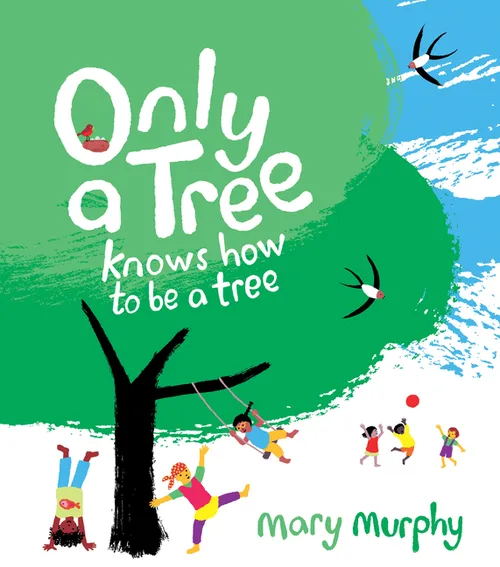 Only a Tree Knows How to Be a TreeMary Murphy, illustrated by Mary MurphyBirds build nests for homes. / They sing different songs, / and their babies hatch from eggs. / Best of all, / they can fly. / Only a bird knows / how to be a bird.” It’s not just a bird, but a tree, a dog, fish … water, the earth … all of these living things are unique to themselves, and different from one another. They’re also different from others like them—other trees, and birds, and fish, and dogs, and cats and … you get the picture. Young listeners and readers will, too. Every creature is unique, and an expert at being themselves. People are too, of course, even though there are billions of us. “Only I know how to be me. / And only you know how to be you.” This affirming message spins out in a gentle, rhythmic narrative paired with cheerful spot and occasional full-page illustrations showing many types of human diversity among the simplified figures of animals and people. Bright white pages form the backdrop for the hand-lettered text and most of the boldly colored art.Picture Books for Young ChildrenView book details
 Night WalkJason Cockcroft, illustrated by Jason CockcroftWhen a little girl lays awake after bedtime, her father suggests a walk. “I had been out after dark before, but this time was different. We were going out just to be out. And it was just Dad and me.” The nocturnal stroll takes the two of them, who appear white, through their diverse neighborhood, where lighted windows provide views unseen during the day. She’s surprised by the number of people out and about, and the variety of small yet significant moments on display. The warm glow from streetlights and spilling out of windows, framed by a dark blue star-speckled sky, imparts a sense of community and belonging to this father and daughter’s nighttime outing.Picture Books for Young ChildrenView book details
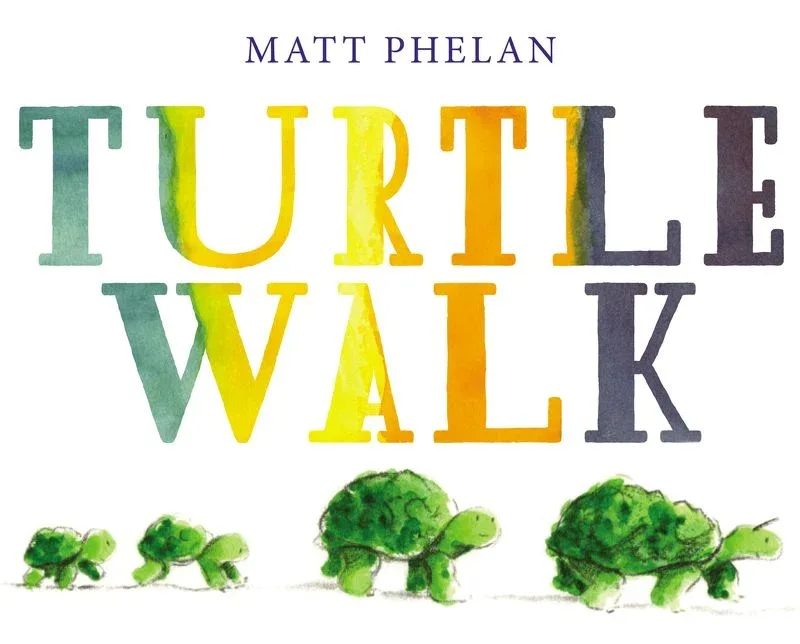 Turtle WalkMatt Phelan, illustrated by Matt PhelanOver the course of a year in seasons, a turtle family (two big, two small) travel from their cave-like hole near a pond, around the nearby area, and return to their home. “Turtle walk. Nice and slow. Here we go. Are we there yet? No.” This refrain (with some slight modifications) repeats throughout their journey, until the satisfying speedy descent down a snowy hill for the grand finale. Their route takes them through springtime wildflowers, summer sun and an active playground, and an autumn orchard and pumpkin patch. The watercolor illustrations are the very definition of cozy and comforting, and the patterned text invites listener participation.Picture Books for Young ChildrenView book details
 The Old TruckJarrett Pumphrey, Jerome Pumphrey, illustrated by Jarrett Pumphrey, Jerome PumphreyAn old truck is the one constant on a small family farm occupied by a Black family whose only child grows from toddlerhood to girlhood, through her teenage years and into adulthood. As she grows older, so, too, does the truck which eventually falls into disrepair and sits, rusting beside the barn, right where it’s always been. The old truck never moves, remaining in the same position on the page while the action of the family happens all around it. The short declarative sentences focus on the experience of the truck while the equally uncluttered illustrations focus on the girl. Astute observers will note that, from an early age, she’s always working alongside her parents, tinkering with machinery. So it comes as no surprise that, once she inherits the farm, she restores the old truck and gets it running again so that it can VROOOOOOOM off the page in a satisfying conclusion. The retro illustrations and the personification of machinery is reminiscent of Virginia Lee Burton (and will appeal to the same audience) but there is a completely modern look to the art, as well, which the brothers created with 250 handmade rubberstamps. This deeply satisfying book is one that young children will want to hear again and again, and adults won’t mind a bit.Picture Books for Young ChildrenLexile Text Measure AD260LATOS Book Level 1.2View book details
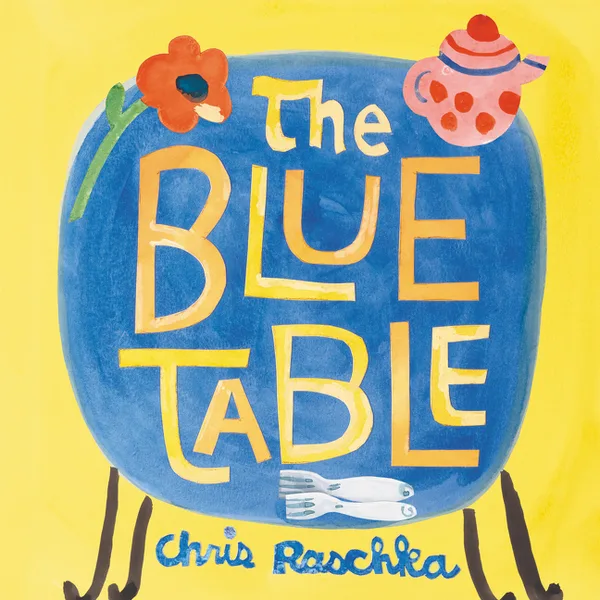 The Blue TableChris RaschkaA table is the central character in this unusual story of a family of three (a child and two parents) preparing for another family to join them for a special Thanksgiving dinner. The scene never moves from an overhead shot of a blue table that holds the visual cues telling the story of the day, from breakfast with coffee, newspaper, and crayons to several scenes of food preparation to the setting of the table and enjoyment of the feast. There are no humans in the illustrations until the very end; even then, it’s just hands and arms (three people with white skin and three with brown skin). The entire story as told through the objects on the table requires a great deal of inference on the part of the readers in order to interpret the day’s events. Raschka’s sunny watercolor and cut-paper collage illustrations are playfully inventive, while the table’s whimsical legs make it seem like a living creature.Picture Books for Young ChildrenView book details
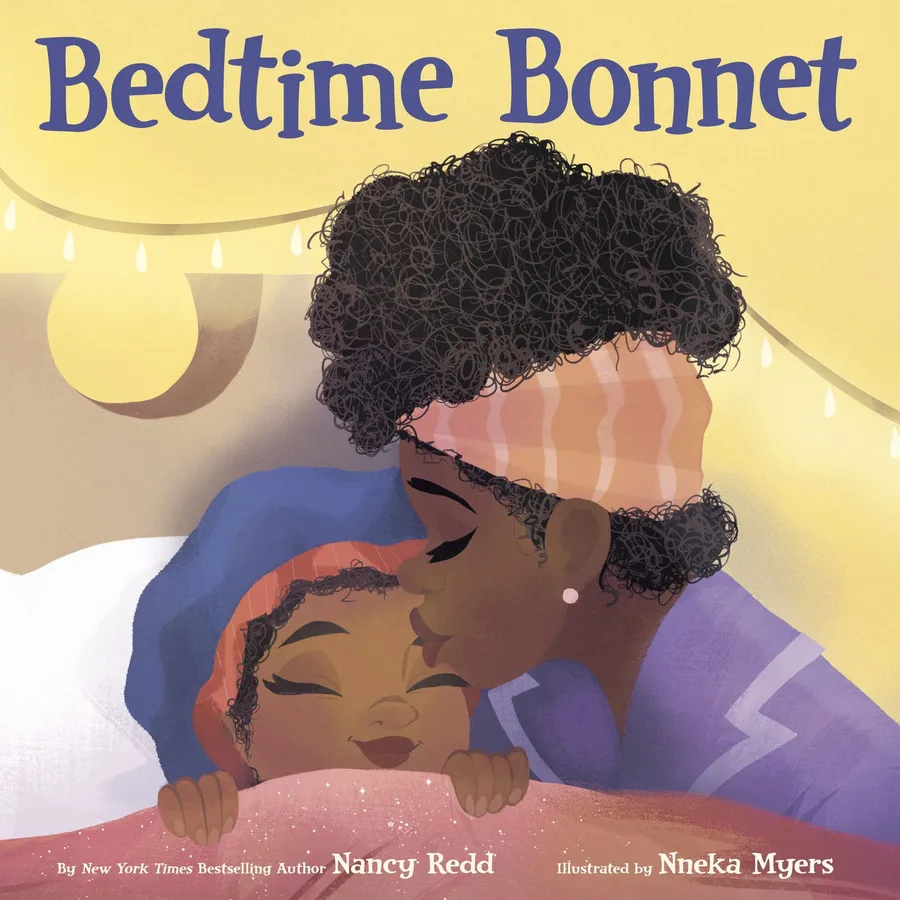 Bedtime BonnetNancy Redd“In my family, when the sun goes down, our hair goes up!” The youngest member of an African American family describes how each person prepares their hair for bedtime. Her brother “twists and tightens” his locs before donning a durag; Sis combs her hair into a swirl atop her head before adding a wrap; Grandma puts in rollers; Mommy wraps her curls with a scarf; and Daddy wears a wave cap. Only Grandpa has no evening ritual for his bald head. After the narrator’s own hair is braided into a crown, the bedtime routine is interrupted as she searches for her missing bonnet, revisiting each family member to ask if they’ve seen it. Her quest ends with Grandpa, who hides behind his newspaper with the bonnet perched playfully on his head, to the amusement of all. Next morning, the process is reversed as each person tends to their daytime hair—even Grandpa shaves his scalp. Brightly hued, stylized illustrations reminiscent of animated film celebrate a loving family engaged in their rituals of hair care.Picture Books for Young ChildrenView book details
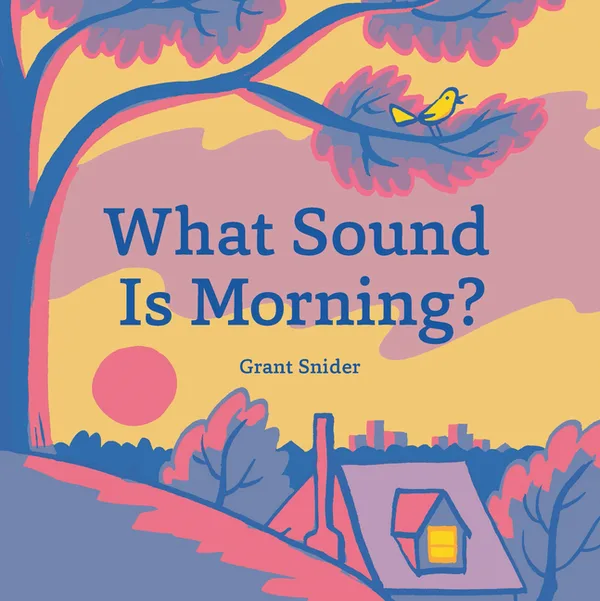 What Sound Is Morning?Grant Snider“In the first morning light, all is quiet. Or is it? Listen. What sound is morning?” Starting in the home, the pages move through the sounds of morning: lights clicking on, a baby babbling, sprinklers hissing, a rooster crowing. As the world wakes up, other sounds join in: a man shouting after a bus, cars and trucks entering the city, hungry stomachs rumbling, frogs plopping into a stream. City sounds, home sounds, and country sounds flow seamlessly from one to the next as the sky brightens, before asking the reader to greet the new day and “fill the world with your song.” A saturated color palette showcases yellow, orange, pink, and red expanding across the horizon, while buildings and streets remain dark green and blue in the foreground.Picture Books for Young ChildrenLexile Text Measure 470LATOS Book Level 3.2View book details
 Khalil and Mr. Hagerty and the Backyard TreasuresTricia SpringstubbKhalil lives with his big, busy family in the second story flat of a house, while quiet Mr. Hagerty lives alone on the first floor. Both like spending time in the backyard, where Mr. Hagerty maintains a garden and Khalil hunts “for bugs and interesting rocks.” The two lead a peaceful co-existence that soon becomes a friendship, as they find ways to help each other out, enjoy celebratory snacks together, and even to surprise each other with small acts of kindness. The friendship between an elderly white man and a young brown-skinned boy is distinctive for the equality of their relationship. The collage illustrations extend the story with details that offer some foreshadowing and show the developing closeness between the two neighbors.Picture Books for Young ChildrenView book details
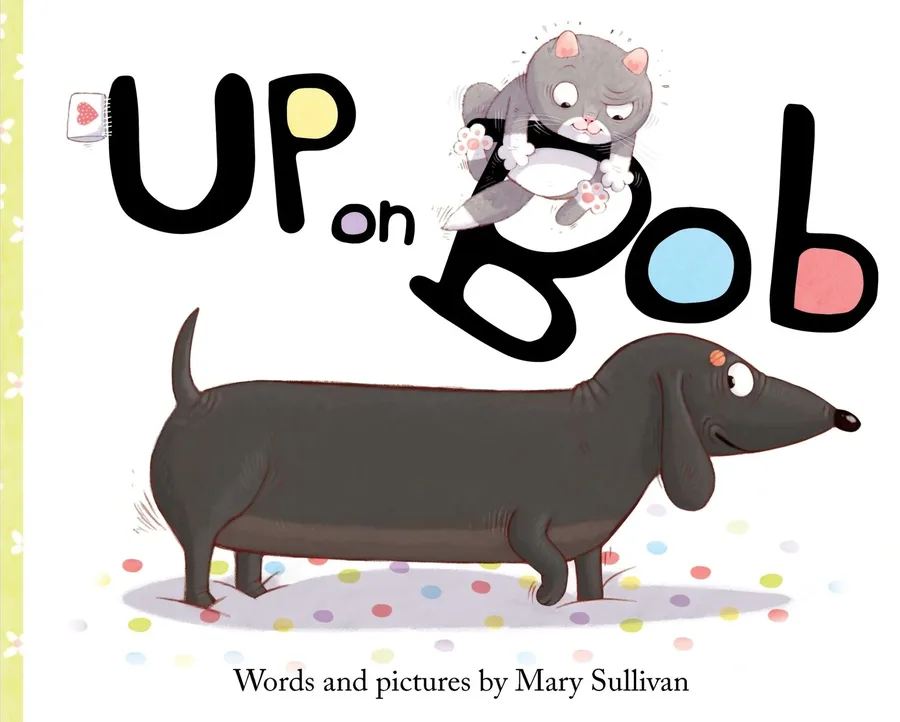 Up on BobMary Sullivan, illustrated by Mary SullivanA funny, easy-to-read picture book about Bob the dachshund, who jumps up on a bed, tosses everything off of it, and musses up the covers to hunker down for a day-long nap. It’s the perfect spot for him, until Bob realizes Someone is watching him. That Someone turns out to be a cat, who then jumps up on the bed to join him. And it turns out her perfect spot is on top of Bob, once she finishes licking, patting, and positioning herself on top of him to settle down for a nap. A funny story told completely in short, declarative, understated sentences and cartoon-style digital illustrations that add a great deal of humor.Picture Books for Young ChildrenLexile Text Measure AD220LATOS Book Level 0.9View book details
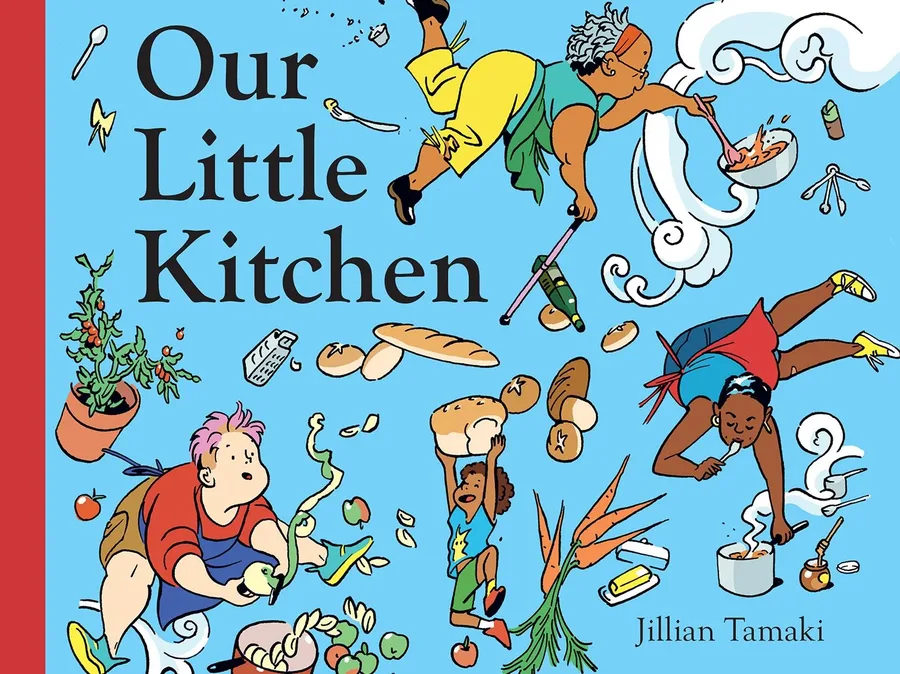 Our Little KitchenJillian Tamaki, illustrated by Jillian TamakiA small biracial child and white woman burst through the door of a kitchen where a Black woman and a light-skinned pony- tailed man are getting ready to cook. With each page turn, more people enter and begin to chop, stir, peel, and sizzle whatever ingredients they have to prepare a community meal. Short couplets are paired seamlessly with dialogue bubbles and bright- hued illustrations showing many aspects of diversity among the neighbors—race, ethnicity, size, and age. Several different kinds of disability are also depicted, including the woman in charge of the kitchen, who uses a cane. What at first seems to be a frenzied chaos soon reveals an order and a purpose, a coming together in camaraderie and community.Picture Books for Young ChildrenLexile Text Measure 241LATOS Book Level 2View book details
 The Bear in My FamilyMaya Tatsukawa“We live with a bear!” a boy insists. The bear that sleeps in the bedroom next to his is loud, bossy, and strong. His parents act like the bear is a member of the family, and he wonders why they can’t see the truth. But when a trio of big kids order him off a swing, the bear roars loudly, scaring the bullies away, and then uses its strong arms to give swing pushes. The bear dispenses band aids when needed, eats food the boy doesn’t like off his plate, and gives bear hugs. The large dark grey bear pictured throughout the book eventually takes the form of a human big sister, saying “I told you I’m NOT a bear!” With a smile, the boy declares that not only is she a bear, but so is he, and the two siblings roar in unison. Brief lines of speech bubble dialogue and short first-person statements from the young narrator are combined with soft-colored digital illustrations incorporating a variety of suggested textures and showing a light brown-skinned family that appears Asian to tell a story full of gentle humor, warmth, and emotional honesty.Picture Books for Young ChildrenLexile Text Measure AD280LATOS Book Level 1View book details
 Outside InDeborah Underwood“Once we were part of Outside and Outside was part of us,” states a young white girl walking through a wooded area. “Now sometimes even when we’re outside… / we’re inside.” The two double-page spreads accompanying this text show two perspectives of the girl riding in a car through the same wooded area. As she enters her home, she continues to talk about the ways the outside always is there, even when we’re inside, with “flashes at the window” and “chirps and rustles and tap-taps on the roof.” Always, the outside beckons with smells and sounds and sights. The simplicity and the rhythm of the narrative will encourage children to think of all the ways they are (or could be) aware of the outdoors, whether they’re outside or inside, in this timely and timeless story. The watercolor illustrations are lush and evocative, and include lines created with dried flower stems and cotton thread soaked in ink, bring the outside right into the inside pages of the book.Picture Books for Young ChildrenLexile Text Measure AD490LATOS Book Level 3.3View book details
 Together We GrowSusan Vaught, illustrated by Kelly MurphyA fox and kits looking for refuge in a thunderstorm are turned away by a barn full of animals alarmed by their arrival and claiming they have no room. But one small gosling goes after the dejected foxes, offering comfort and extending an invitation to enter the barn. Inside the barn, the fox and kits meet the other animals; suspicion is replaced by discovery, and camaraderie, and compassion. The story can be read through the lush acrylic and oil illustrations that are full of warmth and feeling, balancing realism of the animal forms with obvious personification. But the short, rhyming text offers language-rich moments that also invite deeper consideration. “Large or small, / short and tall, / There is room, / there is room, there is room…”Picture Books for Young ChildrenLexile Text Measure AD370LATOS Book Level 2.6View book details
 SharingYusuke Yonezu“We both want this fish!” Two small cats—one orange, one gray—tug a blue fish between them. With a turn of the page, the two smiling kitties each hold half the fish. “Now we each get some.” A board book about sharing marries design to concept and function to form with elegant simplicity, the clever use of colored backgrounds and die-cuts allowing the coveted item to be divided with each turn of the page. Two mice with one piece of cheese, two bunnies with one carrot, two monkeys with one banana, two pigs with one apple, and two bears with one bunch of grapes all share what they have by splitting it in two. And when two kids both want Mommy? A family hug is perhaps the best solution of all. Bright colors and uncluttered design add to the appeal.Picture Books for Young ChildrenView book details
Picture Books for School-Age Children
33 selections
 What Grew in Larry’s GardenLaura Alary, illustrated by Kass ReichGrace enjoys helping her white-haired neighbor, Larry, with his garden. While they work, he talks about what he’s doing and why, sharing his years of gardening experience. Not surprisingly, Larry is a teacher. Every year he gives his each of his students a tomato seedling to nurture, and then requires that they give the plant to someone else, accompanied by a letter explaining why they are doing so. When a new neighbor builds a security fence that blocks the sun from Larry’s garden, Grace applies what she’s learned from Larry. She gives the neighbor a packet of seeds with a letter that explains the best way to feel safe is to have friends. And then she helps him turn his fence into a trellis so that her gift of bean seeds will have something to climb. Warm gouache and colored pencil paintings illustrate an appealing story of building community that was inspired by a real classroom teacher who gives his students heirloom tomato plants each year to grow and then give away. Grace has light brown skin; Larry appears white.Picture Books for School-Age ChildrenLexile Text Measure AD570LATOS Book Level 3.7View book details
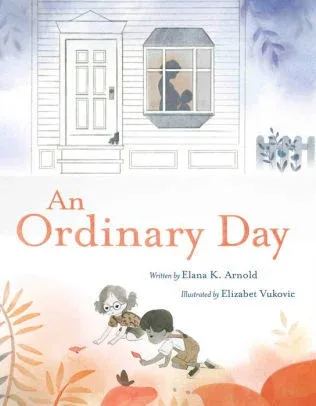 An Ordinary DayElana K. Arnold, illustrated by Elizabet VukovićOn an ordinary street in an ordinary neighborhood, two extraordinary events are about to take place. Two cars pull up in front of two houses. In one car is a veterinarian; in the other, an obstetrician or midwife. Inside the houses, lives change as one family says good-bye to a beloved dog and the other welcomes a new baby. Outside, neighbors go about their daily lives. Superb, expertly paced writing reveals minimal details, allowing muted illustrations to fill in the story and readers to infer events and emotions. Despite its old-fashioned look, the neighborhood is refreshingly multicultural: one family is African American, the other multiracial and queer; the visitors to the houses are Black and Asian American. Steering clear of sentimentality, this quiet story carries readers through a range of big emotions.Picture Books for School-Age ChildrenLexile Text Measure 610LATOS Book Level 4View book details
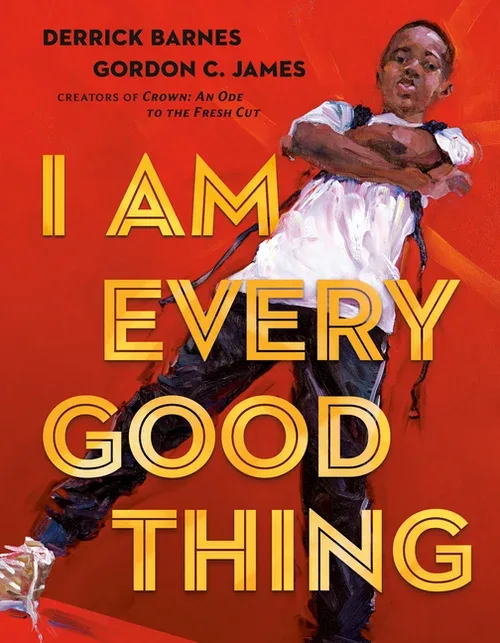 I Am Every Good ThingDerrick BarnesFirst-person statements in the voice of a young Black boy assert all the good things he stands for: “I am a roaring flame of creativity. I am a lightning round of questions, and a star-filled sky of solutions. I am an explorer, planting a flag on every square foot of this planet where I belong.” The accompanying oil paintings show a variety of Black boys in middle childhood engaging in play, sports, scientific study, celebration, and family hugs. Barnes’ strong, poetic text is a love letter to all Black boys, affirming their brilliance and beauty in a world that often is hostile to them. It concludes with the powerful lines: “I am worthy of success, of respect, of safety, of kindness, of happiness. / And without a shadow of a doubt, I am worthy to be loved. I am worthy to be loved.” Amen.Picture Books for School-Age ChildrenLexile Text Measure AD610LATOS Book Level 4View book details
 Big Papa and the Time MachineDaniel Bernstrom“I won’t never forget that September time when I didn’t want to go to school and Big Papa came in his time machine to take us way, way back.” Big Papa’s time machine is his car, which not only serves as the means for getting the young Black boy to school, but also becomes a vehicle for his grandfather to share stories from his own past about times he was afraid and faced his own fears. The stories Big Papa recounts, touching on African American history in his lifetime, come alive through both the conversational narrative and the sketchy, stylized illustrations showing scenes from the past beside more detailed pictures showing the grandfather and grandson riding in the car. The distinctive voice also serves to show the closeness of the relationship between the two —clearly this is a child who has enjoyed many family stories told by Big Papa as he imparts a lifetime of experience and wisdom.Picture Books for School-Age ChildrenView book details
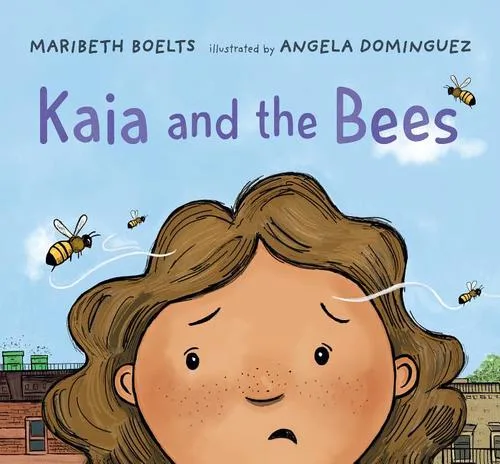 Kaia and the BeesMaribeth Boelts, illustrated by Angela DominguezKaia is happy to tell her friends everything her beekeeper dad has taught her about bees and how important they are, talking as if she’s a beekeeper, too. But in truth, she’s afraid of bees. Her secret is out the day she panics in front of her friends when a bee lands on her. Enough, thinks Kaia. Telling her dad she’s ready, she dons her child-sized beekeeper suit and accompanies him to the hives on their apartment rooftop. In spite of her fear, she’s soon holding a frame full of bees. They’re fascinating! Then her glove gets wet; she takes it off and…ouch! When it’s time to harvest the honey, Kaia still doesn’t want to return to the hives after being stung. Instead she helps in the kitchen, pondering the wonder of sweet honey coming from such tiny creatures. When she sees two bees inside the kitchen window, she realizes that maybe they aren’t out to get her after all. Maybe they just want a way out. In this engaging, honest account, biracial Kaia (her dad is Black, her mom appears white) still finds bees scary, but also “amazing,” and “mysterious.” She’ll go on the roof again, she tells her dad, because bees are worth it, and now “something inside me is …. brave.”Picture Books for School-Age ChildrenLexile Text Measure 381LATOS Book Level 2.7View book details
 Cat Dog Dog: The Story of a Blended FamilyNelly BuchetThis fresh, warm, funny account about members of a newly configured household learning to get along revolves around two dogs (one small, one large) and a cat. The small dog belongs to a white man. The large dog and cat belong to a brown-skinned woman. When the man moves in with the woman, the three animals have some adjusting to do. In a picture book perfect for beginning readers, the spare, repetitive text is limited to labeling the animals on each page (e.g., "Dog," "Dog Cat," "Dog Cat Dog"), incorporating an occasional surprise word related to several scenes ("Bird," "Frog"), including the surprise in the final one. The spirited ink and digital illustrations are full of humor in details familiar to any pet owner (3 boxes labeled “Dog Box” for the move; the animals' manic pursuit of one another; bed wars), while visual clues mark the passage of time across the seasons as the trio gradually moves from suspicion and uncertainty to a tight-knit bond.Picture Books for School-Age ChildrenView book details
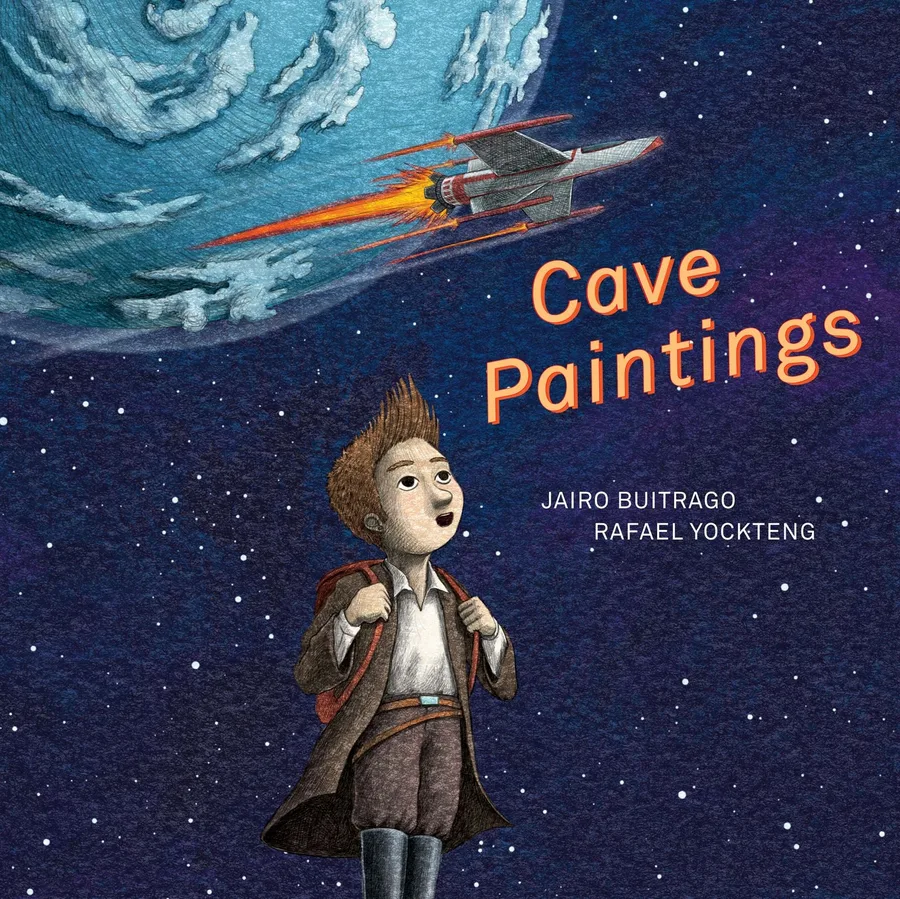 Cave PaintingsJairo Buitrago, illustrated by Rafael YocktengA light-skinned boy travels by space ship (alongside fellow passenger aliens in a range of fascinating forms) to a distant planet for a holiday visit with his grandmother. Once he’s arrived, the two explore the area and see ancient cave paintings. When he leaves, his grandmother gives him a farewell gift of colored pencils and paper that originally belonged to his great grandfather. The boy uses these on the trip back home to record the view out the ship’s window. Clues in the illustrations show that the grandmother’s planet is Earth, and that this story is set in the future, when colored pencils and paper are unfamiliar antiquities. The art theme and those supplies connect the distant past of the cave paintings with the more recent past (our present) of the colored pencils, and the future of the story’s setting.Picture Books for School-Age ChildrenView book details
 Me & MamaCozbi A. CabreraA present-tense narrative in the voice of a young Black girl is pulsing with love from the very first moment of the story. “Good morning to you,” the little girl hears her mother sing. “Papa and Luca are still sleeping, but I want to be everywhere Mama is.” The two get ready to go outside, where it’s raining. “Mama and I both have silver dresses. I wear mine with silver shoes. They’re my favorite. Today is not our silver dress day, Mama tells me. I put my silver dress back on the hanger and pick up the plaid pants instead.” The details are marvelous, the little girl’s keen, child-like observations a delight. (“The sidewalk is longer than it is wide. I love the grass that grows in the in-between.” “Our day is done earlier than Mama and Papa’s. It’s just that way when you’re growing.”) The marvelous full-page acrylic illustrations range from scenes of the girl or the two of them together to enlarged images of items the little girl makes note of (e.g., hers and Mama’s contrasting drinking cups, toothbrushes, breakfast bowls). Playful visual details extend to the endpapers, which feature spot illustrations of items referenced and seen throughout the story.Picture Books for School-Age ChildrenView book details
 All Because You MatterTami Charles“Long before you took your place in this world. You were dreamed of, like a knapsack full of wishes, carried on the backs of your ancestors as they created empires, pyramids, legacies.” A poetic second-person text addressed to Black children begins by speaking of the universe and ancestors before moving on to the specifics of a contemporary child's life. The gentle parental voice traces a child’s life from the time they are born through first steps and first words, to triumphs and struggles at school (learning to read, your name mispronounced), to current struggles in their world. Moving back into an affirmation connecting the child to the universe and all the ancestors who have come before, the text reasserts that every child matters. Collier’s striking collage and watercolor illustrations show a variety of Black people, but the central focus is one young boy, whom we see from infancy to about age ten. The illustrations also integrate colorful quilts with pieces representing the long line of ancestors who have led to a particular child.Picture Books for School-Age ChildrenLexile Text Measure AD810LATOS Book Level 3.9View book details
 The Ocean CallsTina M Cho, illustrated by Jess XDayeon is learning to be haenyeo, a sea diver, from her grandmother. It’s a tradition passed down among women on their South Korean island, but even though she and Grandma practice holding their breathing regularly, Dayeon hasn’t felt ready to dive deep. Instead, she explores along the shore. But on this day, when Grandma comes in from a dive and asks Dayeon if she’s ready to try, Dayeon finds her courage and says yes. She’s still scared, but with Grandma’s guidance and support she explores the ocean world farther out from shore, beneath the water’s surface, looking for “treasures.” When dolphins appear, meaning sharks may follow, Grandma leads her back up, into the arms of other haenyeo waiting on a boat. To be haenyo, Dayeon understands, is to be a treasure-seeker, a mermaid, and most of all part of a community. Gorgeous illustrations with intense watery hues are a captivating backdrop for wonderfully measured, delightfully detailed storytelling grounded in Dayeon’s perspective. An informative authors’ note tells more about the centuries-old tradition of haenyeo, which been named by UNESCO to the list of “Intangible Cultural Heritage of Humanity.”Picture Books for School-Age ChildrenLexile Text Measure AD580LATOS Book Level 3.8View book details
 Overground RailroadLesa Cline-RansomeA first-person narrative tells the story of one family’s journey via passenger train from North Carolina to New York City as part of the Great Migration. Young Ruth Ellen travels with her parents in the “colored car,” watching out the window as they pass fields of migrant laborers living the sort of lives she and her family are escaping. As she travels, she also reads a book her teacher gave her just before they left, Narrative of the Life of Frederick Douglass. Cline-Ransome’s skillful writing draws subtle comparisons between Douglass’s escape on the Underground Railroad and the journey north taken by African Americans generations later. Ruth Ellen’s observations and the conductor’s announcement of stops along the way charts the family’s progress to a place that will offer only a little bit more freedom but much more opportunity for the family. The watercolor illustrations give a strong sense of the time period, as well as the characters of the people on the train in this distinctive look at the Great Migration.Picture Books for School-Age ChildrenView book details
 The Range EternalLouise Erdrich, illustrated by Steve Johnson, Lou Fancher“On cold winter days in the Turtle Mountains, I helped Mama cook soup on our woodstove, The Range Eternal.” On the blue enamel stove in the Anishinaabe narrator’s childhood home, her mother deftly feeds wood into the fire even as she stirs. In winter, the stove is also comfort from the cold, and protection from the Windigo ice monster. But when the narrator looks through the stove’s mica window, the range of this story expands. In the flames, she sees the deer and bear, buffalo and badger that once roamed North Dakota. “I flew the sky, the range of herons, of cranes, hawks, and eagles. I saw The Range Eternal.” After her family gets electricity, The Range Eternal stove is replaced by a modern stove that doesn’t require tending, but clearly something is lost, too, in story that ends with the now-adult adult narrator finding the stove of her childhood in a thrift store and bringing it home to share the vision and history found in its flames, and the warmth of its heart with her family. This substantial picture book narrative is graced by vivid, beautifully rendered details (“The breath of my sister in the rollaway was a feather standing above her lips.”) It feels immediate rather than nostalgic, set against illustrations full of their own warmth. In a note the author explains the stove is based on stories her mother shared about her own childhood.Picture Books for School-Age ChildrenView book details
 Mexique: A Refugee Story from the Spanish Civil WarMaría José Ferrada, illustrated by Ana PenyasA young child traveling on the ship Mexique isn’t sure where she’s going, but knows it is far away and that she’ll stay for a few months, which her mother compared to an “an extra-long summer vacation” during a goodbye hug. She’s one of 456 children on board without parents, but an older girl named Clara takes care of her. The children imagine where they are going, and sometimes at night they cry. They dream “the houses are crumbling, and their memories are blank.” A crowd waving white handkerchiefs greets them on arrival, and they disembark, believing that they’ve left the war behind them. The child’s uncertainty and hope, and a sense of experiencing while not necessarily comprehending, are all imbedded in the distinctive voice of the narrative, while the sophisticated, mostly sepia-toned illustrations emphasize a sense of foreboding and fear. An afterword offers additional information about the children of Spanish Republicans aboard the Mexique, who were sent as refugees to Mexico during the Spanish Civil War. Their anticipated short stay became a permanent exile, with most remaining permanently in Mexico.Picture Books for School-Age ChildrenView book details
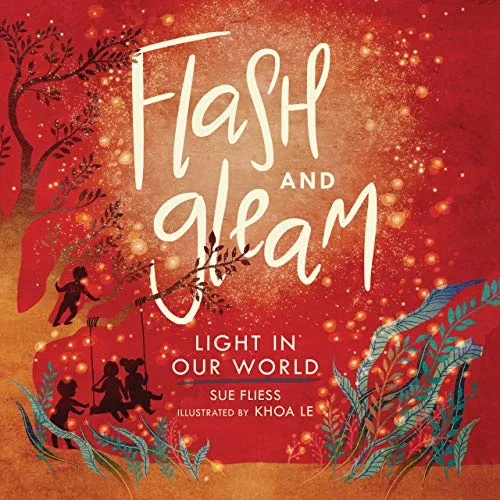 Flash and Gleam: Light in Our WorldSue Fliess, illustrated by Khoa LeEach page or spread of this creative look at many ways light is part of our lives features one or more rhyming couplets describing light in a specific context, set against an illustration showing an accompanying scene. “Bolt / Flash / Thunder and crash”: A brown-skinned family sits inside during a thunderstorm. “Color / Bend / Find the end”: A light-skinned child looks at a rainbow. The warm, inviting illustrations showcase four diverse families, with some of the scenes reflecting religious and/or culturally distinct observances and celebrations—Yi Peng (Thai), Diwali (Hindu), Hanukkah, Christmas, as well as secular (Fourth of July). Weather, seasons, celebrations, community … a picture book rich with thematic connections ends with a note providing information about the science of light and about the specific observances referenced.Picture Books for School-Age ChildrenView book details
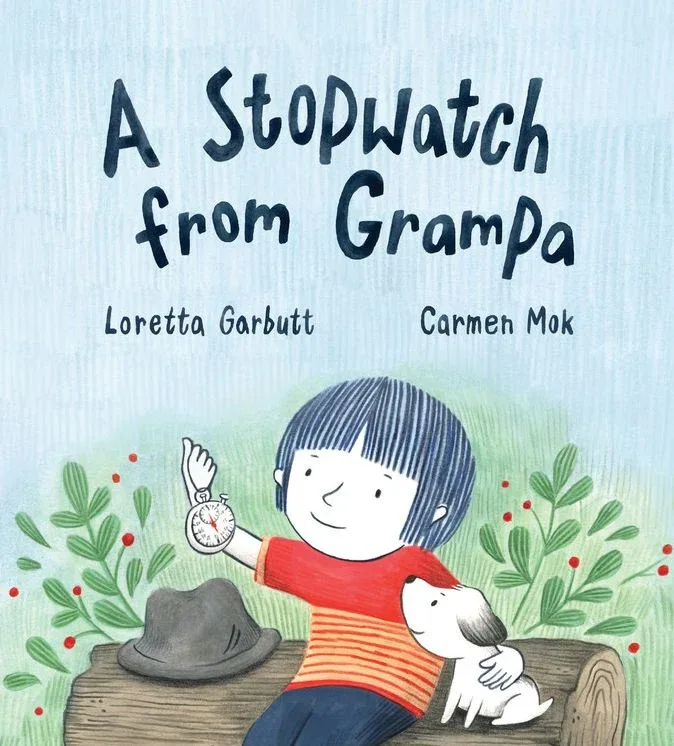 A Stopwatch from GrampaLoretta Garbutt“When summer started, I got Grampa’s stopwatch. I don’t want his stopwatch. I want him.” Remembering the many ways the stopwatch was part of being together, whether Grampa timed eating bubblegum ice cream or how long it took a caterpillar to travel up a pant leg, feels too painful for this grieving white child. The stopwatch is buried in a sweater drawer, and stays there as seasons pass. When the stopwatch is finally rediscovered, the sharp pain of loss has ebbed, and the watch triggers warm and welcome memories of the beloved grandparent. This story about loss, grief, and healing is both appealing and accessible.Picture Books for School-Age ChildrenView book details
 Southwest SunriseNikki GrimesJayden has just moved from New York City to New Mexico, and he’s not happy about it. “Why are we here? What’s so great about New Mexico?” The first morning in his new home, Jayden wakes up with fresh eyes, pockets a field guide his mom gives him, and decides he might as well explore the outdoors. To his surprise, New Mexico is filled with delightful discoveries: colorful flowers, chattering birds “passing secrets” in piñon trees, smooth houses of adobe, “bleached bones like seashells” in “a river of sand.” Jayden marvels at the endless expanse of blue sky, a view he didn’t have in New York City. He misses the incredible height of skyscrapers, but soon he spots “stone towers” in the distance, “red rock pillars” as tall as the buildings back home. Feeling cheered, Jayden picks a handful of flowers for his mom before heading back to their new house. Poetic text bursting with sensory detail tells a story of a curious, open-minded Black boy, and gouache illustrations vary among close-ups of Jayden’s discoveries and arresting depictions of the warm Southwest landscape.Picture Books for School-Age ChildrenLexile Text Measure 561LATOS Book Level 3.7View book details
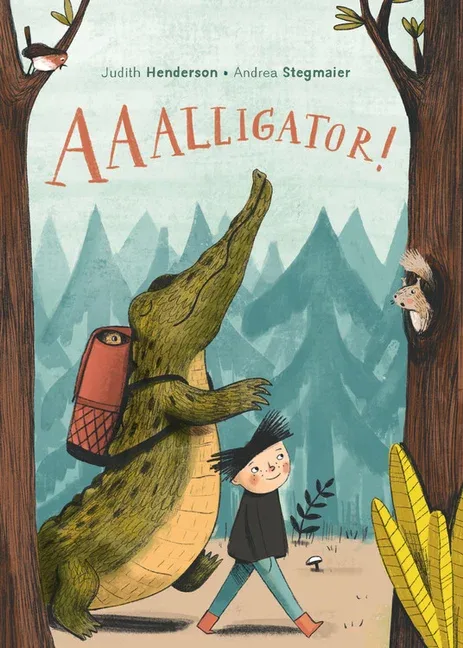 Aaalligator!Judith Henderson, illustrated by Andrea Stegmaier“NO ALLIGATORS, blah blah blah…” That’s the reaction of the town mayor after a boy frees a lonely alligator from a “twisty” vine and the two become fast friends. The quick-thinking boy, who lives just outside of town, next to a lake “big enough for one medium-sized whale,” suggests the hungry alligator could be a great help to the town, taking care of everyone’s leftovers. “NO ALLIGATORS, blah blah blah…” says the mayor. But the townspeople feel otherwise and bring the alligator their leftovers regardless. Everyone but the mayor is happy, while the mayor’s search for the alligator is fruitless. But, the alligator is eating so much, and growing so big, that hiding him is getting to be a problem until the townspeople work together to come up with a whale of a solution. “The mayor never did find the alligator. And, curiously, no one could find the mayor.” A hilarious, slightly subversive story pairs a smartly funny prose narrative full of wonderful language and wordplay with marvelous illustrations that mine every moment for humor. The boy is white, some townspeople brown-skinned.Picture Books for School-Age ChildrenLexile Text Measure AD520LATOS Book Level 3.4View book details
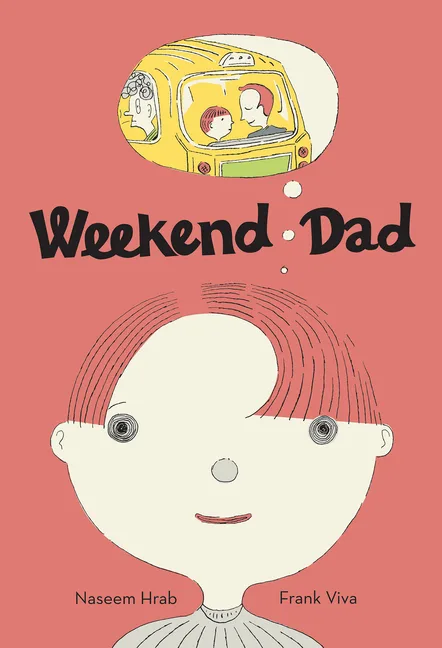 Weekend DadNaseem Hrab, illustrated by Frank VivaDescribing the first week after his dad moves out, a white boy’s thoughts revolve around his absent parent, from memories (how his father’s hair looks red in the sun) to small moments (tuna fish for dinner, a meal his dad hates). The weekend brings a bus trip to a new apartment, which feels simultaneously like home, because his dad is there, and unlike home, because his mom is not. The two learn that their routines work just as well in a new setting, and by the following weekend the bus trip to the apartment begins to feel familiar. A comforting letter reassuring the child of his dad’s unflagging love helps bridge the time between their weekends, and is based on a letter written to the author by her father. Narrative descriptions grounded in reality and a child’s perspective are paired with distinctive, sometimes surreal, hand-inked and digitally-colored illustrations. (Ages 4-8) Johnson, Angela. A Girl Like Me. Illustrated by Nina Crews. Millbrook, 2020. 32 pages (978-1-5415-5777-2) Three contemporary Black girls enact dreams that are visualized in dynamic digital photo and vector graphic collage art. The first one describes her dream of flying high in Supergirl underwear, “with everybody I know saying “A girl like you shouldn’t be flying up there in your underwear.” The next girl envisions striding over tall buildings while people tell her to get down, and the third imagines swimming and seeing everything deep in the ocean, despite those on shore who tell her to stay dry. The three join forces, gathering capes, hats, scarves, and lead a diverse group of their peers to the ocean’s edge, where they gather joyously on a beach, “‘cause a girl like me should always be thinking way up high / and making everything better than the dream.” This empowering message resonates through the final pages, with photos of the 12 girls included in the book and a descriptive personal statement from each, ranging from favorite foods and colors to their own unrestricted dreams for their future selves.Picture Books for School-Age ChildrenLexile Text Measure AD540LATOS Book Level 3.3View book details
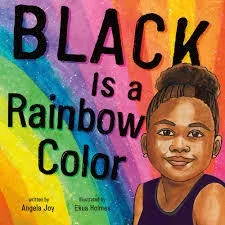 Black Is a Rainbow ColorAngela JoyA distinctive narrative begins with a young girl observing that there is no color black in the rainbow. She then notes things around her that are black—a crayon, her friend’s braid, the tires on a bicycle. As “black” subtly shifts to “Black,” the observations turn into marvelous references to African American culture. “Black is the robe on Thurgood’s back. Black are the trains on the railroad tracks. Black are the eyes on the salted peas. Black are the shadows of ooo-old magnolia trees.” An author's note places each allusion in historical and cultural context while a timeline also at volume’s also documents the use of terms such as “Negro,” “colored,” “Afro-American,” and even Malcolm X’s “so-called Negro,” concluding with “Black is back” and a note under “2020” stressing the importance of capitalizing Black “in the spirit of the W.E.B. DuBois campaign.” Ekua Holmes’ stunning illustrations visually extend this immersive, celebratory look at African American identity. For example, “Black is side-walking in spit-shined shoes” shows a sidewalk composed of historical newspaper headlines and stories, and her paintings echo stained-glass church windows throughout. As richly symbolic as they are, neither art nor text loses sight of the original child, whose final observation, “Black is a rainbow, too,” is set against art showing Black people with a range of variations in their hair and skin.Picture Books for School-Age ChildrenWord Count 394View book details
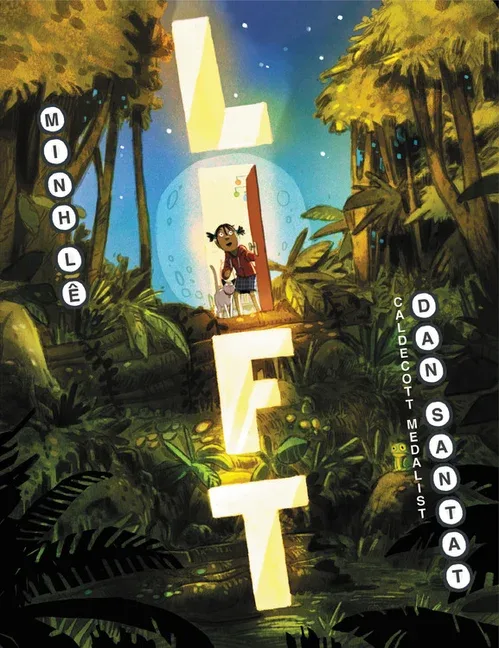 LiftMinh LêWhen Iris is “feeling a bit down,” a ride in the elevator never fails to give her a lift. There’s just something about pushing those buttons! It’s Iris’s special job. One day her little brother beats her to it, and in angry retaliation, Iris presses all the buttons. When she and her Asian American family finally arrive on their floor, Iris finds an elevator button in the trash, discarded by a repairman. She tapes it up beside her closet door, and to her surprise, the button lights up, transforming her closet into a vast jungle. She wants to explore, but the babysitter has arrived. Iris grumpily endures an evening of annoying toddler behavior from her brother (throwing food, overturning their board game) until bedtime, when she is finally alone and free to tour a new world. This time, as she floats in outer space, her adventures are interrupted by her brother’s cries. Instead of getting angry, Iris comforts him with a bedtime story, and, in the morning, takes him along on a new adventure. Drawn in panels, this story of imagination and escapism remains firmly grounded in a true-to-life sibling relationship.Picture Books for School-Age ChildrenLexile Text Measure 390LATOS Book Level 1.3View book details
 We Are Water ProtectorsCarole LindstromA young girl describes how water is viewed among her people. "Water is the first medicine, Nokomis told me... We come from water … The river’s rhythm runs through my veins. Runs through my people’s veins.” Water, Nokomis tells her, has a spirit of its own, and also connects the present generation to the ancestors and the past. The arrival of a black snake whose venom is threatening to poison the water leads the girl and her people to take action, standing together against the snake. They fight for the water, for the earth and its creatures, to defend all those who cannot fight. “We stand / With our songs / and our drums. / We are still here.” A book by an Ojibwe/Métis author and Tlingit artist was inspired by the Standing Rock Sioux Tribe protests against the Dakota Access Pipeline. In their notes, the author and illustrator tell more about Indigenous views, the Standing Rock Water Protectors, and their belief in the importance of this environmental activism to all. The gorgeous illustrations in overall vibrant hues convey the disruption and menace of the snakelike pipeline as it traverses some pages. The art incorporates details of Ojibwe culture while also representing “a diverse group of Indigenous Nations and allies.”Picture Books for School-Age ChildrenLexile Text Measure AD510LATOS Book Level 1.9View book details
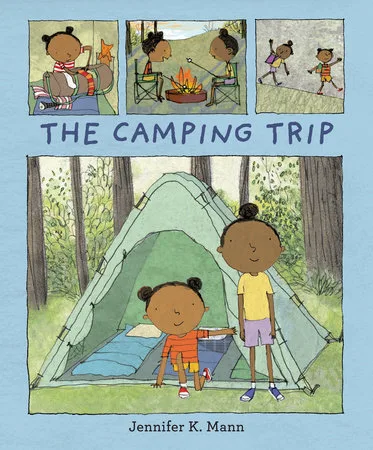 The Camping TripJennifer K MannErnestine can’t wait to go on her first camping trip, with her Aunt Jackie and cousin Samantha. “I’ve never been camping before, but I know I will love it.” Her anticipation mounts along with her preparations: getting a new sleeping bag, packing a duffle, and making trail mix with her dad. A long car ride finally ends at the campground, where it’s quiet and big, and “smells like trees, and fire, and dirt.” Putting up a tent isn’t as easy as building a fort at home, and the realization that fish are swimming alongside her in the lake sends Ernestine to shore. It turns out that hiking uphill is work, tofu hot dogs are as bad as expected, and missing her dad is hardest at night. But challenges are countered with nature discovery, scrumptious s’mores, and the beauty of a starlit sky. Aunt Jackie handles Ernestine’s qualms with calm confidence, and the two cousins play together with familiar ease. Gentle humor and engaging details, right down to endpapers itemizing necessities from tarp to playing cards, show this brown-skinned extended family introducing a new member to the realistic joys and adversities of camping.Picture Books for School-Age ChildrenView book details
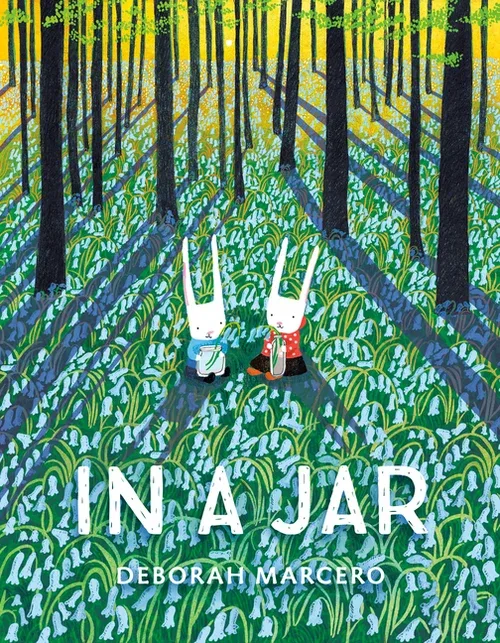 In a JarDeborah Marcero, illustrated by Deborah MarceroLlewellyn is a little white bunny who likes to collect things in small jars. He collects leaves, feathers, stones, and other simple artifacts of nature. When he meets another collector named Evelyn, he soon expands his collection to include more expansive things like sunsets, rainbows, and the wonders of winter, which he shares with her. This can be read as a whimsical story about collectors and nature appreciation, or as a metaphor for love. The lovely cadence of the writing is well-matched by the distinctive, creative illustrations that will stretch young imaginations. How, for instance, would you bottle wonder? Young readers can also pore over all the jars and their contents —all familiar things, for the most part, that one just doesn’t see in jars.Picture Books for School-Age ChildrenLexile Text Measure AD580LATOS Book Level 3.8View book details
 The Homesick ClubLibby Martinez, illustrated by Rebecca GibbonMónica is from Bolivia. Her best friend, Hannah, is from Israel. Both miss things about their homelands. For Hannah it’s the desert sun, the sound of the wind, and the little tortoise that lived near her home. Mónica misses the sound of the frogs, mango trees, and watching hummingbirds with her grandmother. In fact, she wishes she could bring a hummingbird for Show and Tell. Miss Shelby joins their class on Monday, after their regular teacher has a baby. Seeing Miss Shelby, who’s from Texas, standing alone in the lunchroom reminds Mónica that being new is hard for everyone—even teachers and grownups. Inviting Miss Shelby to join the Homesick Club she and Hannah started at lunch, she learns Miss Shelby misses the stars in the open sky, peach trees, the raccoon at her kitchen window, and hummingbird cake. Hummingbird cake? Once Miss Shelby explains, Mónica knows exactly what to bring for Show and Tell. Engaging details in both the narrative and art propel a story in which Mónica, Hannah, and Miss Shelby are wistful but not melancholy about what they’ve left behind.Picture Books for School-Age ChildrenView book details
 HikePete OswaldA brown-skinned father and his child (who could be any gender) wake up before dawn, eat breakfast, pack their car, and head out of the city and into the wilderness, where they spend the day hiking. There are more than a few dramatic challenges for the adventuresome duo in this not-quite-wordless story, from crossing a creek on a single log bridge to scaling a steep rise. There’s plenty of nature appreciation, too (e.g., they stop to watch an eagle and later plant a small tree). Most of all, there is the camaraderie of father and child. Except for the judicious use of onomatopoeia, the muted watercolor illustrations tell the story of their day, which ends back at home as they place a selfie they took into a family scrapbook, next to photographs of three earlier generations of father/child hikers.Picture Books for School-Age ChildrenView book details
 One Summer Up NorthJohn OwensA completely wordless picture book opens with a mom, dad, and child packed into a car topped with a red canoe, heading up north to the Boundary Waters on the Minnesota/Canada border. When they reach their wilderness destination, they leave their car, pack their camping gear into the canoe, and start to paddle, portage, then paddle some more until they reach a good spot to pitch their tent. It’s just the three of them, surrounded by nature, without another human being in sight. Each family member is shown in a moment of solitary contemplation, while the other pair engages in activities such as fishing, gathering blueberries, or simply enjoying the view over a mug of coffee. The textured illustrations in earthy hues give readers a sense of the expansiveness and the beauty of the natural world in this story featuring a multiracial family (the mom and child are dark- haired and brown-skinned, the dad appears white).Picture Books for School-Age ChildrenView book details
 Old Rock (Is Not Boring)Deb PiluttiTall Pine, Spotted Beetle, and Hummingbird all pity Old Rock, imagining how boring his stationary life must be. He proves them wrong as he describes how he once flew (launched from an erupting volcano), how he’s seen a lot through his years (dinosaurs, both friendly and not-so-friendly), how he once took a ride in a glacier, which left him perched atop a high ridge, and later somersaulted down to a valley where mastodons roamed. Eventually, he watched a seedling grow to be the tall pine that keeps him company, while a spotted beetle “wanders along to report all that he sees,” and “the loveliest hummingbird … describes the amazing places she’s visited.” In fact, Old Rock is perfectly content with his spot, and now his three friends agree. There’s light touch to Old Rock’s epic storytelling, and humor is often found in the dialogue bubbles that accompany his tale. A final page highlights some of the time periods mentioned in Old Rock’s life story, from 18 billion years ago to the present day.Picture Books for School-Age ChildrenView book details
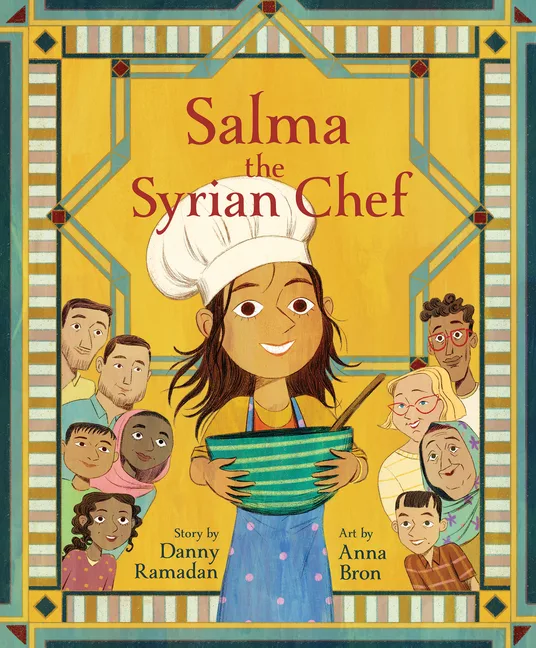 Salma the Syrian ChefDanny RamadanAt the Welcome Center in Vancouver, Salma and her mother adjust to their new life as they await the arrival of Salma’s father. Salma notices a persistent sadness in her mom, who used to laugh with her friends in the refugee camp. Attempts to elicit laughter from Mama with a funny drawing and a joke do not work, so Salma turns to Nancy, a helper at the Center, who suggests Salma draw a memory of a time when Mama was happy. With a handful of colorful Crayons, Salma sketches a scene: her family in their home in Damascus enjoying a meal of foul shami. That’s when it hits her. Surely the taste of Syrian food will cheer Mama up! With assistance from others, Salma prints out a recipe, shops for ingredients, and begins to cook. She runs into a few frustrating snags along the way, but with the generous help of her neighbors, the dish is a success—and Mama is delighted. Illustrations rich with cultural details and Syrian geometric design accompany this story of a creative and determined young immigrant and her supportive, diverse community.Picture Books for School-Age ChildrenLexile Text Measure 570LATOS Book Level 3.7View book details
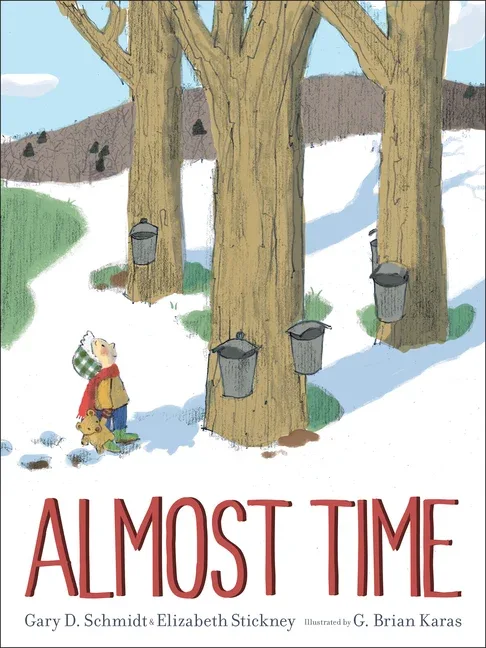 Almost TimeGary D. Schmidt, Elizabeth StickneyWith each late winter breakfast Ethan and his dad have without maple syrup (pancakes with applesauce, cornbread with butter, oatmeal with raisins and walnuts), Ethan asks if it’s sugaring time yet. And each time his dad specifies what they’re still waiting for—warmer days, shorter nights, and, finally, for Ethan’s loose tooth to fall out. “Now Ethan had two things to wait for.” This quiet, child-centered story about patience and waiting and, finally, gratification is filled with details of nature, as well as the process of making maple syrup. The illustrations aptly portray the yearning of a young boy (white) who’d like time to move faster and the dark nights to grow shorter.Picture Books for School-Age ChildrenLexile Text Measure AD500LATOS Book Level 3.3View book details
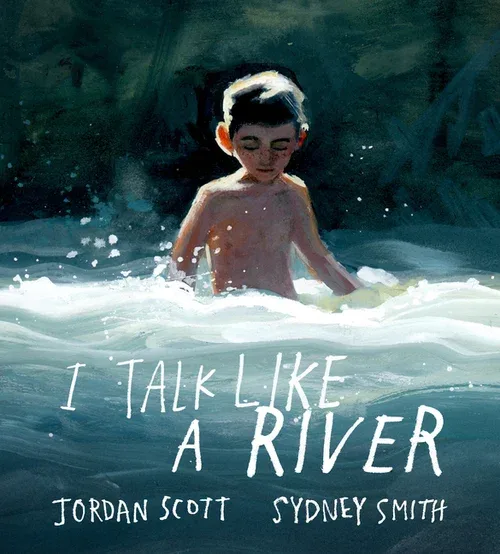 I Talk Like a RiverJordan ScottA white boy wakes every morning surrounded by the sounds of words (P for the pine tree outside, C for the crow perched on a branch, M for the fading moon) but can’t say them (“The P in pine tree grows roots inside my mouth and tangles my tongue.”) He stays quiet during breakfast, and hopes he won’t have to talk in class, where other students can’t see the sounds inside him; they only see the fear on his face, and hear the difference in his speech. After school his dad takes him for a walk along the river, where the quiet and companionship is comforting, but doesn’t erase the day’s pain. The father comparing his son’s speech to the movement of the river’s water gives the boy something to hold onto during distressing and lonely moments. “When the words around me are hard to say, I think of the proud river, bubbling, churning, whirling, and crashing.” An excellent author’s note relates his own experience with stuttering and owning his speech as “terrifyingly beautiful”—like a river. Stunning watercolor, ink, and gouache illustrations capture the child’s emotional landscape framed in the beauty of the natural world.Picture Books for School-Age ChildrenLexile Text Measure 480LATOS Book Level 3.1View book details
 Home Base: A Mother-Daughter StoryNikki TateA white mother and daughter are each facing challenges in this picture book that begins with the daughter getting ready to try out for the baseball team, while her mom is hoping to be hired to build a patio. As the story advances, the duo are shown in side by side images while single-word sentences describe what’s happening. “Cap. Glove. Shoes.” (girl) “Gloves. Goggles. Boots.” (mom) describe what’s happening as the two get dressed and ready to leave. This realistic look at what appears to be a single-parent, working-class family ends with success for both as the daughter pitches a winning game and the mother completes her construction job and they celebrate their success back home.Picture Books for School-Age ChildrenView book details
 The Blue HousePhoebe WahlLeo (who has long hair and both dolls and trucks in his room) and his dad love their old blue house. There’s moss on the roof, leaks in the ceiling, and peeling paint on the walls. Sometimes the heater breaks down. But father and son know just how to make it cozy: baking pies, building blanket forts, dancing in the living room. One day, Leo’s dad delivers some difficult news. Their landlord has sold the blue house to developers. They will have to move. Leo angrily locks himself in his room, but later he joins his dad in the living room for a cathartic song-and-dance session, where Leo does “a special scream solo.” Refreshingly, Leo’s emotions are calmly acknowledged by his dad, who talks about his own feelings and quietly helps Leo to express himself. In their new house, Leo and his dad paint the walls, bake a pie, and slowly begin to make the place theirs. Abundant details in the multimedia illustrations personalize this white family and their beloved dwellings.Picture Books for School-Age ChildrenLexile Text Measure AD520LATOS Book Level 3View book details
 The Most Beautiful ThingKao Kalia YangA fictionalized picture-book memoir of the Hmong author’s childhood focuses on her grandmother, who is “so old, no one knows how old she is.” When her grandmother was young, on the other side of the world, she “once looked into the gleaming eyes of a tiger and felt its hot breath on her face.” Now she is old, with a single tooth left in her mouth. Her grandchildren believe themselves lucky to be able to help take care of her. The child narrator’s job is clipping her grandmother’s fingernails and toenails while the latter shares stories of her own childhood. Grandmother and her three younger siblings were orphaned and often hungry, and that’s the reason Grandmother never says no when offered food today. As the child narrator grows, she begins to understand the economic challenges her own family faces, and to realize that her grandmother is beginning to lose some of her words, but she is always reminded of her grandmother’s smile as “the most beautiful thing.” The theme of respect and love for an aging family member is central to this moving story, as is the stunning, expressive art that includes visual references to Hmong fabric.Picture Books for School-Age ChildrenLexile Text Measure 650LATOS Book Level 4.2View book details
Books for Beginning Readers
6 selections
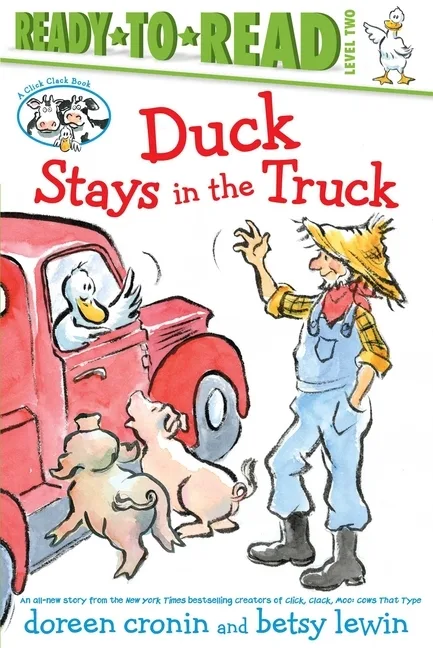 Duck Stays in the TruckDoreen Cronin, illustrated by Betsy LewinCronin, Doreen. Pool Party! Illustrated by Betsy Lewin. (A Click Clack Book). Simon Spotlight, 2020. 32 pages (978-1-5344-5418-7) Farmer Brown and his brother, Bob, both white, and a farmyard menagerie with big personalities star in this lighthearted duo of books geared for beginning readers. Anticipating the pleasure of hiking, fishing, and picnicking together, Farmer Brown, Bob, and the animal crew pile into the pickup truck headed to Breezy Lake at the opening of Duck Stays in the Truck. When they arrive at their destination, all set off in separate directions to fish, picnic, and hike; all that is, except Duck, who stays in the truck. A campfire and marshmallows bring them back together, and even Duck exits the truck to share in the fun. On a hot summer day, Farmer Brown and his animals head over to Bob’s to cool down in Pool Party! One duck, two brothers, three chickens, and four pigs take to the swimming pool’s water with ease. But five cows do not want to be splashed, crowded, or overwhelmed with loud noises, so the others obligingly climb out—until the hot sun sends them back into the splashy, noisy, crowded, and fun pool.Books for Beginning ReadersLexile Text Measure 310LATOS Book Level 2.3View book details
 What about Worms?!?Ryan T. HigginsA brave little tiger isn’t afraid of anything … except worms. They are slimy, they wiggle, and you can’t tell their tops from their bottoms. His fear of worms keeps him from enjoying a pot of flowers (there could be worms in the dirt!) and an apple (what if there’s a worm inside?!) Even a book is suspect, because it might be about worms. Meanwhile, several worms pop up from the ground and see a scary tiger, but they love all the discards he’s “given” them: dirt from a flowerpot, a half-eaten apple, and a book about tigers. They learn so much, and chase the nice little tiger to give him a “worm hug” of appreciation. Pacing and language just right for young readers will allow them to read aloud with expression while savoring the childlike humor of the story.Books for Beginning ReadersLexile Text Measure AD310LATOS Book Level 1.6View book details
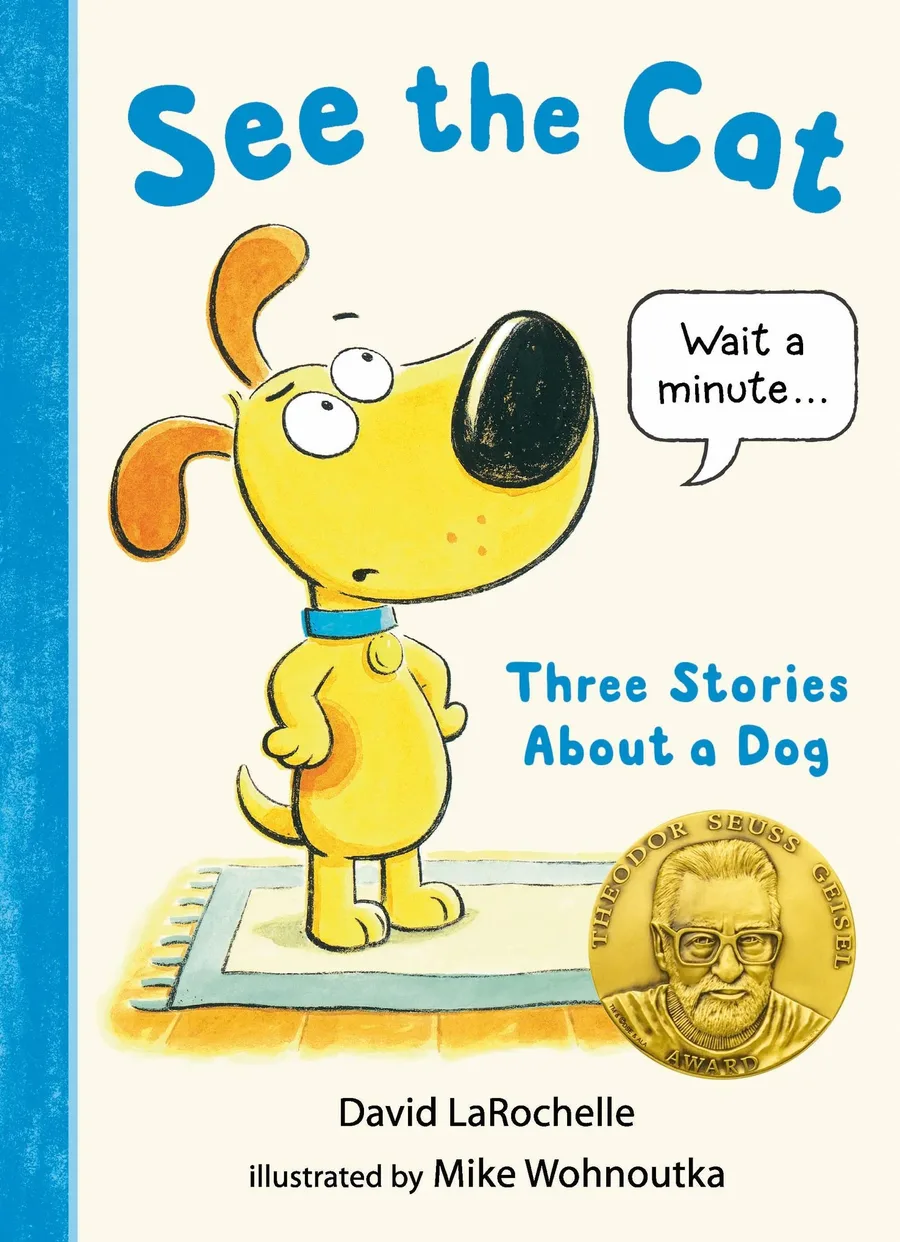 See the Cat: Three Stories about a DogDavid LaRochelleA beginning reader in three short chapters offers humorous metanarrative elements as a dog, speaking in dialogue bubbles, argues with the book being read. The first chapter begins, “See the cat.” In the accompanying illustration, which shows no cat, the dog responds: “I am not a cat. I am a dog.” The narrative text adds a descriptor with each page turn (the cat is blue, it wears a green dress, is known as Baby Cakes, and rides a pink unicorn), all as the dog becomes increasingly incensed. Then two wordless spreads show a unicorn entering the scene, ridden by a cat. With a turn of the page the narrative reads “See the red dog.” “I am so embarrassed,” says the dog. When the second story opens with “See the snake,” the dog laments “Here we go again.” This time he takes charge by editing the text with pencil. In the final story, the dog claims his full agency by identifying identifies the text’s vulnerability: “If I leave this book, no one will want to read it.” The interplay of the patterned text and conversational dialogue bubbles is both predictable and fun.Books for Beginning ReadersView book details
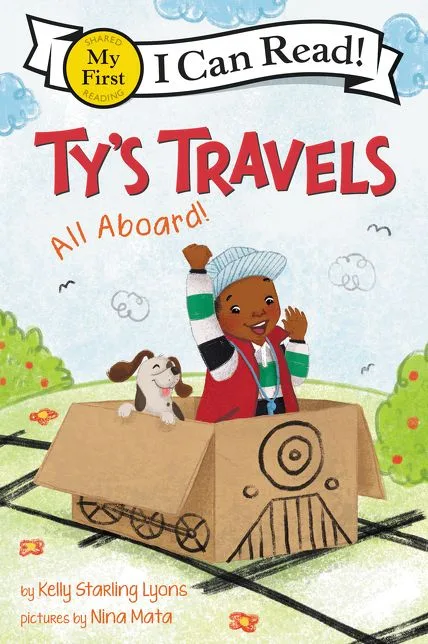 Ty’s Travels: All Aboard!Kelly Starling Lyons, illustrated by Nina MataLyons, Kelly Starling. Ty’s Travels: Zip, Zoom! Illustrated by Nina Mata. (My First I Can Read!) Harper, 2020. 30 pages (978-0-06-295110-6) Two spirited beginning readers feature a young Black boy with a big imagination. In All Board!, Ty asks each family member in turn if they can play with him. But dad is busy cooking dinner, mom folding clothes, and big brother Corey doing homework. So Ty plays on his own, turning an empty cardboard box into a train. He’s having so much fun as he imagines himself traveling past a farm and through a city that the whole family can’t resist joining in! In Zip, Zoom!, Ty, learning to ride his scooter in the park, imagines he’s in a race car zooming around the track while a crowd cheers. But even with his family’s encouragement, learning to ride is hard. “Wobble, wobble. I do not zip. I do not zoom.” Just when Ty’s ready to give up in frustration, a girl named Ari scootering by stops and offers help. “Ari zips. I zoom. We’re racing side by side.” The cheerful illustrations stylistically differentiate Ty’s life from his imaginative adventures.Books for Beginning ReadersView book details
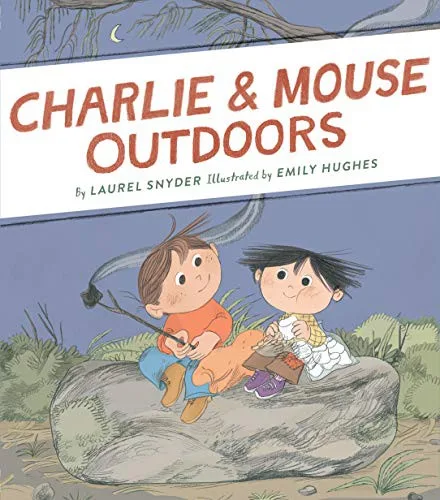 Charlie & Mouse OutdoorsLaurel Snyder, illustrated by Emily HughesThe fourth book in this easy beginning chapter book series takes the easy-going siblings on a weekend camping trip with their parents and, as typical of young children, they get bored on the way there. When their dad suggests they make up a story, older brother Charlies does, and their fictional adventures carry them through most of their camping trip. The events of their family outing are realistically uneventful, so thank goodness Charlie is there to make it all more exciting through his imaginative spin on things. Graphite illustrations, digitally rendered, show the closeness of these two mixed-race (brown-skinned/white) siblings, as well as their very different reactions to the same things.Books for Beginning ReadersView book details
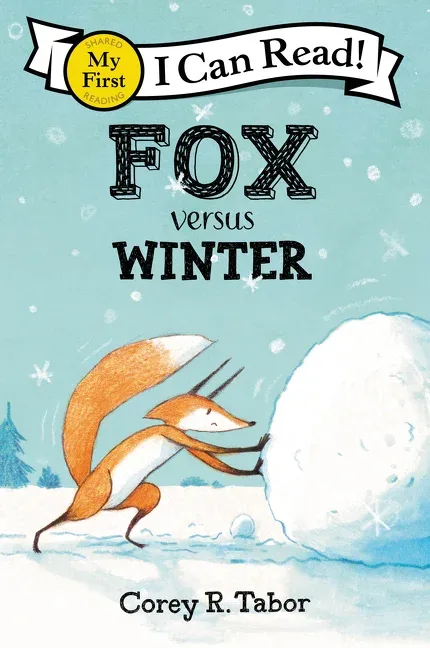 Fox versus WinterCorey R. TaborFox is not a fan of winter. His friends have all migrated south or are hibernating. He tries making new friends out of snow figures, but they don’t do anything. Fox packs his bags to head south, but the ticket windows for buses, planes, and rockets have closed for the season. Deciding to fight winter with a flame thrower seems like an excellent idea, until a blizzard extinguishes his weapon. Finally, he comes across Rabbit, who teaches Fox how to enjoy the solitude of winter, and they decide to be “alone together.” This simple and funny story employs an easy-to-follow plot, with added humor in the illustrations.Books for Beginning ReadersLexile Text Measure 290LATOS Book Level 1.2View book details
Books for Newly Independent Readers
2 selections
 Our Friend Hedgehog: The Story of UsLauren CastilloAfter Hedgehog’s beloved stuffed dog, Mutty, is blown off their island home during a storm, bereft Hedgehog swims to shore in search of him. Mole offers a listening ear, comfort and a plan: They’ll ask sharp-eyed Owl at Lookout Point. Owl asks questions, takes notes, and suggests they visit Beaver’s dam, where things can easily get caught. Beaver, who’s wearing Mutty’s red scarf, explains (somewhat defensively) that he found it in the marsh, which is where the ever-expanding group heads next. Hen and her Chicks are scavenging in the marsh, and busy busy Hen has found a picture of Mutty in front of a nearby house. At the house they all meet Annika Mae Flores, a camera-toting, brown-skinned, Latinx girl who recently moved in. Annika Mae has been looking for her lost story notebook (Owl may know something about that). She’s also found someone very important to Hedgehog. Hundred Acre Wood: Meet Hedge Hollow. Castillo’s sure-handed storytelling in this charming illustrated chapter book pairs her loose, expressive art style combining bold lines and warm colors with a narrative full of tenderness, deep feeling, high drama, humor, and warmth. The tale and its cast of distinctive personalities is an irresistible combination of words and images that will appeal to young listeners and independent readers alike.Books for Newly Independent ReadersView book details
 Wondrous RexPatricia MacLachlanSecond grader Grace’s Aunt Lily is a writer with whom Grace spends a lot of time because her parents are so busy. Is Grace a writer too? She’s learned some great words from Aunt Lily, and some things about writing from listening in when Aunt Lily’s writing group meets, but she doesn’t think of herself as a writer. Aunt Lily, in the meantime, is struggling with writer’s block. Thinking an assistant might help, she places an ad and ends up hiring Rex, a dog belonging to a magician. Rex can’t talk, of course. But he can read, and type on a computer. His calm presence and the inspirational quotes he finds online help get Lily back on track and inspire Grace to do some writing of her own. Just as Rex is far from a typical dog, Grace is far from a typical seven-year-old in this whimsical outing that never explains the magic of Rex, which only adds to its charm. Grace and her family are white in this story featuring occasional black-and-white illustrations.Books for Newly Independent ReadersView book details
Fiction for Children
45 selections
 The Girl and the GhostHanna AlkafSuraya is a lonely child with a sad, distracted mother. So when the pelesit (ghost) once bound to Suraya’s grandmother bonds with Suraya after the old woman’s death, its presence is welcomed by the little girl. She names the pelesit Pink and quickly grows to love him. Pink usually takes the form of a grasshopper and accompanies Suraya everywhere. Suraya’s grandmother used Pink to harm people. Even though he feels a bit uneasy about that part of his past, it’s a hard habit for Pink to break. When he hurts a group of kids who ignore Suraya, she forbids him from doing anything like it again. But Suraya makes her first good friend in Jing Wei, and jealous Pink can’t suppress his anger. When Suraya finally tells her mother about Pink, Suraya’s mother inadvertently invites a new threat when the healer she hopes can help sets out to capture Pink for his own evil purposes. Realizing the only answer is to lay Pink to rest once and for all, Suraya and Jing set off on a journey to find the grave of the child Pink once was. Suraya is exceptionally characterized from early childhood to the verge of adolescence in this fantasy grounded in Malaysian culture that balances genuinely scary elements with bright humor (such as Jing’s obsession with Star Wars) and deep feeling.Fiction for ChildrenView book details
 What Stars Are Made OfSarah AllenLibby, 12, has Turner syndrome, which makes nonverbal learning difficult and causes some health problems. She struggles to make friends, but her parents are supportive and loving, and her older, marred sister Nonny is her trusted confidante. When pregnant Nonny moves home while her husband is away for a job, Libby is thrilled. She can’t wait to be an aunt. But what if the baby has Turner syndrome, too? At school, Libby’s wonderful history teacher, Ms. Trepky, assigns a research project on someone not in their textbook. Ms. Trepky also tells Libby about a Smithsonian competition in which contestants must complete an education project about an underappreciated woman in STEM. Libby chooses astronomer Cecilia Payne for the assignment and the contest. She not only admires Cecilia, she often has imagined conversations with her. Libby’s contest plan is to lobby for Cecilia’s inclusion in the next edition of her textbook. She also makes a deal with Cecilia in her head: If she succeeds, Cecilia will keep Nonny’s unborn baby healthy. As she embarks on the project, Libby also makes her first good friend in Samoan American Talia, a new student who shares Libby’s frustration with a class bully. Libbys’ worries, her determination, her disappointments when determination isn’t enough, and her magical thinking around Cecilia Payne and Nonny’s baby are all appealing elements of this story featuring an extremely likable protagonist and well-drawn secondary characters. Author Allen, like her protagonist, has Turner syndrome.Fiction for ChildrenView book details
 War Is OverDavid AlmondThis short, illustrated novel set in England during World War I captures the nonsensicalness of war from a child’s perspective. John’s father is away fighting while his mother works at the munitions plant in his city. John, white, is struggling to make sense of the war, wonders when it will be over. He’s even written to the king and the Archbishop of Canterbury to ask them. (He’s received no replies.) When a pacifist challenges John and his classmates to reject propaganda telling them “they” are at war — you’re children, he says, you are not at war—the man is belittled and chased away, but not before dropping photos of German children. John secretly picks one up. The photo is labeled “Jan from Dusseldorf.” John can’t stop thinking about Jan and writes the German boy a letter, only to have the police show up at his house after mailing it. “You’re raising a traitor, miss,” the police tell his mom. Dreamed/imagined sequences in which John meets Jan are no more —-and perhaps less —surreal than the actual trip John and his classmates take to the munitions factory in a story firmly grounded in John’s open-hearted, innocent perspective in which politics do not matter (and has not, it must be noted, been influenced by the trauma of living in a war zone). Mostly somber black-and-white illustrations adeptly reflect the story’s emotional tenor.Fiction for ChildrenLexile Text Measure 631LATOS Book Level 4.1View book details
 Isaiah Dunn Is My HeroKelly J. BaptistSince ten-year-old Isaiah Dunn’s father passed away, his grieving mother has started drinking and lost her job. They’ve lost their apartment too. Isaiah, his mom and four-year-old sister, Charlie, are living in a motel room, a fact Isaiah is hiding from his best friend. African American Isaiah finds comfort in his father’s old notebooks, full of poetry and short stories about Isaiah as a superhero. Writing is important to poet Isaiah, too. Credibly naïve, he’s hoping to earn enough selling poems to get his family into an apartment again; he also enters one of his father’s short stories into a contest at the library, hoping for the cash prize. It takes second place, winning an amount far from enough to change their lives. But their lives are improving for other reasons, from his friendship with Angel, a classmate who bullied him until they discover through a conflict resolution program how much they have in common, to the help of a former neighbor who takes them in. Isaiah’s mom, who’s overwhelmed but trying, goes into rehab, and a public librarian whose been mentoring Isaiah helps him spearhead a library project to honor his late dad. Isaiah is a vibrant, likable character caught in the midst of family struggles that are very real. If the story’s upbeat outcome on every front is a little too good to be true, it feels welcome, and a testament to the importance of kindness, community, and compassion.Fiction for ChildrenLexile Text Measure 700LATOS Book Level 4.3View book details
 Fighting WordsKimberly Brubaker BradleyThe effects of trauma are explored with great honesty and sensitivity in a novel that never becomes graphic in its depictions of abuse. Ten-year-old Della and her teen sister, Suki (both white), had been living with their mother’s ex-boyfriend, Clifton, ever since a meth-related incident landed their mother in prison years ago. When Suki catches Clifton abusing Della, the girls are placed in a foster home with blunt-but-caring Francine. Suki, who has always been Della’s staunch protector and caregiver, struggles to cope with the years of sexual abuse she has kept secret. As Suki reaches a crisis point, Francine finally succeeds at getting mental health treatment for both girls. With the help of a therapist, Della begins to recognize her own feelings, understand what is happening to Suki, and practice healthy coping skills as she processes her own trauma. At school, Della stands up to a boy in her classroom who has long gotten away with snapping his classmates’ bra straps, underscoring the important lessons about consent in a story in which the fortitude of both sisters is admirable and not unrealistic.Fiction for ChildrenLexile Text Measure HL540LATOS Book Level 3.6View book details
 King and the DragonfliesKacen CallenderKing is a 12-year-old Black boy living in the bayou of Louisiana with his mom, dad, and the memories of his dead older brother, Khalid. Because he idolized Khalid, King always followed the advice his brother gave him, including dropping his friendship with Sandy, a white boy in King’s class rumored to be gay and who King later outed. But now Khalid is gone, and Sandy has run away from his abusive, racist father. King helps him hide and brings him food; aware his feelings for Sandy are more than friendship. The driving force of this quiet, contemplative novel are King’s complicated feelings about Khalid, who he believes, or imagines, will come back as a dragonfly. He also wants to believe his brother was perfect, but Khalid’s advice about King’s friendship with Sandy, even if it came from the desire to protect King, was hurtful, and wrong. In acknowledging the truth of this, and in his struggle to be seen and heard by his parents, King shines as his own singular self: young and gay, compassionate and sensitive, moving toward Black manhood on his own terms. A novel graced by exquisite writing beautifully captures the landscape of place and as well as deep feelings.Fiction for ChildrenLexile Text Measure 830LATOS Book Level 4.9View book details
 Love, LoveVictoria ChangFrances, 11, lives in Detroit with her Chinese-immigrant parents and older sister, Clara, whose hair has begun to fall out. Doctors can’t find a reason for the bald spot on top of Clara’s head and their mom buys Clara a wig to wear, which is stolen at school. Clara is generally a mystery to Frances so finding out from her sister what happened isn’t possible. Frances has one friend in the neighborhood, Chinese American Annie. Their friendship revolves primarily around hitting a tennis ball back and forth after school, but Frances and Annie think they know who stole Clara’s wig and scheme ways to get it back, to no avail. Meanwhile, their tennis court volleying brings Frances to the attention of a tennis coach, who invites her to practice with a team. Frances gains confidence playing tennis, but hasn’t stopped wondering about her sister’s hair, until a sneaky read of Clara’s diary reveals the truth: Clara’s pulling it out herself (an author’s note explains this is a psychiatric condition called trichotillomania). In this gorgeously written novel in verse, Frances is a carefully observant narrator revealing a slowly brightening emotional landscape in her specific, immigrant family. A playful moment shared by the sisters at story’s end suggests the beginning of something new and happier between them.Fiction for ChildrenView book details
 Leaving LymonLesa Cline-RansomeWith his daddy in Parchman Farms, the state penitentiary, Lymon is being raised by his grandparents in Vicksburg, Mississippi. After his beloved Grandpops dies, his aunts move Lymon and his grandmother, who can barely cope with her own needs let alone Lymon’s, to Milwaukee. When his daddy is released, Lymon hopes they’ll be together again, but Daddy makes promises he doesn’t keep, arriving in Milwaukee one day and leaving the next, always on the road for musical gigs. Lymon’s mother, who left him as a toddler, reappears on the scene when his grandmother’s health declines. She takes him to live with her in Chicago, where he has two younger half-brothers and a domineering stepfather. African American Lymon first appeared as a school-yard bully in last year’s Looking for Langston is seen here from the inside out. A story spanning a decade, from 1938 to 1947, shows Lymon’s anger and sadness build across years of abandonment and, eventually, physical abuse. The constant in Lymon’s life is music, which he “has an ear for,” and it’s music that brings respite, and adults stepping up that bring Lymon hope, by story’s end. Cline-Ransome demonstrates her genius for depicting setting and fully fleshed out characters with an economy of style that makes for a quick, yet deeply satisfying reading experience.Fiction for ChildrenLexile Text Measure 760LATOS Book Level 4.9View book details
 The Only Black Girls in TownBrandy ColbertAlberta lives in the small, tourist town of Ewing Beach, California, with her dads. She loves to surf, and often goes to the beach with her best friend, Laramie, who is white. Alberta’s is the only Black family in town, so she’s excited when Edie and her mom move in across the street. Edie, also Black, is from Brooklyn. As different as Alberta and Edie’s lives have been, they hit it off. When Edie finds old journals from a woman named Constance in the attic of her house —among a number of things left behind —she and Alberta are soon caught up in the narrative. Written in the 1950s and early 1960s, Constance’s journals gradually make clear she was a Black woman passing as white, and the girls are determined to find out what happened to her. Meanwhile, as so often is the case when a third person enters the mix, Alberta is finding it difficult to balance her old friendship with Laramie and her new friendship with Edie, a challenge further complicated by racial dynamics in their town, and in their friendships, that can’t be ignored. All three girls are interesting and complex in an engaging story that gives them permission to be themselves, even as they are expanding their understanding of who they are and how they choose to be in the world.Fiction for ChildrenView book details
 Class ActJerry CraftThis sequel to New Kid, following Jordan Banks into his second year of middle school at Riverdale Academy Day School (RAD), focuses in part on the differing experiences of Jordan and his friend Drew. Both boys are Black, but darker skinned Drew is treated differently at RAD, as revealed in scenes from his perspective throughout a graphic novel that again uses incisive humor to reveal unsettling truths. As the friendship between Jordan, Drew, and white Liam continues to develop, the wealth and privilege of Liam’s family leaves Drew in particular feeling more and more uncomfortable, as it’s a stark contrast to his own reality. The divide is underscored by the fact that Liam regularly invites Jordan and Drew to his house but doesn’t think to visit them in their neighborhoods, a dynamic that is challenged and finally changes by story’s end. The opening of each chapter references, in name and visual style, another well-known graphic novel, a clever, funny device that will delight graphic novel fans, though it may initially puzzle readers less familiar with the format.Fiction for ChildrenWord Count 14242View book details
 Santiago’s Road HomeAlexandra DiazAfter Santiago is kicked out of his unloving aunt’s home in Mexico, he meets young mother Maria Dolores and her small daughter, Alegria. The little girl immediately takes to Santiago and Maria Dolores is too kind to leave Santiago to fend for himself. She invites him to join them on their journey to El Norte. They find a coyote to take them across the border from Mexico into the United States, but greed and power dynamics among the coyotes leads to a violent attack, and the three end up stranded in the desert. They’re in desperate condition when a U.S. immigration patrol picks them up. Maria Dolores is hospitalized, and Santiago and Alegria are separated at a youth detention center. Over the next six months, Santiago’s sadness at losing the first people who truly felt like family turns to despair at believing they’ve deserted him after he discovers Alegria has been released. He makes a few friends during that time, and is singled out for his bright mind by an educator who teaches him to read. Still, living conditions are bleak and there are incidents of abuse and humiliation by the guards and bullying by some older boys. This wrenching look at the desperate conditions—physical, emotional, psychological—inside an immigrant detention center ends with relief and happiness for Santiago, but makes clear not every child there is as fortunate or resilient as he is.Fiction for ChildrenView book details
 What if a FishAnika FajardoA sudden change in summer plans has Little Eddie, 11, traveling to Cartagena, Colombia, where his late dad was from, to visit his half-brother. Big Eddie, 18, is caring for his ailing maternal grandmother, who wants to meet Little Eddie. Thinking of the end-of-summer fishing contest back home in Minnesota, Little Eddie hopes Big Eddie will teach him how to fish, like their father once taught him. Little Eddie barely remembers their dad, but knows he once entered the contest, too. But Big Eddie is resistant to fishing and preoccupied with caring for Abuela, who raised him after his mother’s death. Abuela, for her part, calls Little Eddie “Tito” and shares stories about his dad when he courted and married her daughter. She also helps him understand and experience the beauty and magic of Colombia. After Abuela’s death, Big Eddie accompanies Little Eddie back to Minnesota. Little Eddie still hopes his brother will teach him how to fish in time for the contest, but Big Eddie is moody and withdrawn. He’s grieving, Little Eddie’s mom, who is white, explains. Still, it hurts. So does the behavior of Little Eddie’s friend Cameron, who seems to have gone from a girl unafraid of being her singular self to follower of a trio of racist siblings who taunt him. A captivating narrative voice, deftly managed plot, and complex characters propel a story exploring identity, grief, loss, friendship, and, above all, love and family.Fiction for ChildrenView book details
 A Place at the TableSaadia Faruqi, Laura Shovan. Clarion BooksPakistani American Sara is in her first year at public middle school after previously attending a private Mosque school her family can no longer afford. Elizabeth, Jewish and white, is in the after-school cooking club Mrs. Hameed (Sara’s mom) is running. The two meet in the club and soon realize they have much in common, including immigrant mothers preparing for the U.S. citizenship test (or, in the case of Elizabeth’s British mother, not preparing, which worries her). Alternating chapters from each girl’s perspective chronicle their developing friendship and personal challenges. Sara is worried about her family’s financial situation, and wonders if her parents will ever support her desire to study art. Elizabeth is worried about her mom, depressed since the death of her own mother back in England; her dad’s way of dealing with it is to travel more than ever for work. As the two girls develop a recipe for an upcoming contest, their friendship is complicated by Elizabeth’s best friend, Maddy, whose racist, anti-Muslim comments are not only hateful but ill-informed. Sara is disappointed by Elizabeth’s silence, while Elizabeth knows she should challenge Maddy, but has no idea what to say. How Sara and Elizabeth openly discuss this tension is one of the welcome, intentional aspects of this appealing, insightful novel. So, too, is the role of food, including its connection to culture, and the young chefs’ realistic mistakes and false starts.Fiction for ChildrenLexile Text Measure HL680LATOS Book Level 4.4View book details
 When Life Gives You MangosKereen GettenEveryone in her small Jamaican town of Sycamore understands that Clara, 12, who used to love surfing, doesn’t go near the water anymore. Clara knows it’s because of what happened the previous summer, she just doesn’t remember what actually took place —no one is willing to talk about it, Clara most of all. She’s since had a falling out with her former best friend and cousin, Gaynah, unable to tolerate Gaynah’s meanness anymore. Clara is aware the silence surrounding what happened isn’t the only thing people don’t talk about in her family and town. There is the mystery surrounding her Uncle Eldorath, who lives a solitary life away from the village, vilified by rumors started by their pastor for reasons no one will explain to her. And there’s been silence of a different kind in the life of Ms. Gee in the years of estrangement from her daughter in New York, although that may finally be changing; Ms. Gee’s visiting granddaughter, Rudy, is Clara’s new friend. There’s a stunning surprise near the end of this story in which healing for Clara begins with acknowledging the trauma, grief, and loss of her past. A novel imbued with a marvelous sense of place also examines the complexities of community and human nature through singular characters whose actions occasionally undermine but most often sustain one another.Fiction for ChildrenLexile Text Measure 720LATOS Book Level 4.7View book details
 Shirley & Jamila Save Their SummerGillian GoerzBlending popular format and genre—graphic novel and mystery—Goertz introduces Shirley and Jamila, who have joined forces for the summer as a matter of convenience. Jamila wants to play basketball at a court several blocks from her home, and her overprotective mother is reluctant to let her go until Shirley suggests the two girls can go together. And while Jamila is shooting baskets, she notices that Shirley is frequently meeting with kids who seem to be coming to her for some sort of help or service. It turns out Shirley is a detective, and when Oliver, another neighborhood kid, approaches Shirley about a stolen gecko, Jamila is pulled into the case, even though Shirley would prefer to work alone. What follows is a highly entertaining mystery that takes the two friends—if they can call themselves that—to the pool and around the neighborhood as they talk to witnesses and suspects. In the end, the entire ordeal leads to a new group of friends for a number of kids who had been feeling pretty lonely. There is plenty of humor in the story, and plenty of diversity in their neighborhood, as well: Shirley is white, Jamila is brown- skinned and Muslim, and Oliver is Black. There’s also plenty of appeal for kids looking for a funny, satisfying, and heartwarming story.Fiction for ChildrenLexile Text Measure GN340LATOS Book Level 2.5View book details
 WinkRob HarrellSeventh grader Ross barely has time to wrap his mind around being diagnosed with a rare form of eye cancer before beginning eight weeks of daily radiation therapy after school. Ross is mortified by some of the side effects of treatment, from hair loss to eye droop to the droopy goop he has to apply, not to mention the impact on his vision. The looks of pity he gets from some kids at school don’t help, nor does avoidance from others, including best friend Isaac. His other best friend, Abby, is steadfast, but also has found out her family will be moving away. When memes implying he’s near death start circulating at school, Ross suspects rough-around-the-edges classmate Jimmy is behind them, but has no proof. Outside of school, Ross has been learning guitar from Frank, his radiology technician. The two bonded over music during Ross’s treatments, and Ross has found music an incredible outlet for his intense feelings. It turns out Frank knows Jimmy, a drummer, and suggests the two boys pair up to perform in the school talent show; Ross wants to enter to impress Sarah, a girl he has a crush on. Author Rob Harrell had the same kind of cancer as Ross, and the physical and emotional impact of the illness on Ross, who is white, as well as the reactions of those around him, including his parents (dad and step-mom), feels incredibly real in a story as full of wry humor as honesty.Fiction for ChildrenLexile Text Measure 580LATOS Book Level 3.8View book details
 TwinsVarian JohnsonAfrican American twins Francine and Maureen begin sixth grade with differing mindsets. Quiet, nervous Maureen is dismayed to be enrolled in Cadet Corps. A straight-A student, she worries her poor coordination skills won’t cut it. Worse, she shares only a couple of classes with her outgoing, confident sister, who has decided to run for class president. But when Maureen’s Cadet Corps instructor offers her extra credit for running for the same office, Maureen’s determination to up her grade pits the twins against each other. Friends feel forced to choose between them, and the tension follows them home as they work on their competing campaigns. Colorful, inviting illustrations depict visually distinct twins in this graphic novel about two individuals struggling to balance their close relationship with the need to assert and explore their unique identities.Fiction for ChildrenLexile Text Measure GN360LATOS Book Level 2.9View book details
 When You Trap a TigerTae KellerWhen biracial (Korean/white) Lily, her older sister Sam, and their mom move to Washington state to live with Halmoni, who is sick, Lily begins seeing a large tiger, which demands Lily open the jars in Halmoni’s basement and release the stories inside. Like her grandmother, Lily believes in magic. Although she knows tigers are tricksters in Korean tales, Lily says she’ll release the stories if the tiger will make Halmoni better. Lily’s effort to adjust to the move is made more challenging because teenage Sam, with whom she used to be close, seems angry all the time, while their mother is overwhelmed by Halmoni’s illness — revealed to be a brain tumor that impacts Halmoni’s behavior, and only seems to amplify the differences between the two. The small-town library becomes the source of a quirky new friend for Lily, a hopeful new beginning for Sam, and another perspective on Halmoni who, it turns out, has been a central figure in the community for years, known for sharing traditional Korean stories, food, and healing—all things Lily thought might not have a place in the predominantly white small town. The tiger, meanwhile, proves benevolent, not a trickster: The stories it wants released are painful memories Halmoni locked away: of her childhood in Korea, and loss through separation and immigration. In this moving, masterfully paced tale, Lily discovers healing can happen in the heart and mind, even if a body can’t endure.Fiction for ChildrenLexile Text Measure 590LATOS Book Level 3.8View book details
 We Dream of SpaceErin Entrada KellyThe three Nelson Thomas kids are in separate orbits in January, 1986. Cash is repeating 7th grade and feels inadequate at everything he tries; 12-year-old Fitch has frequent angry outbursts and finds escape at the local arcade; Bird, Fitch’s twin, loves taking apart small machines and drawing their schematics. She draws the machine that is her family, too: gears that aren’t working together no matter how Bird tries to fix it. Their parents fight constantly, hurling anger and insults at each other. At school, Ms. Salonga challenges her students to contemplate the how and why of human space exploration as she focuses on the upcoming Challenger launch in science class. Captivated, Bird dreams of becoming the first female shuttle commander and imagines conversing with Challenger astronaut Judith Resnik, who even offers thoughts on Bird being labeled “smart” but “plain” by her classmates. Bird also imagines what it would be like to have her friend Dani’s family, with parents who get along and pay attention. Bird is at the center of this story’s orbit, but Erin Entrada Kelly masterfully depicts the inner lives of all three children, who are white, as she builds to Challenger’s launch, an event Bird is watching. The tragedy of the shuttle’s explosion devastates Bird. Her brothers, unlike their parents, see their sister’s pain. In a novel rich with motifs and layers of meaning, they rise to meet it with love.Fiction for ChildrenLexile Text Measure 720LATOS Book Level 4.6View book details
 Brother’s KeeperJulie LeeIn December 1950, Sora, 12, and her family live under oppressive Communist rule in North Korea. Within her family, only- daughter Sora struggles under oppressive traditional gender roles. Her mother (Omahni) has forced her to drop out to of school care for her youngest brother, Jisoo, and learn to cook and keep house. When the war front approaches their village, the family flees for South Korea, hoping to join relatives in Busan. On the road, Sora and her 8-year-old brother, Youngsoo, are separated from their parents and younger brother during a violent attack. Uncertain if their parents and little brother are alive, the two continue the journey south. Over and over Sora must make life-and-death decisions, trying to keep them safe and alive. She carries Youngsoo on her back when he is too weak from starvation and illness to walk. Against the odds they arrive in Busan, but the relief for Sora proves only temporary as Youngsoo’s health continues to decline and her dream of returning to school is denied. The push and pull between Sora’s bitterness over the favoritism her mother and society give to her brothers and her genuine love for Youngsoo is painful and believable in a story that sees Sora’s understanding of family, loss, and love deepening. Above all, however, it’s affirmation of her own value that is transformative in this moving work.Fiction for ChildrenView book details
 A Ceiling Made of EggshellsGail Carson LevinePaloma (Loma) and her wealthy Jewish family live in a juderías, a segregated neighborhood where Jews are forced to reside in late 15th-century Spain. Loma is 7 when her grandmother dies of plague and her grandfather, Belo, impressed by Loma’s cleverness, begins taking her on his travels. Over the next ten years, Loma gains a deepening understanding of her grandfather’s efforts to protect Jews in Spain: Belo uses his wealth and connections with powerful Christians, including King Ferdinand and Queen Isabella, to do favors in exchange for the Jews’ safety. This includes collecting taxes from Jewish communities to support Spain’s war against the Moors. Safety is nonetheless tenuous and some Jews choose to publicly convert, risking torture and death if they are caught still secretly practicing Judaism. As she gets older, Loma grapples with deep disappointment when her dream of marrying and having children is denied so she can continue supporting her grandfather in his work, while her brother’s conversion puts their family at greater risk. When Belo and Loma learn that all Jews will be forced to convert, leave Spain, or be killed, their entire community is in peril. This fascinating, thoroughly researched novel unfolds at a measured pace, offering a detailed tapestry of Loma’s family and community and Loma’s growing maturity across the story’s 10-year span.Fiction for ChildrenLexile Text Measure 670LATOS Book Level 4.8View book details
 Show Me a SignAnn Clare LeZotteMary lives in Chilmark on Martha’s Vineyard in 1805. Along with a significant portion of the population of Chilmark, Mary is deaf. There is no distinction between those who can and cannot hear and most in the community know and use sign language. When a scientist from the mainland arrives, it quickly becomes clear he thinks people who can’t hear suffer from an “infirmity” and are less intelligent than hearing people. Kidnapping Mary, he takes her to the mainland, turning her over to another scientist who plans to conduct research to understand why some people can’t hear. The kidnapping plot makes for high adventure, but it’s as a work of historical fiction illuminating Mary’s community and its little-known history that this novel shines. Author LaZotte, who is Deaf, includes an informative note telling more about the high incidence of deafness on Martha Vineyard and other aspects of the island’s history. The novel’s fascinating backstory is wonderfully realized in her depiction of the setting and people of Chilmark. The story and author’s note also reference the complex, troubling, and too often unacknowledged history of how colonialism and white settlement impacted Indigenous Wampanoag and Black community members. Fictional Mary’s attitudes toward Wampanoag and Black members of her community are likely be progressive for a white person of the time.Fiction for ChildrenLexile Text Measure 730LATOS Book Level 5.1View book details
 Mulan: Before the SwordGrace Lin, illustrated by Grace LinIn this telling, the Chinese hero Mulan’s journey to greatness begins after her younger sister, Xiu, is bitten by a spider—the shapeshifter White Fox demon Daji in disguise. Daji believes Xiu is the girl prophesized to one day save the emperor. The healer who arrives to help is an immortal, Jade Rabbit, who explains that the medicine that will save Xiu requires two hard-to- obtain ingredients, one of which resides in the garden of the Queen of the Immortals. Mulan, who believes herself is a failure at everything a good daughter should be, adores her perfect sister. Ignoring all conventions and expectations, she sets off on her beloved horse, Black Wind, to join Jade Rabbit on a quest to find the ingredients. Their search is complicated by Daji who, assisted by Red Fox, repeatedly tries to trap, hinder, and mislead Mulan in various guises. Meanwhile, Jade Rabbit is growing increasingly weak, having also been bitten by Daji’s spider form, which forces Mulan to take the lead more and more in their quest. Eventually Mulan finds herself in the midst of an army of warriors, desperate to hide her identity, only to discover that as her true self she can lead them all. Irresistible characters inspired by Chinese folklore, an action-packed plot, numerous stories-within-the-story that further illuminate histories and connections among the characters, and beautiful bookmaking combine in this rich and lively tale.Fiction for ChildrenLexile Text Measure 820LATOS Book Level 5.8View book details
 What Lane?Torrey MaldonadoSixth grader Stephen and his best friend Dan share a passion for superheroes, live in neighboring apartments, and spend a lot of time together. Stephen thinks they are essentially twins, except that they don’t look alike. Light-skinned Stephen has a Black dad and white mom, while Dan is white. They’ve always had each other’s backs, but lately Stephen is bothered that Dan doesn’t seem concerned by his cousin Chad’s racist jabs. Chad taunts Stephen and tries to get him into trouble, and Stephen finds it hard to stand up to those aggressive tactics. He’s begun noticing how people treat him differently than his white friends, even when they are all doing the same thing. And his Black friends are starting to give him a hard time about abandoning them to hang out with the white kids. His dad is schooling him on the dangers of being a Black man, lecturing him to always be careful in public, while his mom wants to shelter him from what she believes are adult concerns. Stephen wants to occupy all lanes, and resents feeling pushed to choose one over others. Through the course of this short novel, Stephen personal beliefs about tough issues of race, identity, and the complexities of friendship evolve as he transitions between childhood and adolescence.Fiction for ChildrenLexile Text Measure HL500LATOS Book Level 3.5View book details
 The Time of Green MagicHilary McKayAfter Abi’s dad marries Max and Louis’s mom, the family rents an old, vine-covered house that has more space and both parents take on additional work to afford it. In the midst of these big changes, Max, 14, has fallen out with best friend Danny and developed a crush on Esme, the French art student hired to care for Louis after school. Louis, 7, misses and worries about his mom, whose new job takes her to dangerous places in other parts of the world. And Abi, 12, sometimes resents sharing her dad with the boys. She’s also noticed something strange in the house: Whenever she reads a book, the world of the story becomes real. She’s found herself sailing on the Kon-tiki, and sitting in a bus teetering on the edge of a cliff. When Louis confides to Abi that he’s been keeping a secret pet he calls Iffen, a “cat-thing” that started out small and friendly but has since grown large and wild, Abi realizes that Iffen must come from a book, too, but Louis actively resists reading, so what book? Finding the answer, and returning Iffen to the book from which it came, requires the cooperation of all three kids, cementing their transformation into a family. A novel that wonderfully integrates the magic of books into the real world is classic Hilary McKay: observant, thoughtful, poignant, and laced with brilliant dashes of humor. Biracial Abi is Jamaican/white, Max and Louis white, in this story set in Britain.Fiction for ChildrenLexile Text Measure 750LATOS Book Level 4.8View book details
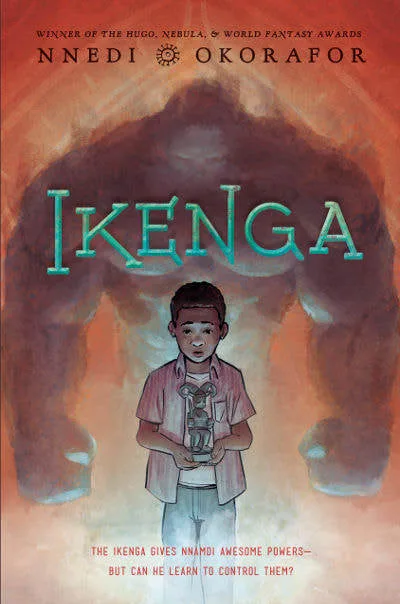 IkengaNnedi OkoraforNnamdi’s dad was the police chief of Kaleria, Nigeria, until his unsolved murder a year ago. A surprising and all-too-brief encounter with his father’s ghost leaves 12-year-old Nnamdi in possession of the Ikenga, a magical statue. With it, Nnamdi can transform into a larger-than-life, powerful man. He begins targeting the community’s chronic criminals almost by accident, but soon hopes to avenge his father by discovering who was behind his murder. The more he transforms, however, the more Nnamdi struggles to manage his powers and the rage that is starting to become a regular emotion, even when he’s himself. And while this mysterious avenger with the dark black skin was initially praised, media coverage begins shifting perception, framing him as someone to fear. The kidnapping of a classmate gives Nnamdi and his best friend, Chioma, the opportunity to begin to put all the pieces of the mystery together, but there are still unexpected revelations before Nnamdi discovers the truth behind his father’s death. Nnamdi’s grief and anger over the loss of his father are so genuine in a story in which the challenges of mastering his supernatural abilities and feelings so he doesn’t turn violent adds to the tension.Fiction for ChildrenLexile Text Measure 670LATOS Book Level 4.6View book details
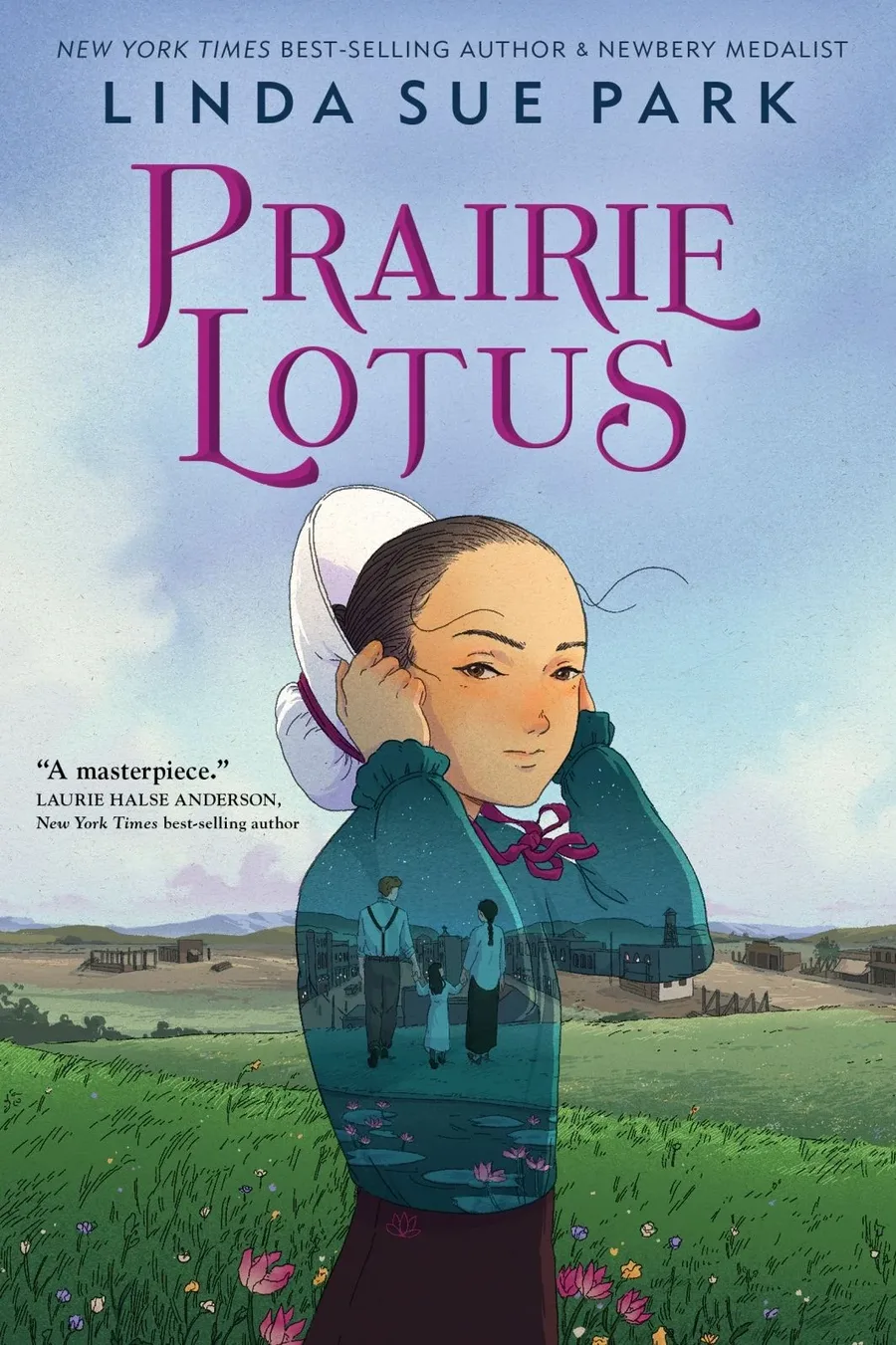 Prairie LotusLinda Sue ParkHanna’s mama died when Hanna was 12. Now 15, she and Papa have left Los Angeles far behind to start over in the growing frontier town of LaForge, Dakota Territories, in 1880. Hanna has two strong desires: to get her diploma, and to make dresses for the fabric shop Papa is opening. Papa, who is white, doesn’t want Hanna to sew for the shop. He and Mama owned a dress shop, but because Mama was Chinese many assumed he married her to get free labor. Hanna knows her parents had a marriage of love and a true partnership in business, but Papa is worried what people will think. And when most of the other families pull their children out of school in protest after Hanna starts attending, Hanna isn’t sure people will even come to the shop once it opens. There are numerous similarities to Laura Ingalls Wilder’s Little House books here, many of them captivating. There are also critical, intentional differences. Racism on the frontier is openly acknowledged and examined through Hanna’s experiences and observations, while the Native people (Oceti Sakowin/Lakota) Hanna meets are portrayed with respect and dignity. Park writes about the Little House books, which she loved as a child, in an author’s note that begins, “I wrote Hanna’s story as an attempt at a painful reconciliation.” Familiar or not with those books, readers will find this one a deeply satisfying story with a resilient, winning protagonist.Fiction for ChildrenView book details
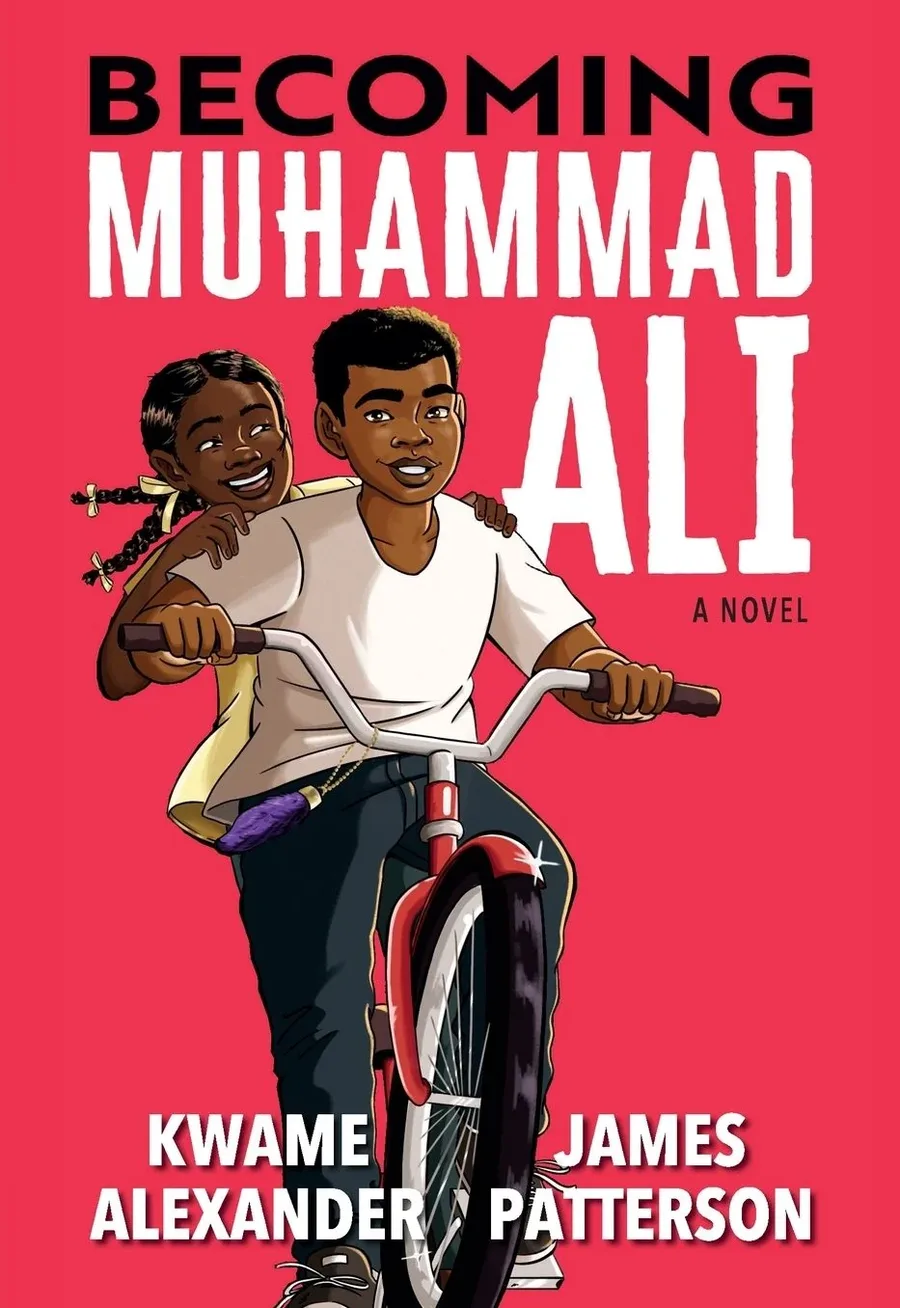 Becoming Muhammad AliJames Patterson, Kwame AlexanderCassius Clay grew up in a segregated Louisville, with a close family that included a beloved grandfather and lots of friends. His best friend Lucky narrates the prose sections of this novel, while Cassius’s sections are in verse. When the theft of his new red Schwinn Cruiser Deluxe bike led Cassius to Joe Martin’s gym, it triggered his drive to become a boxer and provided the venue for his early development. This focus on Cassius’s childhood and adolescent entry into the amateur boxing world is bookended by his 1958 performance in the Golden Gloves championship bout. Lucky’s sections provide insight into his friend’s character and context for the cultural and social stage of the time, while Cassius’s free verse infuses personality and energy into this accessible account of the boxing superstar as a young person.Fiction for ChildrenLexile Text Measure 1010LATOS Book Level 5.4View book details
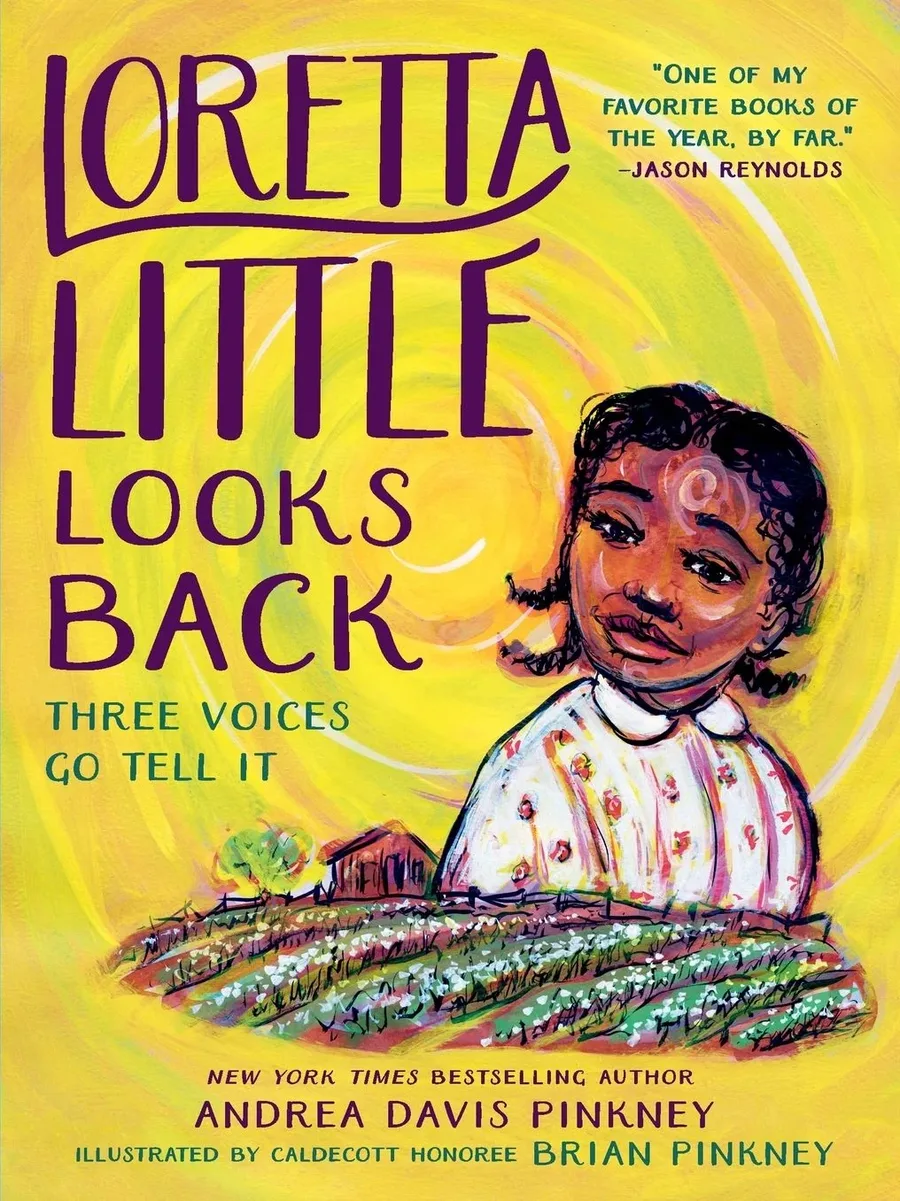 Loretta Little Looks Back: Three Voices Go Tell ItAndrea Davis Pinkney, illustrated by Brian PinkneyIn lengthy monologues well suited to reader’s theater, three members of the fictional Little family speak about life in Jim Crow- era South. In 1927 Loretta Little lives with her sharecropper father and siblings and often witnesses their white landlord demean her father. When Loretta and her sisters find an abandoned baby, they name him Roly and take him in. By the time Roly is a teenager, he and his family own some land. The second narrator, Roly recounts an incident in which a group of white men poisons his family’s farm animals. Roly marries and has a daughter, Aggie, but his wife leaves the family to pursue a different life up north. As a girl in the 1960s, third and final narrator Aggie accompanies her Aunt Loretta as she attempts to register to vote. Having seen her struggle through a rigged and unfair exam of arbitrary questions, Aggie helps her aunt study for the test and raise money for the poll tax so that she can vote. Through their personal narratives, the Littles guide readers through four decades of daily life, hardship, and maddeningly slow political and social change.Fiction for ChildrenView book details
 Trowbridge RoadMarcella PixleyIn the summer of 1983, June’s father recently died of AIDS, and June’s mom isn’t just grieving, she’s falling apart: The illness and death of June’s dad’s exacerbated her mom’s mental illness. Now her mom won’t leave the house, while her overwhelming fear of germs—she insists everything, including June, be cleaned with bleach—dominates their life. June, often hungry, only gets reliably fed when her Uncle Toby comes by with weekly groceries—an intrusion her mom is terrified of. When Ziggy moves in nearby with his grandmother, June covertly watches them, imagining what it would be like to live within the love of Nana Jean’s home. June and Ziggy, both branded as outcasts in the neighborhood—Ziggy for his long hair and appearance, June because of her mother’s strange behavior and how her dad died—become friends, often escaping into a shared world of their imaginations. For June, this is respite from her increasingly desperate situation at home. For Ziggy, it’s respite from uncertainty: His mom is struggling, too, with a boyfriend who hits her whom she can’t bring herself to leave. A book filled with pain is also marked by the resilience of June and Ziggy (both white), and the welcome, necessary relief of adults who figure out that they need to step up and step in.Fiction for ChildrenView book details
 A Game of Fox & SquirrelsJenn ReeseSamantha, 11, and her sister Caitlyn, 14, have just arrived at their aunt Vicky’s in Oregon, but Sam is already thinking about going home. Caitlyn, who has a broken arm, seems content. After Aunt Vicky gives Sam a beautiful old card game called “Fox & Squirrels,” Sam encounters the dashing fox and friendly squirrels from the game in the woods. She’s determined to succeed at the challenges the Fox sets to earn the Golden Acorn, with which, he explains, Sam can wish herself back home. But the fox’s requests are morally questionable and increasingly disturbing, while his unpredictable personality and the way the squirrels strive to not upset him mirrors a truth that Sam doesn’t want to admit—the truth of why they’ve come to stay with Aunt Vicky and her wife, Hannah: Sam and Caitlyn’s dad is dangerous in the exact same way, and Caitlyn’s broken arm was no accident. A book that explores child abuse and its impact within a family—their mother’s ineffectiveness at protecting them, Caitlyn’s efforts to protect them both—and across generations—Vicky and their dad were both victims as children—is tense but also beautifully reassuring, especially as Vicky and Hannah provide safety and support for the sisters. The line between fantasy and reality is never delineated in a book about a white family that allows readers to mine their own meanings from its depths.Fiction for ChildrenATOS Book Level 4.6AR Interest Level Middle Grades (MG 4-8)View book details
 Black Brother, Black BrotherJewell Parker RhodesDonte and his brother have recently started at a new mostly white, wealthy school called Middlefield Prep. The middle class brothers are biracial (Black/white), but while Donte presents as Black, Trey presents as white, and Donte’s experiences at the school are very different from Trey’s. Donte feels alienated at Middlefield, where he often finds himself blamed for things he didn’t do and any frustration he expresses is clearly perceived as threat of violence; he’s also bullied by a blatantly racist kid named Alan (king of the fencing team), who taunts him by calling him “Black brother.” Donte wishes Trey would join the fencing team and beat Alan at his own game. Trey urges Donte to learn to fence instead, and with the help of Black, ex-Olympic fencer Arden Jones, who works at the nearby Boys and Girls Club, Donte does. This hard-to-put-down story follows Donte through fencing training and competitions that inevitably lead to a satisfying showdown with Alan and Middlefield prep. Along the way, it illuminates racism in the sport of fencing, in the justice system (where class issues also come into play), and in schools, with Donte’s experience at Middlefield Prep echoing the way assumptions about and perceptions of Black students in schools feed the school-to-prison pipeline.Fiction for ChildrenLexile Text Measure HL400LATOS Book Level 2.8View book details
 Race to the SunRebecca RoanhorseNizhoni Begay is a Diné (Navajo) seventh grader who can see monsters masquerading as regular people. This includes Mr. Charles, the white head of a big oil company who’s is only pretending to be interested in hiring her dad in order to capture her younger brother, Mac, for his ability to control water. Nzhoni knows she has to figure out how to stop Mr. Charles. Mr. Charles, for his part, is intent on stopping her. With the help of Mr. Yazzi, a toy horned toad come to life, Nizhoni sets off with Mac and their friend Davery, who is Black/Navajo, to gain the knowledge and gather the gifts that will help defeat Mr. Charles. Their quest takes them first to the home of Diné Holy Person Spider Woman, who gives them a map to the home of the Sun, where they can get weapons forged to fight the monsters. Along the way, they must stop at each of the Four Sacred Mountains to gather gifts and pass through a series of obstacles that transform according to each of their weaknesses/traumas. For Nizhoni, whose mother also had the ability to see and fight monsters and was being trained by Mr. Yazzi when she was disappeared years before, this means reckoning with her loss. Nizhoni is the first-person narrator at the center of an immensely likeable cast of heroes in this captivating fantasy.Fiction for ChildrenLexile Text Measure 680LATOS Book Level 4.4View book details
 The Mulberry TreeAllison RushbyImmy and her parents have moved from Sydney, Australia, to a small town just outside Cambridge, England. Both Immy’s parents are doctors, and although they told her they’ve moved for her heart surgeon mom’s new job, Immy knows they also left Australia because of her dad’s depression: He’s been unable to work since an accident involving one of his former patients. They rent Lavender Cottage despite warnings that the gnarled, centuries-old mulberry tree in the backyard was responsible for the disappearance of two girls —one in the 18th century, one in 1945 —on the eve of their 11th birthdays. To soon-to-turn 11 Immy, who is white, the tree does feel ominous, but neither she nor her parents believe the stories. Their new neighbor Jean is truly worried for Immy, however: It was her best childhood friend who disappeared in 1945. Almost everyone in town, it turns out, has beliefs and prejudices shaped by stories about the tree, and Immy is drawn into researching the missing girls and the mulberry tree’s history. At the same time, she’s trying to fit in at a new school, and struggling with feelings of frustration and anger at her dad’s inability to function. A novel that is tense and eerie is also compassionate and insightful as it weaves realism and the supernatural into a story where elements of the present parallel the past, and forgiveness and healing go hand-in-hand.Fiction for ChildrenView book details
 MañanalandPam Muñoz RyanSet in a fictional Latinx country, Santa Maria, “somewhere in the Americas,” this allegorical tale centers on Max, who has been raised by his father and grandfather. He never knew his mother —she left when he was still a baby. Although Max would like to follow his passion for soccer, instead he works with his father, a stonemason/bridge builder, on his latest project, gathering stones from the legendary complex that includes a tower, La Reina Gigante. The tower is rumored to be haunted by the spirits of refugees who hid there while fleeing their neighboring country of Abismo during time of war and oppression. Max is surrounded by stories that may be just that—stories. For example, his grandfather was rumored to be one of The Guardians, locals who protected the refugees that sheltered in tower over the years. When Max is called upon to help a young refugee, Isadora, on her journey to her next checkpoint, he realizes that the stories he has heard his grandfather tell all his life actually hold the clues he needs to reach their destination, while the journey itself holds clues to the reason for his mother’s departure years before. Despite the fantasy setting, this story in which Max grows from self-centered to selfless as he helps the young girl escape has many parallels to contemporary and historical issues, from war and indentured servitude to refugees and immigration to the Underground Railroad.Fiction for ChildrenLexile Text Measure 650LATOS Book Level 4.5View book details
 Land of the CranesAida SalazarFourth grader Betita loves creating picture poems—drawings accompanied by words to capture her experiences and feelings. Her father loves telling her stories about Aztlán (the land of cranes), and likens their family to cranes flying free, their escape to the United States to flee cartel violence in Mexico a return to ancestral homelands. When Betita’s father is picked up at work and deported by ICE, Betita and her pregnant mother make the long drive to visit him at Friendship Park at the border in San Diego, only to miss the exit. Detained as undocumented immigrants trying to come back, they’re caged with other women and children on a cold floor, given silvery blankets that provide no comfort and little warmth. Lice is rampant; the food is barely edible; the guards uncaring, sometimes abusive. Betita’s mom offers support and encouragement to Betita and others, but when she’s hospitalized after frightening pregnancy complications, Betita is left alone. A lawyer working on her father’s case, a young activist who has also been detained, and a family Betitia becomes close to provide respite from that fear, as do Betita’s picture poems, which become a way for her and others to document what is happening to them. This child-centered novel in verse in Betita’s voice conveys the warmth and love of her family in early pages as vividly as the coldness of the detention center, and her fear.Fiction for ChildrenLexile Text Measure 890LATOS Book Level 5.1View book details
 Can You See Me?Libby Scott, Rebecca WestcottTally is anxious about starting middle school. Her best friend Layla will be there, but she’s still afraid of getting lost or overwhelmed, and worries about not knowing the rules, social and otherwise. Layla is the only person who knows that Tally, who is white, is autistic (a term Tally uses). Tally works hard to fit in at school; it’s exhausting, and made more challenging by Luke, a classmate who gives her an especially hard time. At home, Tally’s supportive parents are sometimes exasperated by her behavior, as is her older sister, Nell, who often gets fed up. A story told in third person is punctuated by first-person diary entries in Tally’s voice written by coauthor Libby Scott, a 12-year-old with autism. The result is a novel offering incredible insight into Tally’s particular experience and outlook. Tally is smart, funny, observant, and sensitive. She knows what she needs from others and longs to be seen as a person rather than her diagnosis, which includes “pathological demand avoidance,” a condition that makes it nearly impossible for her to perform any task that has been directly demanded of her. Tally also has frequent meltdowns, which, unlike tantrums, she explains, she can’t control. And she experiences anxiety—a lot. Sometimes, wearing her special tiger mask helps; in fact, Tally thinks Tiger Girl is braver than regular Tally. But of course they are one and the same, something Tally is learning to embrace.Fiction for ChildrenLexile Text Measure 350LATOS Book Level 2.5View book details
 Not Your All-American GirlMadelyn Rosenberg, Wendy Wan-Long ShangWhen sixth grader Lauren and her long-time best friend Tara try out for the school musical, “Shake It Up!” (hula hoops and Elvis are involved), Lauren aces her audition while Tara does okay. But it’s Tara who gets the starring role. The teacher explains that blonde-haired Tara embodies the “all-American girl” female lead, the clear implication being that dark-haired, biracial, Chinese American Jewish Lauren does not. Lots of 1980s details in this novel that revisits characters from the authors’ earlier collaboration, This Is Just a Test, place this story firmly in that decade, but the essence of the plot and its exploration of identity could be happening now. The more Lauren thinks about the racist implications of how the teacher is interpreting “all-American” the more upset she becomes. She finds camaraderie with fellow chorus members, and comfort in the emotionally rich songs and voice of a country singer she discovers on the radio, even after learning the woman wasn’t a Jewish singer breaking barriers in that genre (it turns out her name is Patsy Cline, not Patsy Klein). By story’s end, Lauren and Tara’s friendship has been tested and survived, while the cast comes together in a subversive opening night maneuver that affirms “all-American” is an identity that embraces them all in a story that deftly moves between humor and deep feeling.Fiction for ChildrenLexile Text Measure 630LATOS Book Level 4.4View book details
 When You Know What I KnowSonja K. SolterTen-year-old Tori’s Uncle Andy, her mom’s brother, has been a constant, loved figure in her life. Then he molests her. She’s already confused and scared when she tells her mom. “Honey / you must have misunderstood. / You know how he plays around / how goofy he is / just like you.” Further traumatized, Tori is rage and numbness. When Tori’s mom finally asks Tori to tell her more, she takes needed action that has a ripple effect. Tori’s grandma, refusing to believe Tori, is furious the police have been called. Tori’s dad—her parents are divorced—threatens to fight for custody. Tori’s little sister—the one person who believed Tori from the beginning—feels ignored when Tori gets all their dad’s attention. Even her best friend is wondering why Tori is acting so strange. Tori (presumably white) is afraid to tell her friend the truth of what happened, including the fact that she let her beloved hamster, Furball, given to her by Uncle Andy, out of his cage and he’s been missing ever since. This vivid, emotionally authentic novel in verse is grounded in Tori’s perspective. Her struggle with what happened is complicated by the behavior of people around her, whose responses reveal their own struggles. By story’s end, Tori is feeling stronger and more certain of herself and the people she knows she can rely on.Fiction for ChildrenView book details
 A Wish in the DarkChristina SoontornvatPong has grown up in Namwon Prison in Chattanna city, born to a prisoner who later died. Nok, daughter of Namwon Prison’s warden, has grown up believing in the rule of law established by the city’s governor. Escaping Namwon at 9, Pong spends four years at a Buddhist temple in the mountains, taught and protected by Father Cham, before Nok’s family arrives in the nearby village. Knowing Nok has recognized him, Pong flees. Nok goes in pursuit, wanting to prove herself to her family. Back in Chantanna, Pong gets caught up in a resistance movement among the city’s poor against the government. He’s motivated less by the fight for justice than the movement leader’s promise to help him flee the city again. Nok, hunting for Pong, feels no compassion for the hardships of the city’s poor. As the governor, whose costly magical orbs light the city, says: “Light shines on the worthy.” Nok doesn’t see that wealth, not worthiness, determines opportunity, and government laws perpetuate the economic status quo. A vibrant, richly textured fantasy in a Thai-inspired setting moves back and forth between Pong’s and Nok’s narratives, which collide at the protest in this homage to Les Miserables and its social justice-driven themes. Pong and Nok lead an entire cast of memorable characters, and the two protagonists don’t just come to see the world around them more clearly, but themselves and one another, too.Fiction for ChildrenView book details
 The List of Things that Will Not ChangeRebecca SteadTwelve-year-old Bea’s parents divorced amiably two years ago, after her Dad came out, and she divides her time between their two apartments in New York City. Her dad and his easygoing partner, Jesse, are planning their wedding in May, and for only- child Bea this means she may get something she’s always longed for: a sister. Jesse’s daughter, Sonia, lives in California with her mom. Still, Bea has worries, lots of worries, and they’re making her chronic eczema worse. She worries about her sometimes-lonely mom. She worries that Sonia won’t love her as a sister. She worries about conflicts with other kids at school, and about failing yet another weekly spelling test. Bea is mostly truthful with her therapist, Miriam, whom she sees regularly. But she isn’t completely honest, especially about the times she’s been mean, really mean, to other kids —times that adults have missed. In short, almost vignette-like chapters, Stead skillfully balances introspection and action as she reveals Bea’s inner and outer lives. Bea’s deep-set guilt for some of her past actions continually churn, making her worry and itch, itch, itch. Bea is a character so real, her flaws portrayed with rare verisimilitude, that she will resonate deeply with many child readers in this brilliantly crafted story about guilt, forgiveness, and change.Fiction for ChildrenLexile Text Measure 680LATOS Book Level 4.2View book details
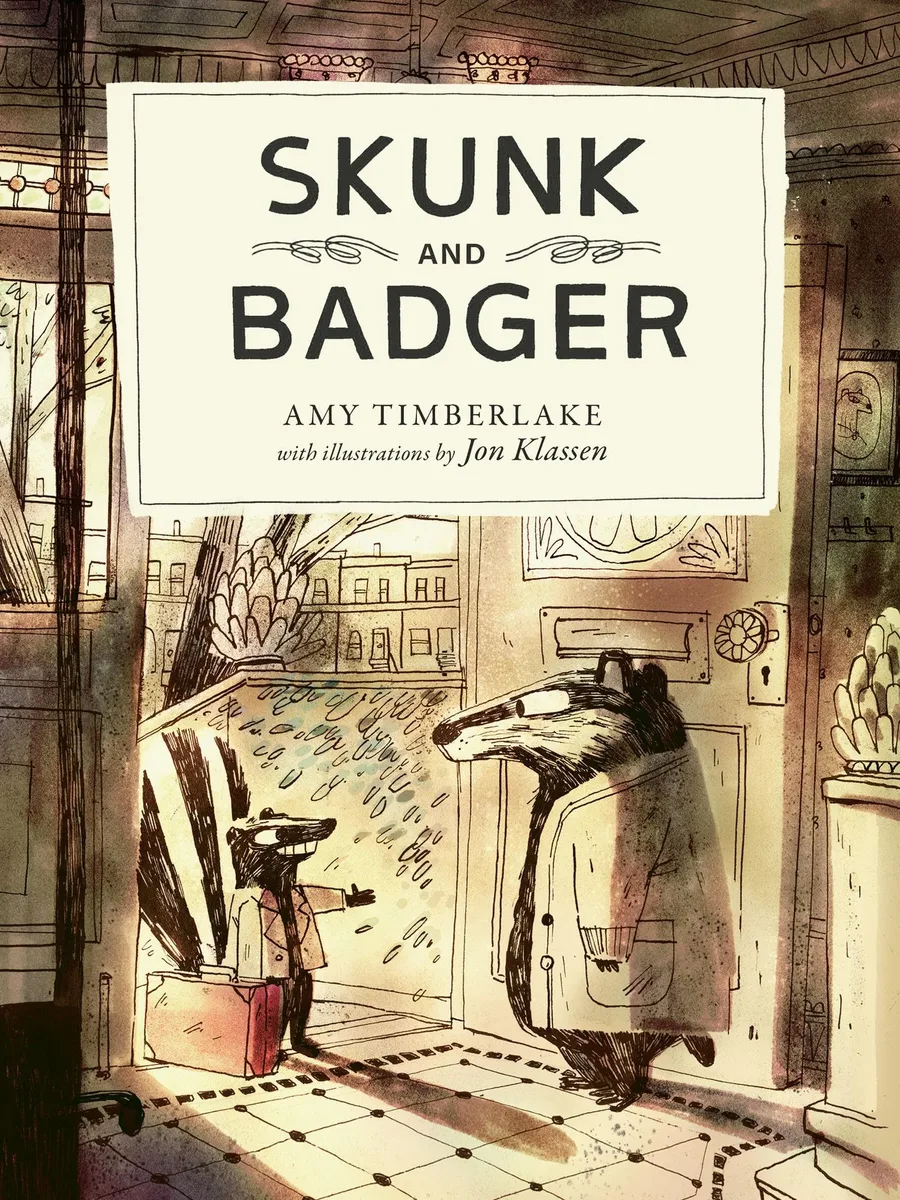 Skunk and BadgerAmy TimberlakeEnjoying a quiet, solitary life in the brownstone owned by Aunt Lula, a pine marten whospeaksveryfast, Badger is dismayed by Skunk’s arrival, battered suitcase in paw, with an invitation from Aunt Lula to stay there, too. On the bright side, Skunk is a terrific cook, and Badger reluctantly agrees that doing the cleanup afterward is fair … mostly. Skunk’s quiet nighttime pursuits—reading Shakespeare and contemplating the moon—are harmless. But scientist Badger cannot abide Skunk’s constant daytime interruptions of his Important Rock Work and writes Aunt Lula to say the arrangement isn’t working. While Badger awaits her reply, Skunk invites some chickens over for story time—lots of chickens. Skunk is sure the stoat who delivers a telegram from Aunt Lula is lying in wait for the chickens so insists they spend the night. After Badger is caught in the crossfire when Skunk sprays the stoat (who was lying in wait for the chickens), he loses his temper. Skunk and the chickens disappear. Problem solved? Not quite. Badger didn’t mean to hurt Skunk’s feelings, or upset the chickens—can he make things right? A story offering humor and warmth in equal measure shines with rich language, playful descriptive writing (“The bulb hummed fluorescently”) and terrific characterizations. There’s so much for younger listeners and older readers to delight in and reflect upon, including two full-color plates and occasional black-and-white illustrations that add to the immense pleasure of this story by Wisconsin native Timberlake.Fiction for ChildrenView book details
 Ways to Make SunshineRenée WatsonAfrican American fourth grader Ryan lives with her mom, dad, and older brother, Ray, in Portland, Oregon. Money has been tight since her dad was laid off from his postal service position and the new job he’s found doesn’t pay as much. Their landlord’s decided to sell the house they’ve been living in, and their new house, while closer to school, is much smaller. Meanwhile, one of Ryan’s two best friends, Amanda, has moved to a big house in the suburbs and Ryan wonders about her place in Amanda’s expanding social circle. Ryan is also worrying about an upcoming event at church in which she has to speak in public, what she will do for the fourth grade talent show, and whether she can follow the clues provided by four distinctive hairpins she found in her new old house to figure out who lived there long ago. Ryan has a realistic awareness of race and a realistically adversarial but loving relationship with her older brother Ray in a breezy yet substantial chapter book that unfolds in episodic chapters.Fiction for ChildrenWord Count 27746View book details
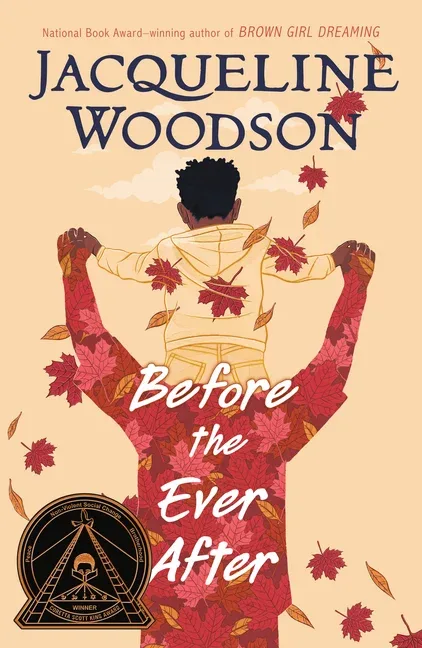 Before the Ever AfterJacqueline WoodsonZJ’s father, “Zachariah 44,” is a famous NFL football player. ZJ loves his dad, and occasionally feels the weight of the spotlight as his son, especially as he considers whether football is a sport for him. ZJ’s dad has taken many hits to the head throughout his career, but he’s always gotten back up and gone back into the game he loves. Now, however, those hits seem to be catching up to him, and what starts as a temporary pause from playing soon marks the end to Zachariah’s career. It’s confusing and scary for ZJ to see his dad’s agonizing headaches and small memory lapses deteriorate into mood swings, personality changes, aggression, depression, and terrible memory loss. Sometimes his dad doesn’t even recognize ZJ as his son. Doctors aren’t sure what’s wrong, and worse, they’re not sure how to help. As his dad’s condition worsens, ZJ finds comfort in memories—of good times with his dad, before things started to change—and in the support of his mom and the friends who stick with his family, including ZJ’s own three best friends. This novel-in-verse is set in the early 2000s, before much was widely known about CTE (chronic traumatic encephalopathy) and the risks posed to players in the NFL. Despite the heartbreak of what is happening to ZJ’s dad, moments of joy and love shine through.Fiction for ChildrenLexile Text Measure 780LATOS Book Level 4.5View book details
 Three KeysKelly YangThings are looking up for Mia Tang and her Chinese immigrant family, who recently purchased the Calivista Motel in Anaheim, until Mia learns about Proposition 187. If passed, the ballot initiative in the upcoming California election would prohibit undocumented immigrants’ access to public education, health care, and other services. Mia is dismayed by some of the racist and anti-immigrant things she’s hearing as part of the campaign. Meanwhile, her developing friendship with Jason Yao is causing tension with her best friend, Lupe Garcia, who reveals her late mother once worked for Jason's family When Lupe’s father is jailed returning from Mexico, where he'd gone for his mother's funeral, the challenges faced by undocumented families becomes personal for Mia. Both optimist and activist, aspiring writer Mia, who knows how hard Lupe’s father works, the challenges immigrants face, and the sacrifices most, including her parents, have made, organizes an informal immigrant support group at school and joins the effort to help Lupe's father. She also begins challenging the racism and misinformation she's hearing in her sixth-grade classroom. An engaging civics lesson, this follow-up to Front Desk features the same light touch and buoyant spirit, even as it illuminates the devastating impact anti-immigrant policies and racist attitudes have on individual lives. In an author’s note, Yang recalls vivid memories of Proposition 187, which was on the ballot when she was ten, in 1994. She based the hate crimes in this story on actual incidences that occurred during the campaign.Fiction for ChildrenWord Count 62497View book details
Fiction for Young Adults
38 selections
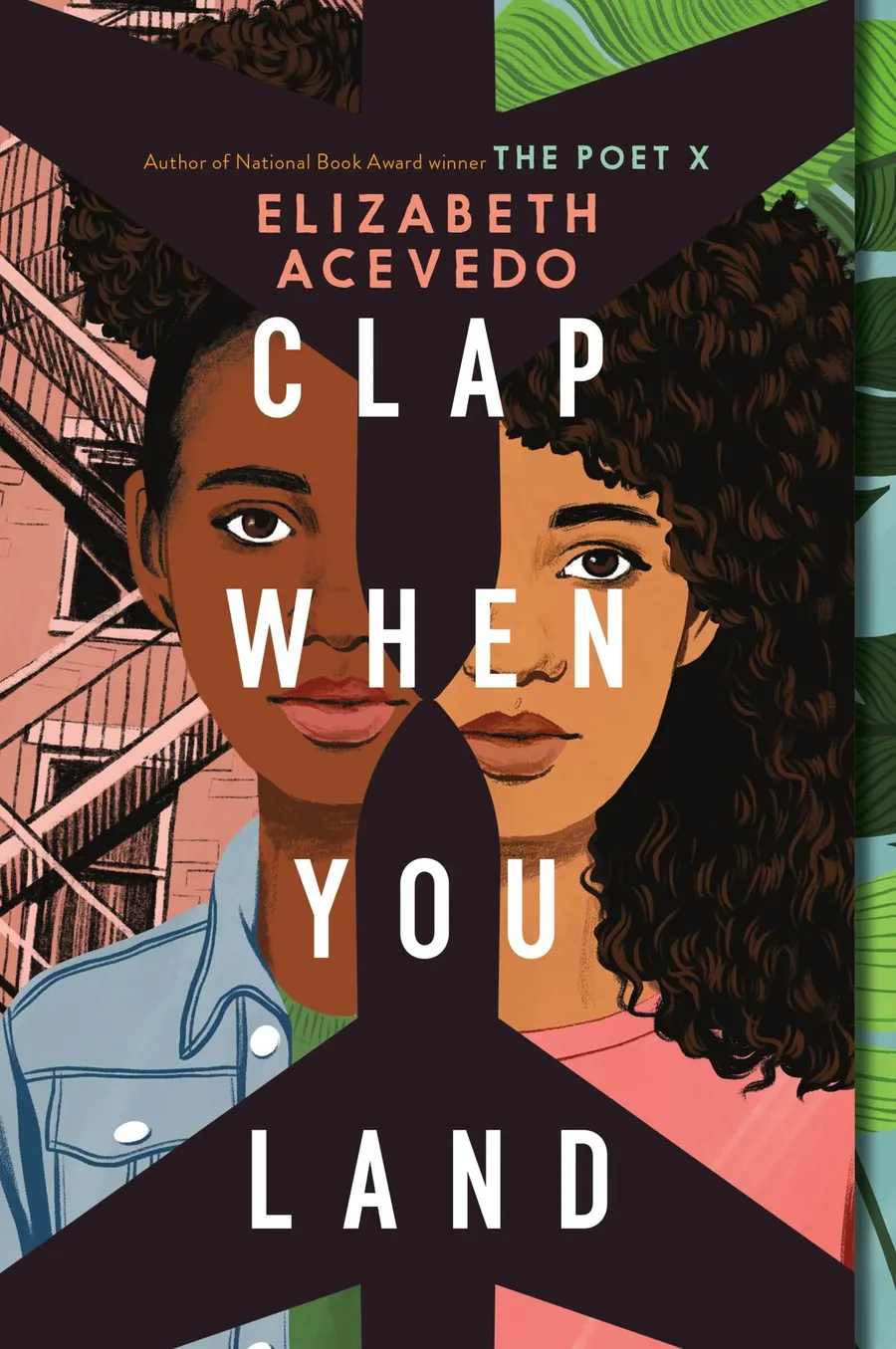 Clap When You LandElizabeth AcevedoCamino Rios lives in the Dominican Republic with her aunt; her mother is dead and her father, who lives in the United States, visits for three months every summer. Yahaira Rio lives in New York City with her father and mother; her dad travels to the Dominican Republic for three months every summer to visit family. Just months apart in age, neither knows about the other until the plane carrying their father crashes. Each is stunned by his sudden death and the revelation she has a sister. Their grief is further complicated by other factors: Camino’s dad paid for her schooling, and she hoped he’d help her move to the United States to pursue her dream of becoming a doctor. He also paid for her safety, and now a young man who trafficks girls and young women is threatening her. Yahaira, who’d barely spoken to her dad since discovering he already had a wife in the Dominican Republic when he married her mom, is struggling with the gulf that had been between them, and her mother’s anger. Their two compelling voices alternate in this novel-in-verse with a riveting emotional arc that illuminates many complexities of family but also shows the sisters’ relationship developing into something deep and lasting. This story gives a glimpse into the anguish of the fall 2001 plane crash that in part inspired it—an event in the headlines briefly before being eclipsed by ongoing coverage of 9/11.Fiction for Young AdultsView book details
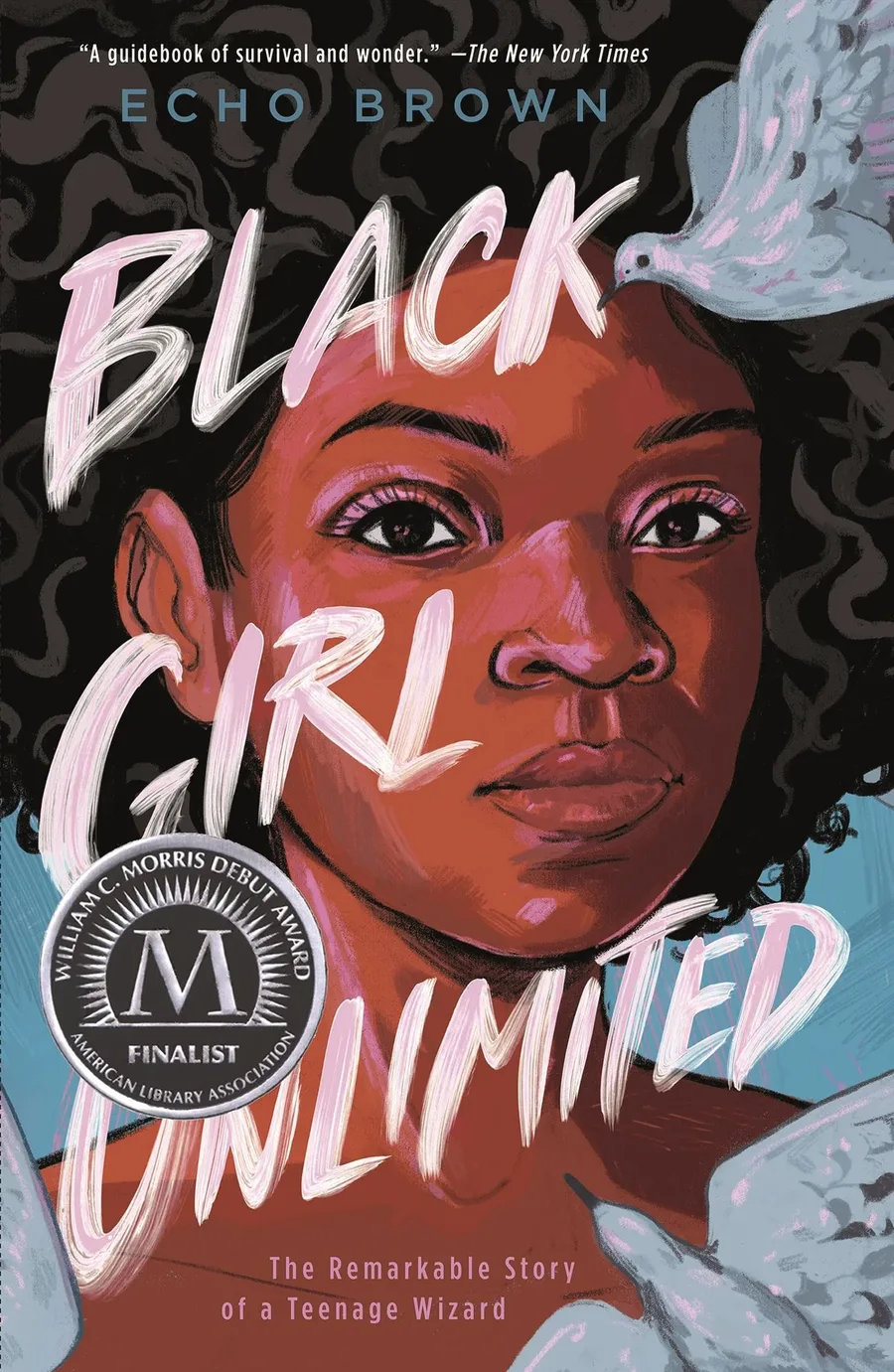 Black Girl UnlimitedEcho BrownEcho and her younger brothers are growing up in a family with limited economic resources and parents who find respite from their struggles with drugs and alcohol. As Echo also navigates a school system that undervalues Black students and underestimates their abilities, her determination to attend Dartmouth drives her to succeed. Then an abusive boyfriend assaults her and she shuts down, unable to get out of bed. Echo knows she and her mother are wizards who can freeze time. She realizes the two of them aren’t alone with their magic when her mother calls on other women in their community to help Echo rise. A story that regularly jumps back in time—a shift marked visually on the page with a mid-sentence gap and broken vertical dash before the sentence picks up again at a time in the past that relates to the present—reveals Echo was sexually assaulted as a child, a memory she has deeply buried. In this arresting fictionalized account of the author’s life growing up in Cleveland, systemic racism and personal trauma have palpable weight. The magical realism underscores the impact of that trauma while also illuminating the vulnerabilities and especially the strength of Echo and others in her African American family and community. Following Echo to her first year at Dartmouth, this is a story full of both pain and grace.Fiction for Young AdultsLexile Text Measure 920LATOS Book Level 6.1View book details
 The Phantom TwinLisa BrownJane and Isabel Peabody are white conjoined twins who share an arm and a leg. Sold as small children to a circus “freak” show during what appears to be the 1920s, they form a family with the other performers. After a doctor performs a new operation to separate them as teenagers, Isabel awakens from the procedure to learn that Jane didn’t survive the surgery. But, for Isabel, Jane is still there, like a phantom limb. And Jane is full of resentment that Isabel survived and she did not. With a crude prosthetic arm and leg, Isabel continues with the sideshow act, now billed as The Mechanical Girl. Haunted and lonely, she is tricked into talking about the fakery in the acts by an undercover journalist who publishes an exposé that gets her kicked out of the sideshow. Eventually finding love with a tattoo artist, Isabel and her phantom twin reconcile their conflict. Isabel and the others in the sideshow appear as fully developed, distinct characters. An excellent author’s note offers more insight into freak shows, including the ableism and ethnocentrism inherent in these displays, and her own discomfort with the subject. A muted, sometimes moody, palette colors this cleanly illustrated graphic novel that depicts the phantom version of Jane as uncolored with black outlines.Fiction for Young AdultsLexile Text Measure 329LATOS Book Level 2.4View book details
 The Light in Hidden PlacesSharon CameronCatholic teenager Stefania (called “Fusia”) leaves her family’s farm to move to Przemyśl, where she begins working for the Jewish Diamant family. She is embraced by the family and romanced by one of the sons, Izio, promising to marry him. When Germany occupies Poland, marking the start of World War II, the Diamants are forced into the Przemyśl ghetto. In addition to caring for her younger sister, Helena, only six when Fusia finds her all but abandoned back home after their parents are sent to a labor camp, Fusia becomes a lifeline for the Diamant family. First she smuggles food into the ghetto. After Izio dies in a labor camp, Fuzia, working with Izio’s younger brother, Max, works out a plan to help the remaining members and several others escape. She and Helen hide them—13 people in all—in increasingly precarious living situations. At one point, two nurses working at the German hospital across the street from their apartment are boarded with them, their SS boyfriends visiting regularly. The 13 hide in a cramped attic space, behind a false wall Max built. This fictionalized account of a true story reveals so many sides of human nature, from suspicion to annoyance to brutality to the false comfort of denying things are not as bad as they seem. But compassion is the resonant theme. Photographs and additional information about Fusia, Helen, and Max (whom Fusia married after the war) is included at the end of this tense, compelling work.Fiction for Young AdultsView book details
 We Are Not FreeTraci CheeThe voices of 14 teenagers and young adults, all friends and acquaintances from San Francisco's Japantown, narrate this story of Japanese and Japanese American imprisonment during World War II. The novel begins and ends in the voice of aspiring artist Minnow (Minoru). In between, chapters from the perspective of the other 13, boys and young men, girls and young women, chronicle their individual and collective experiences from March 1942 to shortly before Allied victory in Europe three years later. The intensity and range of emotions, including their sadness, anger, and frustration, is palpable as they and their families are sent first to the Tanforan assembly center (a racetrack), then to the Topaz “camp.” Family tensions—some of which existed before the war, some of which imprisonment foment or amplify—and disagreement over the loyalty oath all over 17 are eventually asked to swear to the United States (both insulting and dangerous in the opinion of many) —add to their trauma. Some end up at Tule Lake, where conditions are more overtly racist and brutal than at Topaz. A few join the U.S. Army. The narrative strand of each of their stories is never dropped even as chapters focusing on one and then another in turn. This ambitious, expansive novel always feels intimate, grounded in the lives and experiences of its distinct, vividly realized characters.Fiction for Young AdultsLexile Text Measure 860LATOS Book Level 5.5View book details
 FlamerMike CuratoAiden Navarro (Filipino/white) is nervous about transferring from Catholic to public school in fall when he starts high school. For now, he’s happy to be at Boy Scout camp. He loves scout camp for the activities and camaraderie, and as a chance to be away from his unhappy home. Generally well-liked by other campers, Aiden takes some teasing in stride but meaner comments—racist and homophobic taunts he’s sadly familiar with—are hard. Despite an obvious crush on fellow camper Elias, Catholic Aiden is in denial about being gay. Elias, who’s been a terrific friend at camp, distances himself after Aiden— surprising them both—kisses him. The recent firing of a counselor because he’s gay, and the silence of Aiden’s best friend Violet, a devout Christian who hasn’t written back since Aiden hinted in a letter he might be gay, compound Aiden’s suddenly dark feelings and he seriously contemplates suicide. The “flamer” of this graphic novel’s title has obvious literal and symbolic meaning, but one of the enduring ones is “light,” not only because Aiden realizes that he is loved, cared for, and accepted for who he is when Elias, other campers, and Violet all come through, but because of the brightness of Aiden’s personality, which makes his deep sadness and feeling of hopelessness before he finds light all the more aching by contrast. This honest, ultimately affirming work features black-and-white illustrations punctuated with bursts of orange to great effect.Fiction for Young AdultsLexile Text Measure 479LATOS Book Level 3.2View book details
 LegendbornTracy DeonnAfrican American Bree, 16, grief stricken since her mother’s death in a car accident, is in the Early College program at UNC- Chapel Hill, her mom's alma mater. When she discovers the Order of the Roundtable, a secret society dedicated to fighting Shadowborn that threaten the world, a merlin attempts to mesmer Bree so she won’t remember the demon attack she witnessed, or the Order. Not only does it fail, it sparks a memory of a mesmer attempt the night her mother died. Certain someone in the Order is behind her mom’s death, Bree convinces her white peer mentor/boyfriend Nick, scion of King Arthur, to sponsor her as a Page in the Order. Smoldering Sel, the merlin sworn to protect Nick, is suspicious of Bree’s ability to resist mesmer. Bree doesn’t understand it either, until her Black female therapist explains that African American Rootcraft runs strong in Bree, and did in Bree’s mother, too. This revelation amplifies Bree's sense of loss, and her determination to find answers. One of many remarkable elements of this brilliant reimagining of a tale traditionally mired in whiteness is its direct, unflinching reckoning with racism in both the present and past, including the trauma and traumatic legacy of slavery. Bree’s place in this contemporary Arthurian legend is unassailable, the reason behind it immeasurably painful, mirroring truths that resonate in our country today. A rich cast of supporting characters, including nonbinary and queer characters, adds to the pleasure and depth of a story that also examines friendship, family, loyalty, loss, and love.Fiction for Young AdultsLexile Text Measure HL730LATOS Book Level 4.7View book details
 Every Reason We Shouldn’tSara FujimuraOlivia Midori Kennedy (Japanese American/white), 16, is the daughter of former Olympic pairs champion skaters. She was a rising star on the skating scene herself before a recent metaphorical crash and burn at her first senior-level competition. Olivia’s now working at Ice Dreams, her parents’ struggling rink, and helping her mom —in chronic pain due to career injuries— manage while her dad performs around the country to help pay the bills. Korean American Jonah Choi’s family rents rink time at Ice Dreams so he can practice short track speed skating. Jonah is an elite young athlete on the rise; Olivia’s career may already be over—or is it? Even as their obvious attraction builds, Olivia is also realizing her struggles at the senior level were as much about people forcing her to be someone she wasn’t as adjusting to physical changes in her maturing body. But how does she work her way back to skating on her own terms? The strength of this blithe romance is in its surprising substance. Olivia and Jonah’s relationship is all the more satisfying for being measured as they strive to support each other’s dreams. Terrific secondary characters, from the other (all Asian, they note) kids at Olivia and Jonah’s high school lunch table, to Oliva’s friend Mack, a 20-year-old single white mom working at the rink and living with her grandmother, to Olivia’s friend and former skating partner helping her chart a new course, all contribute to the enjoyment.Fiction for Young AdultsView book details
 Not So Pure and SimpleLamar GilesDel has had a crush on Kiera since grade school, and she’s finally boyfriend-free. He volunteers to join a youth group at church in which Kiera is involved as a way to impress her, only to discover that he’s unwittingly committed to a Purity Pledge: No sex until marriage. At Del’s high school, a rash of recent pregnancies has been perceived by some, including the media, as being the result of a pact among the teen moms to get pregnant (in truth it was the coincidental outcome of an unscheduled week of cancelled school and boredom). While the new moms, including Del’s friend Shianne, are often shamed, the fathers remain largely unscathed in public opinion; meanwhile, sex education in the curriculum is under fire. Del’s voice and situation are laugh-out-loud funny as he is drawn into the Purity Pledge group despite himself (it turns out they’re all hungry for accurate information about sex). Del, African American, is hopeful he has a chance with Kiera based on their exchanges; then she starts dating a guy Del can’t stand. After all he’s done to impress her, Del wonders, how could Kiera reject a nice guy like him? A novel that never loses its sense of humor asks essential questions about the male entitlement that permeates even a “nice guy” like Del’s perspective, and the damaging impact of toxic masculinity on our culture.Fiction for Young AdultsView book details
 Sia Martinez and the Moonlit Beginning of EverythingRaquel Vasquez GillilandSia (Artemesia) Martinez’s mother was deported to Mexico three years ago and disappeared while trying to make the desert crossing back to the United States; she’s now presumed dead. Despite her dad’s love, the support of her best friend, Jamaican American Rose, the reassuring presence of her late abuela’s spirit and comfort of her traditional stories, Sia remains mired in grief, and fury: Her mom was reported to ICE by their town sheriff. When Sia is paired with new student Noah, who is white, for a science project about the moon, their attraction is immediate, but Rose is sure she saw Noah being friendly with the sheriff. Noah denies it, and as Sia’s relationship with him intensifies, Rose seems to pull away. Sia discovers Noah’s lie just before the shocking reappearance of her mom. A prisoner of the U.S. government and subject to experimentation involving alien (extraterrestrial) species, her mom has escaped, but the government, including an extraterrestrial agent, is in pursuit. Sia’s mom has striking new abilities, but both she and Sia are at risk and soon on the run, joined by Sia’s dad, Rose, Noah, and friend and conspiracy theorist Omar. Sci-fi plot elements underscore and amplify themes of immigration and racism in this deeply thoughtful, gorgeously written novel that also explores family and friendship, has multiple satisfying romances, and terrific moments of humor. It’s all grounded by achingly honest characters navigating relationships and challenges that are all too real.Fiction for Young AdultsView book details
 Ever CursedCorey Ann HayduJane, 18, is the oldest of the five Spellbound princesses of Ever, each cursed to go without something particular from the moment she turns 13. Jane can’t eat, Nora can’t love, Alice can’t sleep, Grace can’t remember. Eden, about to turn 13, will go without hope. Jane and her sisters think their father is a good king and kind man; Reagan, the young witch who cast the spell, knows otherwise. She cursed the family after learning the king raped her mother. She only recently discovered that in casting the curse she threatened a long-ago agreement between witches and royals. Now there are four days until Reagan turns 18 and the curse turns True—irreversible. Reagan’s only hope to save her family and Jane’s only hope to save herself is if it can be undone. With blistering honesty, this feminist novel alternates between Jane’s and Reagan’s points of view as it exposes sexism and misogyny, and the willful ignorance and lack of compassion on which power and economic privilege depend. Jane and Reagan are both white, but the fresh, imaginative world-building embraces racial diversity and queer inclusiveness in a story as intentionally unsettling (e.g., the sexual objectification of Jane and her sisters by suitors who prefer them Spellbound; the silence that supports the status quo) as it is immensely satisfying, if not cathartic, once the two young women join forces, silences are broken, truths are made public, and a reckoning occurs.Fiction for Young AdultsView book details
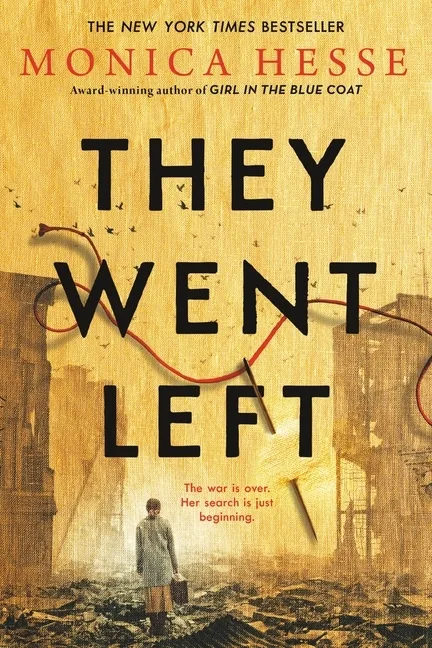 They Went LeftMonica HesseAfter liberation from Gross-Rosen concentration camp and months in a hospital following the end of World War II, Jewish Zofia Lederman, 18, goes in search of her younger brother, Abek. When a Russian officer tells her that Abek may be at a refugee camp in Germany with other survivors of Dachau, she makes her way there. At the camp, Zofia forms bonds with other refugees, including Josef. The two are drawn to each other and a romance slowly develops. Meanwhile, she continues her search for Abek. It feels like a miracle when her brother shows up at the camp. He was only 12 the last time she saw him; now he is a young man, one who remembers little about their lives and family years before. Many ways that Holocaust survivors and others coped and struggled after the war plays out in the lives and experiences of Zofia and other characters in this arresting novel. Zofia’s own struggle to reconcile her memories and desires with reality, and to ground herself in the present while being haunted by the past, is at the heart of this moving story.Fiction for Young AdultsLexile Text Measure HL730LATOS Book Level 5.1View book details
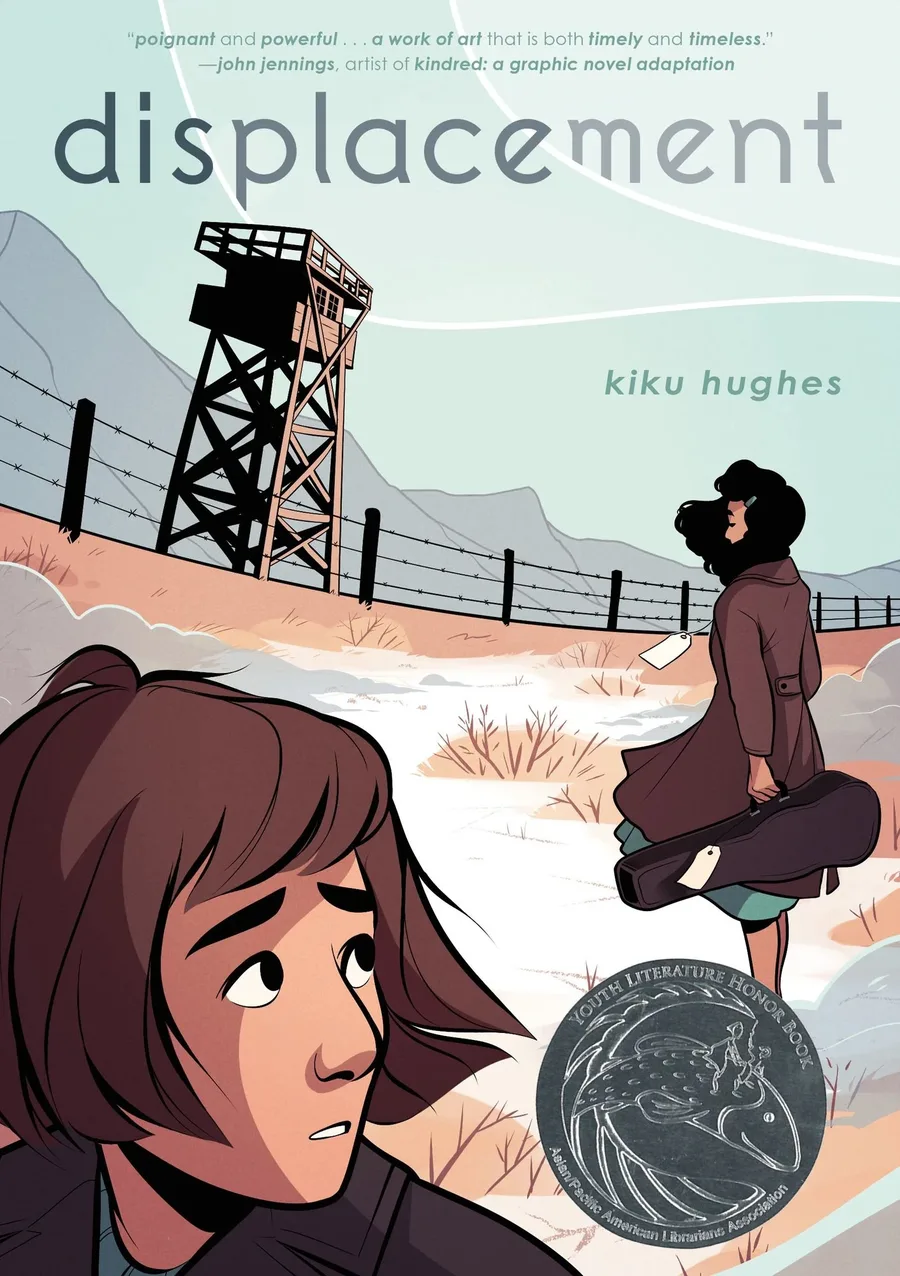 DisplacementKiku HughesAuthor Hughes is the main character of this absorbing graphic novel with elements of time travel fantasy when teenage Kiku is “displaced” from her contemporary 21st-century life and imprisoned with other Japanese Americans, including her maternal grandmother, Ernestina, during World War II. Biracial (Japanese/white) Kiku is frustrated by how little she knows or has learned about the imprisonment of Japanese Americans; it has been glossed over in her education and there is a silence surrounding it in her family. The chance to get to know Ernestina, who died before she was born, is a bright spot, but even though they live next door, on the other side of a thin wall, her grandmother’s family remains an enigma since they only speak Japanese, a language Kiku doesn’t know, for reasons she suspects are connected to cultural silence around internment. Still, Kiku observes them closely while making other friends, including a young woman with whom she has a budding romance. Kiku doesn’t know when she will find herself transported back to the 21st-century, a device that masterfully echoes the experience among those imprisoned by and at the mercy of the U.S. government in a work that gives a strong sense of life under imprisonment while drawing a connection between what happened then and attitudes toward immigration now. Here, that plays out in the contemporary story as the “displacements,” which Kiku learned her mother experiences too, inspire the two to get politically involved.Fiction for Young AdultsView book details
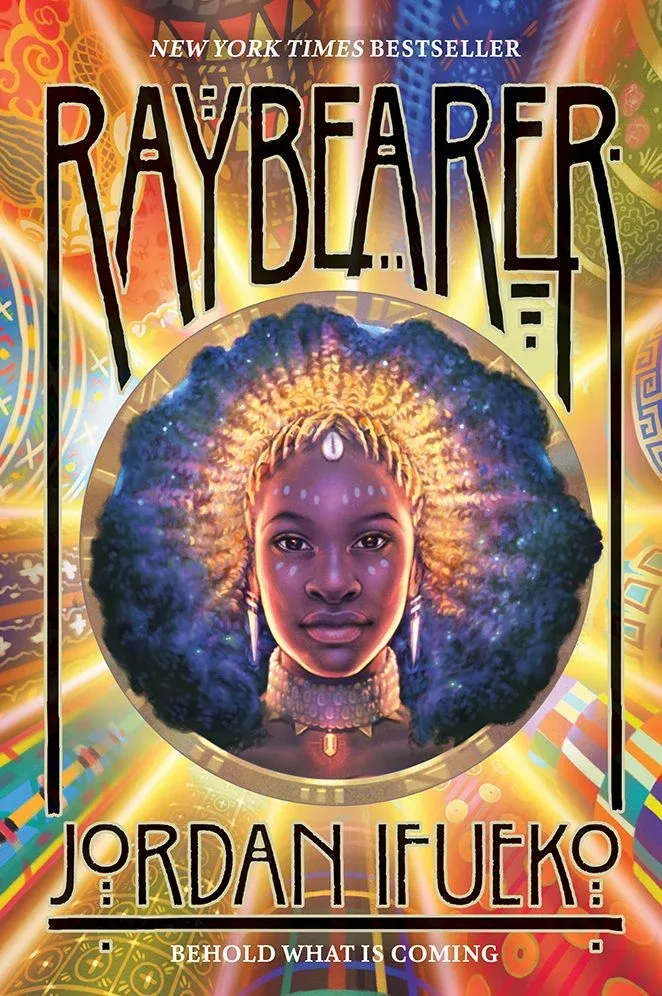 RaybearerJordan IfuekoIn a fantasy set in a mythical African nation, young Tarisai, half-human and half-ehru (djinn), has been raised in isolation, trained by tutors preparing her to become one of the eleven members of Prince Ekundayo’s council. She barely knows her distant mother, whom she calls The Lady. What she does know is that her mother, through magic, has compelled her to kill The Prince Tarisai is supposed to dedicate her life to serving. As she tries desperately to resist the magic, Tarisai also attempts to unravel her mother’s background and the complicated history of their land, which includes grappling with the effects of imperialism and colonialism. Why does her mother want the prince dead? The question leads Tarisai to a discovery that will change her future and that of the empire. Ifeuko excels at world-building in her captivating first novel, creating a place so lush with sensory details readers will feel as though they have fully entered it. The complexity of the characters and their interdependency also serve to bring Tarisai’s world to life, and readers will struggle, as she does, with moral choices, love, political alliances, and forbidden knowledge in order to find and fulfill her true destiny.Fiction for Young AdultsLexile Text Measure 860LATOS Book Level 5.5View book details
 The Henna WarsAdiba JaigirdarNishat is thrilled to see new student Flávia at her Catholic girls’ school in Dublin. They met at the wedding of Nishat’s cousin, and Nishat was immediately smitten. Like Nishat, Flávia is dark-skinned (her father white, her mother Afro-Brazilian), and the two stand out among their many white Irish classmates. At home, Nishat recently came out to her conservative parents, who emigrated from Bangladesh to Ireland; they don’t want her to bring shame on the family by being gay. At school, Nishat learns Flávia is the cousin of Chyna, who has made Nishat’s life a living hell of micro-aggressions and exclusion. Nishat’s interest in Flávia is further complicated when Nishat starts a Mehndi business for a class project and Flávia and Chyna do the same. For Nishat, the elaborate henna drawings she makes on customers’ hands are an important part of her cultural tradition. She’s upset that Flávia and Chyna think it’s ok to appropriate what they only see as pretty decorations, which Flávia learned about at the Bangladeshi wedding. Nishat and Flávia are fierce competitors even as their attraction intensifies, and Nishat can’t help but question whether Flávia’s feelings are genuine when both are willing to do whatever it takes to win, including sabotage and retribution. This unusual, compelling teen romance draws readers in with fully developed characters navigating queer politics, race, and culture.Fiction for Young AdultsView book details
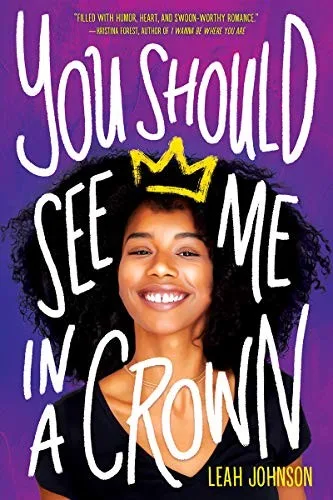 You Should See Me in a CrownLeah JohnsonRunning for prom queen is way outside high school senior Liz Lighty’s comfort zone, but she’s motivated by the $10,000 scholarship for the winner, since she didn’t get the music scholarship she was counting on for college. The Prom Court competition is a huge, drawn out affair in their small town, with weeks of challenges in which candidates vie for points and popularity. Liz is one of a small number of Black students at her small-town Indiana high school and out only to her closest friends. One of them throws herself into managing Liz’s campaign, seeking to transform quiet, intentionally under-the-radar Liz into a serious contender. New student Mack (Amanda McCarthy) is also running. Mack, a legacy (her mother was prom queen) and Liz are soon falling for each other, and it’s both exciting and complicated: Mack doesn’t care about winning but doesn’t want a closeted relationship, and Liz is convinced a lesbian has no chance of being prom queen. A novel offering both humor and substance combines romance with friendship tension and family worries, including Liz’s brother illness: Robbie has sickle cell anemia, the same disease that killed their mom. This thoughtful and entertaining story also examines the high school’s failure to support LGBTQ students, and Liz’s love of music. Above all, it celebrates Liz’s growing confidence in asserting all aspects of her identity, for love, yes, but first and foremost for herself.Fiction for Young AdultsView book details
 Darius the Great Deserves BetterAdib KhorramIn this follow-up to Darius the Great Is Not Okay, teenage Darius, now back in Portland, is happily involved with his boyfriend, Landon, whom Darius met at the tea shop where he’s been interning. Biracial Darius is also enjoying the new closeness he and his dad forged on their family trip to Iran, but is less sure about how his dad’s two emotionally reserved white moms (one of who is transgender) feel about him. What he does know is that their visit has triggered a depressive episode in his dad. When Landon begins initiating greater physical intimacy, eventually making clear he wants to have sex, Darius isn’t sure he’s ready, or even wants to. His growing feelings for Chip, one of his soccer teammates, who seems to be sending romantic signals, further confuse him, as does the fact Chip is best friends with Trent, a blatantly homophobic bully. Worry about his ailing maternal grandfather in Iran, and about his best friend, Sohrab, who lives there too but hasn’t replied to recent emails, including one in which Darius came out, add to Darius’s concerns. Darius’s relationships—romantic, platonic, family—-are at the heart of a story that explores these connections and their complications with warmth and refreshing honesty. Darius’s uncertainty about having sex is particularly welcome as he realizes that wanting different things and asserting boundaries is perfectly okay, even if it means the ends of a romance.Fiction for Young AdultsView book details
 ElatsoeDarcie Little BadgerFollowing news that her older cousin Trevor has died, Ellie, a contemporary Lipan Apache teen in Texas, is visited by Trevor in a dream in which he tells her he was murdered. Ellie, whose beloved dog Kirbie remains her devoted companion five years after his death, doesn’t find communicating with the spirit world unusual. She was named Elatsoe for her Six Great grandmother, a woman whose legendary skill fighting real-world and supernatural threats helped protect the Lipan Apache people. But Trevor’s message is deeply upsetting, adding anger to Ellie’s heartbreak. Determined to find the killer, Ellie investigates with the help of her best friend Jay, who is white (a descendant of Oberon, although Jay’s magic is faint). Evidence soon points to a doctor from nearby Willowbee, a small, mysterious, whitewashed Texas town where he has a secretive clinic and lives in a house guarded by vampires. Not all vampires are evil—Jay’s sister is dating one who joins the effort to catch Trevor’s killer—but these most certainly are. The more Ellie learns, the greater the danger, including, her mother cautions, risks that go hand-in-hand with her gift. Ellie’s search for justice, and rest for her cousin’s spirit, is also a story of family ties and family history, friendship, loss, and self-discovery in a novel with an engaging, original plot; unique, creative world- building; and terrific characterizations, including the depiction of Ellie as asexual. Black-and-white illustrations at the start of each chapter depict Six Great’s story.Fiction for Young AdultsLexile Text Measure HL610LATOS Book Level 4.7View book details
 Tigers, Not DaughtersSamantha MabryAna Torres died from a fall when the branch she was using to sneak out of her second-floor window broke. One year later, Jessica, Iridian, and Rosa believe their older sister has returned. Evidence is the mysterious hand pressing against the shower curtain; the angry writing appearing on the walls of their home. A novel that unfolds from the three girls’ alternating points of view gradually reveals events the night Ana died, and how each of the sisters has coped with grief. The girls’ father, feckless even before Ana died, is grieving, too, and mired in debt. Jessica, now oldest, holds the family together financially while dating Ana’s abusive boyfriend. Iridian hasn’t left the house since being humiliated by a classmate, instead immersing herself in old books of Ana’s and the story she’s writing. Youngest Rosa, 12, in some ways the most competent and clear-thinking of the sisters, pays close attention to the natural world and is convinced the recent escape of a hyena from the zoo is connected to Ana. The perspectives of the teenage boys who gather at the house next door round out this tale. Fascinated by Ana, the boys were witness to some of what happened the night of her death, and were the first to see her ghost. This singular, mesmerizing work is a story of revenge, justice, and family in which three Latinx sisters facing grief and other challenges affirm their bond.Fiction for Young AdultsView book details
 The DegeneratesJ. Albert MannLondon, 14, an orphaned Italian immigrant, is violently picked up by Boston police and taken to Fernald, a state-run “school” warehousing social outcasts, most of them labeled “morons” or “imbeciles” if they don’t have visible disabilities. Pregnant, London realizes the family of the boy who is the father reported her to police. At Fernald, she is placed in a dorm with African American Alice, 14, who has a club foot, and white sisters Maxine, 14, and Rose, 13. Rose is “mongoloid,” while the others, including London, are classified as “morons.” London, the only one among them who hasn’t been there since childhood, is intent on escaping. But as slowly building trust among the four grows into friendship, she realizes she can’t leave the others behind. Fernald was a real, horrifying place, and the early-20th-century attitudes regarding physical and intellectual disabilities and those who are poor are as equally true and disturbing as the history of Fernald itself. The four young women in this novel are light to counter this darkness: Their distinct and well-developed personalities, the connections among them, and the details of their lives solidly ground this riveting story. Their collective perspective on a budding lesbian romance and on race, and the open but relief-filled ending, may be hopeful for the time but don’t deter from either the plot or this thoroughly researched account of how people with disabilities—whether actual, or conveniently labeled for social control purposes—were perceived and treated.Fiction for Young AdultsView book details
 Here the Whole TimeVitor MartinsTeenage Felipe, 17, has dealt with jokes and bullying about being fat all his life. He’s never been teased for being gay, thankfully, but only because no one looks beyond his physical appearance to consider him as someone sexual. When Felipe’s upstairs neighbor Caio comes to stay with Felipe and his mom over winter break, Felipe is mortified. They attend different schools and haven’t spent time together since they were 12, but he’s had a crush on Caio for years. What will they talk about? What will Caio think of his body? And they’ll be sharing a room! It turns out Felipe finds it easy to talk to Caio as they lie in their beds in the dark, but during the day he’s far too worried about what to say and how he looks to converse with any ease. Felipe’s mom loves and supports him unconditionally. Felipe’s therapist gently challenges him. But it’s Caio’s college-age friend Becky, who’s been a source of support for Caio since he came out at his private school the year before, who convinces Felipe that Caio likes him, too. As a narrator, Felipe is as honest and genuine as he is laugh-out-loud funny at times. His growing confidence and self-esteem are as triumphant as the romance that develops between these two sweet, lovely young men in this novel set in Brazil.Fiction for Young AdultsView book details
 Agnes at the End of the WorldKelly McWilliamsSixteen-year-old Agnes, who is white, lives with her family in Red Creek, the site of an isolationist Christian cult led by the powerful Prophet. Agnes is a model member of the group, caring for her five younger siblings and obeying the Prophet’s strict rules—except one. Agnes defies the prohibition against contact outside the community borders to meet secretly each month with Matilda, an Outsider nurse, who brings insulin to treat her little brother Ezekiel’s type 1 diabetes. When the Prophet orders Agnes to marry a church Patriarch, she knows Ezekiel’s access to the vital treatment will be disrupted, and her habit of obedience is shaken. The desperate situation is amplified by news of a pandemic raging in the Outside. The Prophet brings an infected dog into Red Creek, claiming that the faithful will be unharmed, but the bizarre disease begins to spread. Realizing the Prophet is a liar, Agnes launches an escape with Ezekiel, just as her rebellious younger sister Beth, long defiant of Red Creek restrictions, resolves to comply with the Prophet’s demands. Agnes and Ezekiel join forces with Matilda and her son Danny, who are Black, in a nearby town, where the enormity of the pandemic’s impact becomes clear, while the situation at Red Creek implodes. Questions of individual faith and spirituality co-exist with the suspense of a sci-fi global crisis (written pre-COVID), budding romance, and family loyalty, while Agnes’s religious power eludes traditional definitions.Fiction for Young AdultsView book details
 We Unleash the Merciless StormTehlor Kay MejiaWe Set the Dark on Fire was a story of political intrigue and romance set in a fictional Latinx-inspired country facing issues resonant in our world today. This sequel shifts the point of view to Carmen, rival-turned-love interest of Dani, the young immigrant woman at the center of the first book. Returning to La Voz, the activist social justice group in which she was raised, Carmen finds some people questioning whether she’s more devoted to Dani than their cause of overthrowing the corrupt and exclusionary government of Medio. Carmen wants to prove her loyalty, but also doesn’t want Dani, who spied for La Voz, left stranded in the household of Mateo Garcia, scion of a powerful political family. Carmen is also alarmed by changes in La Voz during her years away, including a second-in-command more interested in power than ideals. Unsure if she can support La Voz anymore, she goes rogue to extract Dani, even as she wonders whether Dani retains any feelings for her since being abandoned. An action-packed plot offsets drawn out romantic uncertainty (she likes you already!), while the moral and ethical decisions Carmen faces when the organization and people who have been her compass can no longer be trusted or admired deepen the substance of this satisfying tale.Fiction for Young AdultsView book details
 Miss MeteorTehlor Kay Mejia, Anna-Marie McLemoreIn Meteor/Metorite, Texas, the annual Miss Meteor contest is huge. Lita Perez once dreamed of winning, but the word “alien,” hurled at her in middle school, shut those dreams down. Mexican American Chicky Quintanilla has never wanted to be Miss Meteor, but wants legacy Kendra Kendall, white, to know the title doesn’t automatically belong to her. Kendra taunts Chicky for being a lesbian as if Chicky should be ashamed. Chicky isn’t lesbian—she’s pansexual. And she’s not ashamed. She’s just afraid to tell the truth, just as she’s afraid to take her relationship with best friend Junior Cortes to a new but clearly mutually desired place. When Lita decides to run for Miss Meteor—because her body is reverting to the stuff of stars from which she came, although no one knows; because she has nothing to lose and everything to gain in trying—she asks for Chicky’s help. Chicky agrees, despite not having spoken to former best friend Lita since middle school. Among those supporting Lita is Kendra’s brother, Cole, who is transgender. Chicky, Lita, Cole, and Junior are the heart of a story chronicling transformational discoveries and connections. They anchor a lively cast of characters in this entertaining novel alternating between Chicky’s and Lita’s perspectives and exploring not only friendship, love, family and community, but also race and class, gender and sexuality, and ideas about identity and belonging.Fiction for Young AdultsView book details
 BurnPatrick NessIn an alternate 1957, where dragons are real though not generally trusted, biracial (Black/white) Sarah Dewhurst’s widowed white father has hired a Blue named Kazimir to clear his fields. Sarah knows little about dragons but is intrigued by thoughtful Kazimir. Malcolm belongs to a dragon-worshipping cult whose mysterious leader has charged him with assassinating Sarah because of a prophecy. FBI Agents Dernovich and Wolf are in pursuit of Malcolm. On the way to kill Sarah, Malcolm’s singlemindedness falters when he meets and falls in love with a young man named Nelson. Kazimir saves Sarah and her best friend, Japanese American Jason, from a violent, racist deputy sheriff. Agent Dernovich is murdered. The Russians launch Sputnik. A portal opens. Everything falls apart. End Part 1. In Part 2, Sarah, Malcom, and much transformed Kazimir and Agent Wolf find themselves in a parallel universe—1957 of our world. Kazimir is human; Sarah’s mother is alive and shocked to see a girl claiming to be her daughter, who died of cancer; Malcolm grapples with guilt and remorse—for the cold killing he’s done, for abandoning Nelson; and the dragon goddess Mitea is set on destroying humanity—one city at a time. Sarah, Kazimir, Malcolm, the Agent Dernovich of this world, and others are set on stopping her. Set against the backdrop of the Cold War, when the threat of violence and annihilation was a subtext of human existence, this richly imagined, unsettling story raises provocative questions about our humanity.Fiction for Young AdultsView book details
 The Magic FishTrung Le NguyenTiến reads fairy tales aloud to his Vietnamese-immigrant mother to help her with English. Tiến’s mother has been saving money for a trip home to Vietnam to see her own mother. When her mother dies, Tiến’s mom finally makes the journey back to Vietnam. Three interconnected strands in this moving graphic novel—Tiến’s contemporary life, his mother’s trip home and the memories it inspires, and the fairy tales themselves—are delineated by storytelling in three separate color schemes (black on red, black on golden yellow, black on blue). Tiến is in secretly love with his friend Julian, facing homophobia from his Catholic school teachers, and thinking about how to come out to his parents (there isn’t a Vietnamese word for “gay”). His mother, who left Vietnam as a refugee, is burdened by both guilt and sadness—at leaving her mother behind, at not making it back before she died. The three fairy tales—The Little Mermaid and German and Vietnamese variants of Cinderella—connect thematically to both Tiến’s and his mother’s struggles. The overlapping elements from the fairy tales, Tiến’s life, and his mom’s story make for a rich and rewarding reading experience in this work illuminating how the immigrant experience impacts generations. The fairy tales also prove to be a bridge across generations, one that connects Tiến and his mom as he seeks a way to come out. The author/artist caps this exceptional work with extensive end notes providing insight into his creative process and considerations.Fiction for Young AdultsLexile Text Measure HL400LATOS Book Level 3View book details
 LookGabi Snyder, illustrated by Samantha CotterillHigh school senior Lulu regularly uploads photos and video to a platform called Flash (think Snapchat). Lulu meets down-to- earth Cass at a party. Although Cass is uninterested in social media and stereotypical trappings of moneyed teens in L.A., Cass’s best friend, Ryan Riggs, is the teenage brother of Flash’s founder. Ryan is renovating a formerly grand hotel built by his great-father as his family “project.” Lulu and Cass regularly hang out at the unfinished hotel, which feels like a refuge. Ryan prohibits anyone else from taking photos there but is constantly framing his visitors through the lens of his own camera. As Lulu and Cass fall for each other, the hotel becomes their intimate, private space—until Ryan betrays them. Lulu, white and Jewish, had already begun thinking critically about media’s treatment of women through reading for her cinema studies class and discussions with Cass. Ryan’s unconscionable violation of their trust and privacy intensifies her reflection on the female body, from her own to Ryan’s great-grandmother's, a silent film star whose work seeded the family fortune, as possession and commodity. Lulu's own understanding of what she chooses to share on platforms like Flash shifts with her expanding perspective on female exploitation. The relevance and immediacy of these issues in the lives of teens today, along with the complexity and depth of Lulu’s relationships with family and friends, both add to the satisfying substance of this queer romance.Fiction for Young AdultsFountas & Pinnell Text Level KView book details
 Don’t Call the WolfAleksandra RossOrphaned Ren, a girl who can transform into a lynx, is known as queen of the forest where she lives. Her lynx brother Rys and wolf friend Czarn are her closest companions. Lukasz is the last of the Wolf-Lords, the youngest of 10 human brothers revered for killing dragons and other monsters. While Ren seeks to save her forest from evil creatures that seem tied to the appearance of the Golden Dragon, Lukasz is searching for the last of his brothers, all of who set off to slay the Golden Dragon only to never return. After a dramatic meeting, Ren and Lukasz join forces with soldier Kozmar, scholar Jakob, an Unnaturalist who studies magical creatures, and Felka, Jakob’s friend, to hunt the Golden Dragon in her lair. The seven traveling companions, all white, are locked in an uneasy truce; all have secrets in their past, some unknown even to themselves, all are struggling with their own questions and choices, and trust issues abound even as there is an obvious, growing attraction between Ren and Lukasz. Alternating chapters follow the group on its quest and tell the story of what happened to Lukasz and his brothers after they fled their home following a devastating dragon attack a decade before. This rich and riveting fantasy is a complex, original story drawing from Eastern European/Polish folklore and its legends of dragons and monsters and mythical beasts … oh my!Fiction for Young AdultsView book details
 Yara’s SpringJamal Saeed, Sharon E. McKayAt 10, Yara is a loved and happy child living with her parents behind their bakery in Aleppo, going to dance class with her best friend, Shireen. A few years later, in 2010, her visiting Uncle Sami expresses hope in the Arab Spring uprising against the oppressive government of Syrian President al-Asaad. That hope is soon replaced by fear, violence, and death when their home takes a direct hit from government bombs and Yara’s parents are killed. Yara, her little brother, Saad, and Nana (her grandmother) survive and soon begin a journey toward refuge, taking Shireen and Shireen’s older brother, Ali, with them. Their goal is Jordan, but first they must reach Damascus and Uncle Sami. This riveting story is propelled not just by the drama of harrowing events as they unfold but by characters who offer an intimate, insider’s point of view on recent events in Syria and the intensity of living with such violence, uncertainty, and fear. The contrast between Yara’s life at 10 and everything else that happens is striking, and further underscores her losses, which resonate across the lives of many refugees. Yara does arrive at a place of physical safety, but her emotional journey clearly continues. A note reveals that author Saeed’s personal story, while much different from his fictional characters’, also involved oppression, flight, and exile.Fiction for Young AdultsView book details
 A Cloud of Outrageous BlueVesper Stamper, illustrated by Vesper StamperIn 14th-century England, 16-year-old Edie (white) has been sent to the priory of St. Christopher, as a conversa (laborer); she’ll work for the order, not join it. At the priory she makes a fast friend in postulant Alice. The Sub-Prioress, Agnes de Guile, seems to appreciate Edie’s intelligence; that liking cools when Mason, the young man Edie loves, gets a stonemason job at the priory and they’re caught spending time together. Edie, who hasn’t told anyone that she sees sounds as colors, and that colors themselves deeply affect her, is assigned to mixing ink in the scriptorium, where her first time working with lapis lazuli sends her into a trance during which she has a vision. Tension builds across multiple elements of this lush novel incorporating gorgeous full-plate illustrations. Plague hits the priory and neighboring town and Edie bears witness to suffering caused by the disease and fanatical responses to it as she cares for victims. She learns Agnes, who also had visions once but denied them, is twisted and cruel, recently locking Alice in a stone tower for a small transgression. Edie’s love for Mason is paired with growing resentment when he pressures her to leave, which would mean abandoning Alice and the sick and dying. Rising above it all are questions about the meaning of her vision, which she believes is pointing her toward a plague cure, in this riveting work that deftly blends the historical and the mystical.Fiction for Young AdultsView book details
 RunningNatalia SylvesterCuban American Mariana Ruiz’s father is a Florida senator who is running for president. Mari hates being forced into the spotlight and, as the campaign progresses, grows increasingly uncomfortable with the lack of privacy. And the father she knows —who cares about the environment, and who shows himself to her when they’re spending time one-on-one (not that he has time anymore)—seems to be totally different from Senator Ruiz the candidate. Mari’s gradual, initially reluctant involvement in an activism club at school gives her further insight into her dad’s voting history: It turns out he supported a bill that allows developers to dump sewage into Florida’s main aquifer. With their community under a boil-water order, it’s more than a little disillusioning to learn her father’s biggest donor pushed for the bill. The question of whether Mari will join the activism club’s planned walkout in protest has both personal and political implications—her participation will definitely attract media attention, and also further anger her dad, already upset when she bailed on a national TV show appearance. And Mari isn’t sure what her mom wants anymore. This novel’s extraordinary premise is made wholly believable because of the complexity, credibility, and nuance of its characters, especially Mari and her parents but also many others, from campaign staff to Mari’s family housekeeper and her partner, to various teen activists.Fiction for Young AdultsView book details
 All the Days Past, All the Days to ComeMildred D TaylorTaylor completes the Logan family cycle about Cassie and her family that began with Song of the Trees in 1975 and now concludes 45 years later with Cassie an adult, working as an attorney. While marriage, pregnancy, miscarriage, and a professional career may not the usual fare for a book for young people, fans of the Roll of Thunder, Hear My Cry and other books in the sequence will be interested to know what happened to Cassie and her brothers when they grew up. As with the earlier volumes, readers are given a front-row seat to the struggle for civil rights in the American South through the eyes and experiences of one African American family from Mississippi. Cassie’s personal story from the mid-1940s to 1963 intersects with key events in the Civil Rights Movement, such as the Freedom Riders, voter registration, and the leadership of Medgar Evers. Taylor’s oeuvre of nine books is an absolute gift to readers.Fiction for Young AdultsLexile Text Measure HL800LATOS Book Level 5.2View book details
 Cemetery BoysAiden ThomasCuban/Mexican American Yadriel’s family are brujx. Women are healers, and men make sure spirits move to the land of the dead before turning evil. Yadriel is trans and his family has not accepted his true gender, so he hasn’t had his quinces, the ceremony where Lady Death affirms a 15-year-old’s power. In the days leading up to Día de Muertos in this parallel East Los Angeles, Yadriel, now 16, with the support of his best friend and cousin, Maritza, a bruja, secretly performs the quinces on his own. When his cousin Miguel dies unexpectedly, Yadriel is determined to find and release Miguel’s spirit to show his family he’s a true brujo. But he mistakenly summons the spirit of Julian Diaz, an obnoxious boy from his school, instead. When Julian refuses to move on until he’s sure the friends he was with when he died are alright, Yadriel hides him, hoping his family doesn't find the annoying spirit staying in his bedroom. Yadriel is surprised to realize Colombian American Julian, gay like him, seems to understand him. Falling in love with a spirit wasn’t his plan, but the attraction and sexual tension between them builds, even as the mystery of what happened to both Julian and Miguel remains: Yadriel suspects their deaths are linked. This inventive, refreshing first novel features witty dialogue, cultural details as essential as air, and opportunities for reflection on what it means to be gay, trans, and part of a traditional Latinx family and community.Fiction for Young AdultsView book details
 The Mermaid, the Witch, and the SeaMaggie Tokuda-HallFlora/Florian, an orphaned Black sailor on the pirate-posing-as-passenger-ship Dove, and Evelyn, a young woman of the ruling Nipran empire (drawn from Japanese and British influences) traveling to her arranged marriage, fall in love during the journey. When crew members capture a mermaid to sell on the black market, Evelyn is horrified. Flora/ian, who knows that the Dove’s passengers including Evelyn will be sold into slavery, helps Evelyn and the mermaid escape. That’s Part 1 (the Mermaid) of this ambitious historical fantasy that charts an original course as it follows the fate of its two intriguing main characters through their encounter with a witch, and their effort to rescue Flora/ian’s brother on the Dove and help the Sea, mother of mermaids, punish its captain for the harm he’s allowed be done to her daughters. Full of political and social intrigue, the story also examines ways in which freedom is compromised. There is physical freedom denied in the Dove’s imprisonment and sale of its passengers, Evelyn’s pending forced marriage, Flora/ian and Alfie’s indentured life aboard the Dove, and the mermaid’s capture, for a start. There is also the freedom to be true to one’s self, beautifully explored and expressed through the gender inclusivity of the novel, including Flora/ian’s own emerging understanding of identity. Flora/ian initially thought posing as a boy aboard the Dove was a matter of physical survival, but comes to realize she/he/they are gender fluid. For Evelyn, Flora/ian is simply the person she loves.Fiction for Young AdultsLexile Text Measure HL730LATOS Book Level 4.7View book details
 The Enigma GameElizabeth WeinLouisa Adair, a mixed-race (Black Jamaican, British white) teen, has a job caring for Jane, a retired German opera singer and widow of a British man, in Windyedge, Scotland, during World War II. Louisa and Jane live in rooms at the same pub as Ellen McEwan, volunteer driver for the RAF. Ellen keeps her identity as a Traveller under wraps, given the prejudice and scorn Traveller’s face, much like Jane downplays her German roots. Louisa, who cannot hide her heritage, must contend with racism, but not from Ellen and Jane, nor from Jamie Stuart, an old friend of Ellen’s. Jamie is an RAF unit leader stationed at Windyedge. When a lone German pilot lands at Windyedge with a white flag, it thrusts Louisa, Jane, Ellen, and Jamie into a tense intelligence game. The German pilot has risked his life to deliver an enigma machine to the British to decode German messages. When he must leave again before his contact in British intelligence can get to Scotland, he hides the machine at the pub. Louisa finds it; soon she’s decoding German messages, which Jane translates. Jamie uses the information to give his squad an advantage on their flights. An author’s note at the end of this tightly plotted, fast-paced work expounds why the events of this story might have been possible, if not probable. The story’s richly developed characters includes some recognizable from other novels, including Code Name Verity, in this story set several years before that one.Fiction for Young AdultsLexile Text Measure 860LATOS Book Level 5.5View book details
 The Snow Fell Three Graves DeepAllan WolfTragedy refuses to abate in this fictional account of the Donner party’s expedition west. Narrated mostly in verse by a cast of distinct characters and an omniscient, non-human figure (“Hunger”), the story begins as the group of families sets out with a slew of animals and wagons stocked with supplies. Among them are children Patty Reed (dubbed “The Angel”), whose narration is in the form of prayers, and Virginia Reed (“The Princess”); their father James Reed, who fancies himself a strong leader, is later ousted from the group for killing a fellow traveler. Attempting a shortcut to California, the settlers spend a winter trapped in the snowy mountains, where some starve to death and others cannibalize the bodies of those who die. Tamzene Donner (“The Scholar”) refuses to leave her dying husband’s side; Ludwig Keseberg (“The Madman”) endures agonizing injury before his long-awaited rescue. Voices are given to two Miwok vaqueros who attempt a rescue expedition and are murdered by the settlers when the situation becomes dire. Extensive back matter provides short biographies of the characters, a timeline, a miscellany of facts and figures, and more.Fiction for Young AdultsView book details
 Superman Smashes the KlanGene Luen YangIn 1946, Roberta and Tommy Lee’s Chinese American family moves from Chinatown to the suburbs of Metropolis after their scientist dad gets a new job. Their father encourages them to assimilate as much as possible, something easier for Tommy, through baseball, and their dad than it is for Roberta and their mother. When the family becomes the target of the local branch of the Klan of the Fiery Kross, they come to the attention of Superman and his alter ego Clark Kent’s Daily Planet colleagues Lois Lane and Jimmy Olsen. Superman comes to the rescue and takes on the Klan in a story with plenty of fast-paced Superhero action and satisfying comeuppance. But a quieter yet no less essential element of this graphic novel is the way in which Roberta’s struggles in her new surroundings parallel Superman’s own origin story as an outsider/alien suppressing his true identity and real talents to try to fit in. An author’s note provides fascinating information about Superman battling the Klan to save a Chinese American family in the radio serial just after World War II, as well as Yang’s reflection on being a Chinese American kid who loved comics.Fiction for Young AdultsView book details
 Punching the AirIbi Zoboi, Yusef SalaamBlack teenager Amal Shahid, convicted of assaulting a white teenager who remains unconscious, didn’t take a plea bargain; he knows he left the fight before the boy was seriously injured. A pulls-no-punches novel-in-verse follows Amal from the final day of his trial into juvenile prison. Flashbacks recount the day of the fight, when the racist taunts of the boy and his friends in their gentrifying neighborhood led to Amal throwing the first punch, as well as the trial itself (the testimony of his well-meaning white art teacher, who clearly doesn’t truly see Amal and only reinforces the perception of him as an angry Black teen, is particularly unsettling). In prison, the threat of violence comes from fellow inmates and racist guards alike, while Amal’s ineffectual social worker doesn’t see or refuses to comprehend his reality. Amal’s family life is anchored by the love and expectations of his Black Muslim mother, Umi; he knows he let her down. Struggling with depression while incarcerated, poet and artist Amal finds respite and release in a class taught by a visiting poet. The spoken-word poems Amal writes—and this novel-in-verse narrative as a whole—are powerful, illuminating, heartrending, including the ongoing theme exploring the parallel between the prison pipeline and slavery. Coauthor Yusef Salaam is one of the five Black men exonerated after serving time for the “Central Park jogger” case. Like his story, Amal’s ends with hope, but not before it illuminates and indicts racism.Fiction for Young AdultsLexile Text Measure 888LATOS Book Level 5.7View book details